196.6
The LAN Tracepoints (Application Description)
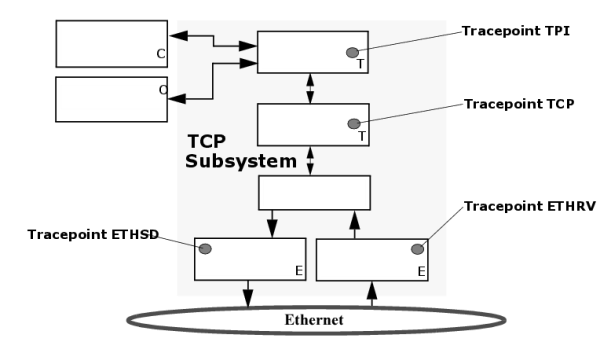
In the subsystem LAN there are 4 tracepoints:
TPI:
This tracepoint makes it possible for the user to protocol and analyze connection specific one ( the relevant) part of the interface between the LAN subsystem and its users (OS,CMS) . The activation of this tracepoint supplies instructive informations for clearing if an error occurs inside or outside of the LAN subsystem.
TCP:
Via this tracepoint, again connection specifically, the calls to the protocol layer TCP itself and their processing can be watched. This tracepoint will supply necessary advisories for analyzing lost connections or problems concerning the build up of connections, keepalive functions, resource problems and so on.
ETHSD, ETHRV:
For analyzing protocol data (Ethernet, IP, TCP, ICMP, ARP) the tracepoint ETHSD can be used for outgoing packages and the ETHRV for incoming packages. Both tracepoints provide exactly these (protocol) data, which were sent to or received from LAN. The Ethernet driver has no memory for connections, therefore the tracepoints are not connection specific. Further the protocolling of user data at this points it does not make sense, because TCP does
NOT work message oriented.
OpenScape 4000 V10, Volume 1: AMO Descriptions, Service Documentation, Issue 20
, ID:
P31003H31A0S107207620
©
05/2026
Mitel Networks Corporation. - All rights reserved.
Mitel and the Mitel logo are trademarks of Mitel Networks Corporation. Unify and associated marks are trademarks of Unify Software and Solutions GmbH&Co. KG. All other trademarks herein are the property of their respective owners.