2.1.4. Voice Quality 


For the transmission of voice over IP networks, there are three other
factors that influence the subjective voice quality experienced by the
customer:
- Delay
-
Occurs in the packetization of voice data (see Figure 1 Packet-by-packet voice transmission) and in the transmission of packets. Compression codecs (e.g. G.729) require processing time. In order to compensate for fluctuations in the packet runtime (jitter), a buffer is inserted on the receiver side (jitter buffer). The size of the jitter buffer also influences the overall delay.
- Packet loss
-
Packets can sometimes be lost during transmission in IP networks. Fill data must then be inserted on the receive side in place of the required packet data.
- Jitter
-
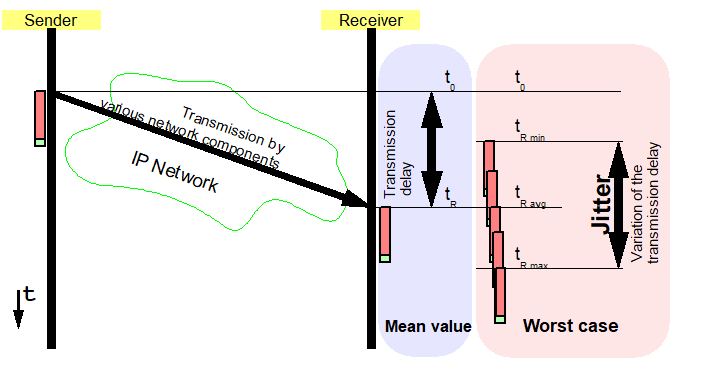
Fluctuation of the packet runtime above or below a mean value, see Figure 2 Jitter: variation of the transmission delay. The jitter buffer must intercept these fluctuations. The packet earmarked for use is lost if the deviation from mean value is so great that it can no longer be intercepted by the jitter buffer. The effect is the same as for packet loss in the network.
Figure 1. Packet-by-packet voice transmission
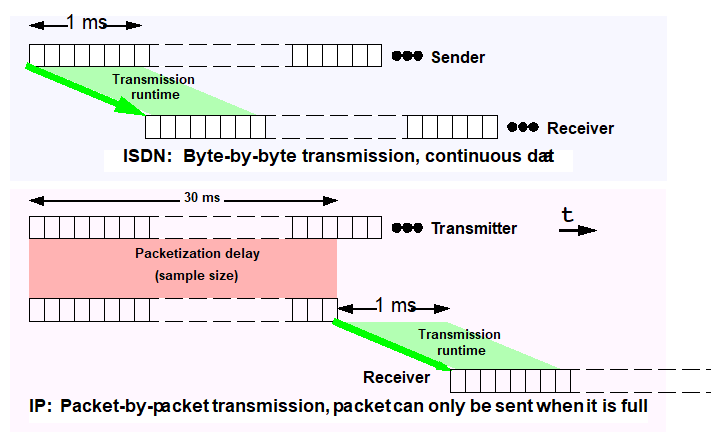
Figure 2. Jitter: variation of the transmission delay
 The effectiveness of both parameters also depends on the sample size (how many milliseconds of voice per packet) and on the codec type.Figure 3 Voice quality depending on delay illustrates an evaluation of voice quality depending on delay.
Figure 3. Voice quality depending on delay
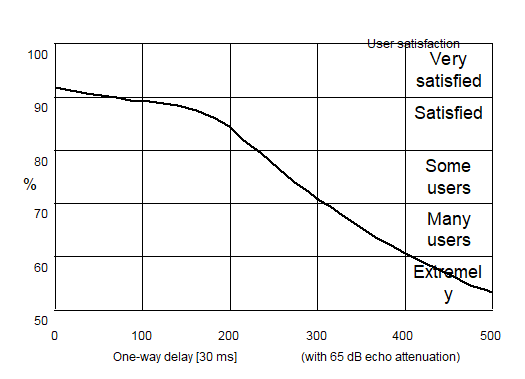 Table 2, “Voice quality depending on delay and packet loss rate” illustrates an evaluation of voice quality depending on delay and packet loss rate.
Table 2. Voice quality depending on delay and packet loss rate
Scale of acceptanceValueAcceptance0 - 5Very good6 - 10Good11 - 19Satisfactory20 or moreUnsatisfactoryDelay[ms]Packet loss rate in %< 1%1%1.5%2%2.5%3%> 3%500468101230100046810123015004681012302003791113153325010141618202240300151921232527453502024262830325040025293133353755For all solutions over IP, i.e. including OpenScape 4000, configurations with multiple IP-TDM (or TDM-IP) conversions in a connection should be avoided, as each conversion creates a delay. This is because of the potential losses in voice quality where the number of delays is too high. Every module in the HG 3500 family (and HG 3575 in the access point) as well as every terminal device distributed directly via HFA has a IP-TDM conversion. The maximum number of IP-TDM conversions should (not including HFA terminal devices) be no higher than two.