2.1.6.2. Delay and Echo 


Figure 10. Delay and echo
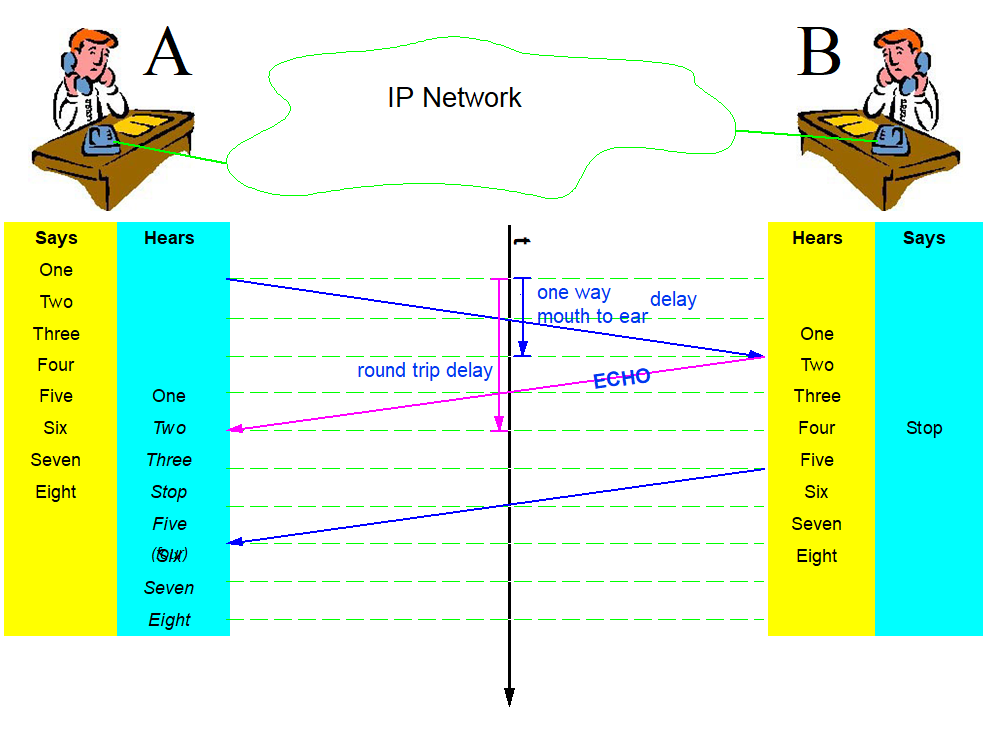
Voice transmission generally requires more runtime than we are used
to in conventional telephony. Figure 10 Delay and echo
contains an example illustrating how this sounds. Here the mouth to ear
delay is approximately 250 ms.
If Speaker A counts from one to eight and Speaker
B says stop after he hears three, A hears
stop while he is saying eight. Obviously, selecting a number
and saying STOP during counting is not something that happens very often
in real conversation. Nevertheless, the delay effect caused by round
trip delays is noticeable in normal conversation. It often leads to collisions
when the speaker changes.
If an echo is generated on the B side (e.g. because of the 2-wire/4-wire
hybrid of analog terminal devices, also known as hybrid coil), this is
noticed by the speaker, who finds himself speaking over what he said
a half a second before, for example.
With high transmission runtimes, it is therefore generally necessary
to have echo-free signals on the transmission path. With IPDA, this is
achieved through active echo cancellation in the HG 3500 and HG 3575
modules, which filters out the signal section received from A in the
send signal from B (the echo) before transmission of the send signal
from B.