2.2.5.6. DMC Considerations 


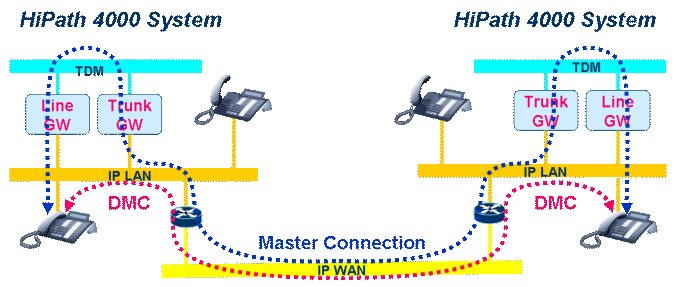
Whenever a DMC connection is established, a “Master Connection”
is setup as well.
The master connection is following the same path as the signaling
through all the gateways between to IP clients.
The master connection ensures that the necessary resources are always
available whenever a feature is invoked that results in a multi party
call (e.g. conference). There is also no delay for invoking these types
of features because the connection is already setup.
However, there are drawbacks to the master connection concept as well:
- Additional bandwidth is required for sustaining the master connection
- Depending on the configuration significant delays and multiple hops can occur between IP clients when voice payload is using the master connection. Especially when IP end points are located on different IP Access Points on IP connected systems, delays may increase beyond acceptable levels.
In Figure 13 DMC and Master Connection
the DMC and Master Connection is shown between two IP networked OpenScape
4000 systems for a call between two IP clients (one on each system).
Figure 12. DMC and Master Connection
Enabling VAD will reduce the required bandwidth on the master connection
to negligible levels.
Note that delays for each TDM to IP conversion accumulate. In the
example above the master connection goes through 3 hops which will result
in approximately 200ms end to end delay assuming G.711 encoding with
30ms sampling time and a high quality network (20ms delay). The DMC connection
goes only through one hop resulting in an end to end delay of about 80ms.
For more details please refer to Section 4.1, “Direct Media Connection (DMC)”.