10.2.12. External Music on Hold 


If an internal sound type (SIU) is replaced by an external sound source
(e.g. music on hold), this new sound type is applied throughout the system.
In the example below (Figure 39 “Routes for music on hold: Supply in the central system”)
an external MusiPhone is configured in the central system, as is most
commonly the case.
IP payload connections to the central system are then required for
all circuits in IPDA access points that are switched to external MOH.
If multiple circuits/subscribers in one access point are connected to
the same MOH, only one payload connection (B channel) is connected for
transmission of music between the central system and the access point,
and all relevant circuits of the AP cut in to this.
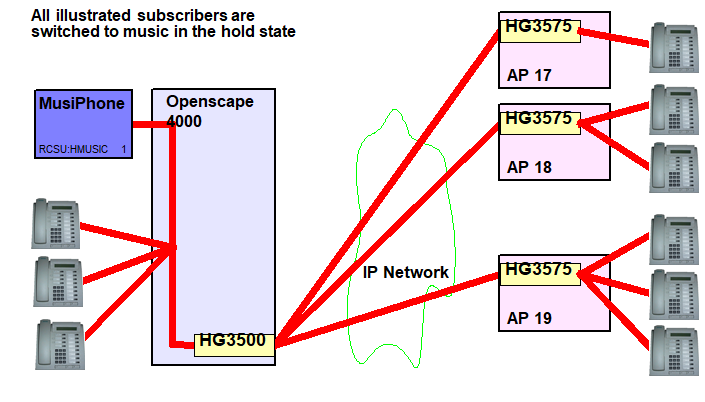
Routes for music on hold: Supply in the central system
IMPORTANT:
If a circuit is switched to MOH, e.g. as a result
of consultation hold, the original payload connection remains active.
In other words, the connection of MOH uses an additional payload connection.
If the external MOH is supplied in an access point rather than on
the central system, the connections continue to be handled as explained
below.
Circuits within the access point in which the MOH is supplied are
switched to MOH via the internal AP memory time switch. In other words,
no additional payload connections over IP are required.
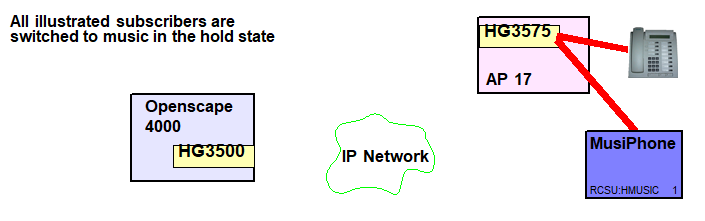
Routes
for music on hold: Supply in access point 17 - local subscriber
If circuits in the central system are switched to MOH, a payload connection
between the access point with the MOH source and the central system is
switched, from which all circuits of the central system are then operated.
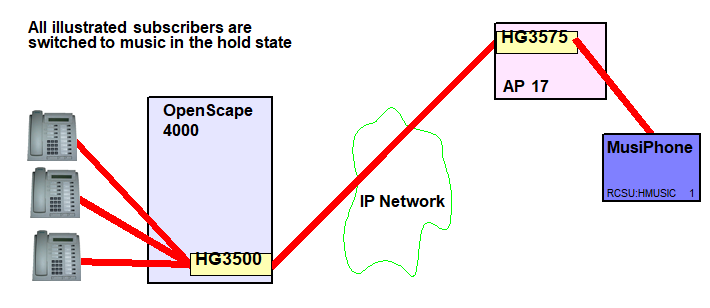
Routes
for music on hold: Supply in access point 17 - central subscriber
If circuits of other access points are switched to MOH, a separate
payload connection to the central system is switched for these access
points. The central system is connected to the access point with the
MOH source via a second payload connection. MOH connections between access
points are therefore always switched via the central system.
There is no alternative routing via access point <-> access
point connections if there are not enough or no resources available for
the route via the central system.
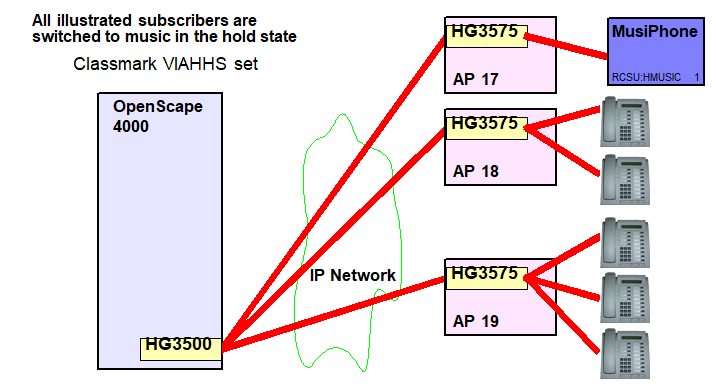
Routes
for music on hold: Supply in access point 17 - subscriber in different
AP
 |
Configuration Management > Station >
Special Stations
Click Search and select the special
station (Station Type: EXTANS).
Set or delete the
required classmarks on the Features tab and Save.
|
 |
ADD-SSC:PEN=1-2-37-10,TYPE=EXTANS,CPCALL=HOLD,
                                 CLASSMRK=G711&ML;
or
CHANGE-RCSU:PEN=1-2-37-5,CLASSMRK=G711&&ML;
|
IMPORTANT:
With
CHANGE, please note that
you must specify all classmarks that are to be set. Classmarks that were
set prior to the changes will not be taken over. Always specify the
classmark ML, otherwise an individual payload connection to the
source HG 3575 will be set up for each circuit on a HG 3575 that requires
active MOH. As a result, considerable bandwidth and B channel resources
are consumed.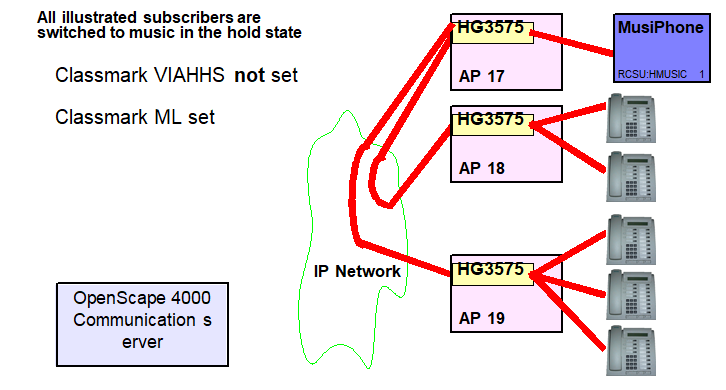
Routes
for music on hold: Supply in access point 17 - subscriber in different
AP
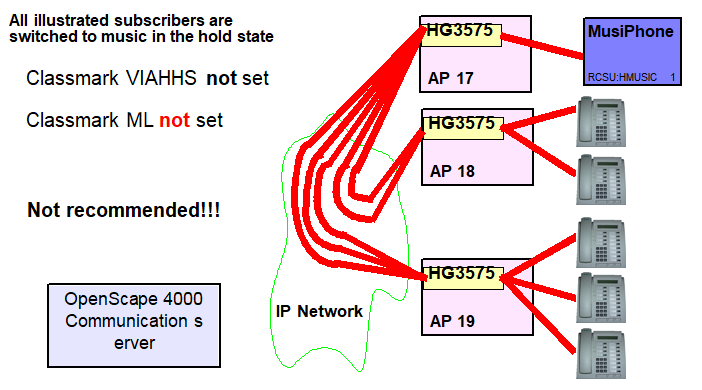
Routes
for music on hold: Supply in access point 17 - subscriber in different
AP
Multiple Music on Hold
With IPDA-based branch concepts, a requirement exists for the setting
of different music on hold for different branches.
With the aid of flex routing, up to 150 different announcements can
be used in the system. The announcements are assigned on a subscriber
basis.
If all subscribers of an access point are assigned the same MOH and
this MOH is supplied locally in the access point, no payload connections
over IP are required for MOH. If, however, a subscriber is assigned MOH
that is supplied in a different access point, two payload connections
over IP are switched - one from the MOH source to the central system
and one from the central system to the AP of the subscriber.