10.1.5. Survivability for Signaling and Payload 


In the basic configuration (without the survivability features), an
IPDA installation function depends completely on the availability and
reliability of the LAN/WAN infrastructure used. The failure of an access
point's IP connection leads to failure of the access point.
Total failure of the IP infrastructure leads to the failure of all
access points. Only the central system and the "classic" peripheral units
connected continue to work.
Survivability for signaling and payload ensures that OpenScape 4000
also offers the greatest availability in distributed operation. The public
telephone network/an alternative LAN connection (in the case of Signaling
Survivability) can be used as an alternative route in the event of an
IP network failure or if the IP network temporarily fails to provide
the requisite quality for voice transmission.
Figure 174. Survivability: failure in the IP network
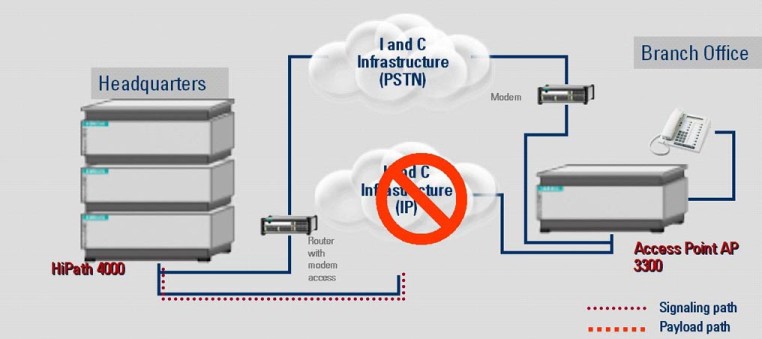
If the IP connection from an access point/OpenScape 4000 SoftGate
to the central system fails, there can be no interaction between the
access point/OpenScape 4000 SoftGate and the central system. Messages
from the terminal devices and trunks in the access point/OpenScape 4000
SoftGate are temporarily buffered on the (v)HG 3575, while messages from
the central system are buffered in the central processor. If the duration
of the failure exceeds a definable limit, the Access Point/OpenScape
4000 SoftGate is reset, thereby disconnecting all calls.