14.5.5.3. Configuration 


The HG/vHG Loadware contains SIP-Provider Profiles for the SIP trunks "Telekom
DeutschlandLAN” and “CompanyFlex”. Only these profiles must be used for
connectivity.
The profiles require a correct input of the Telekom account data, e. g in case of
DeutschlandLAN:
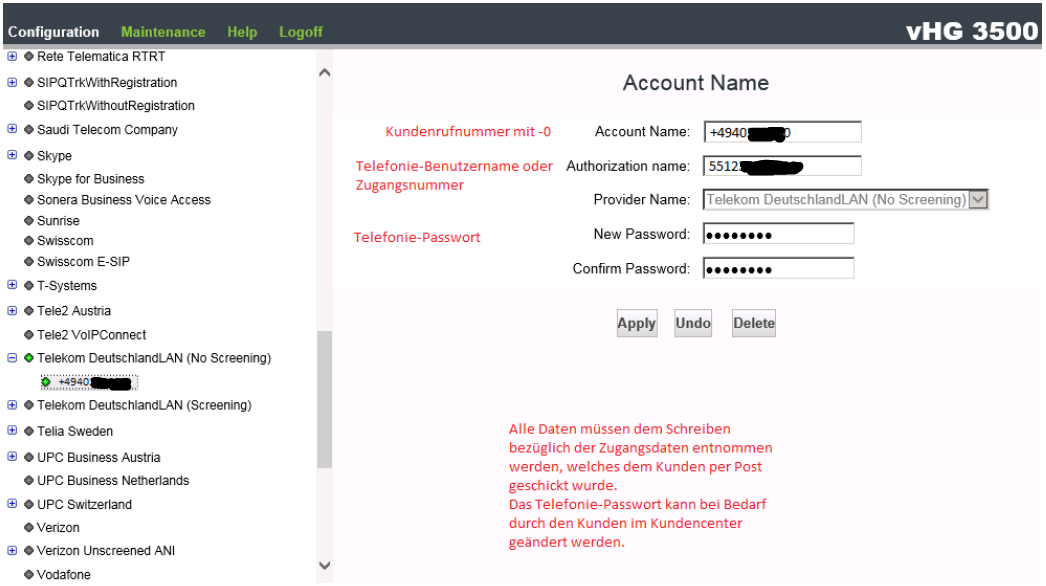
Like conventional SIP providers the Telekom offers two different modes: Registration
and Static mode. Telekom prefers, the default “Registration” mode. The static mode
can be enabled via the Telekom customer service if necessary.
Static Mode is no longer supported with CompanyFlex.
OpenScape 4000 also uses as default the registration mode in the SIP Provider Profile
preset (Outbound Proxy). If required this can be changed manually (Outbound Proxy:
stat.sip-trunk.telekom.de) in case of "Telekom DeutschlandLAN”.
There are separate profiles for CompanyFlex:
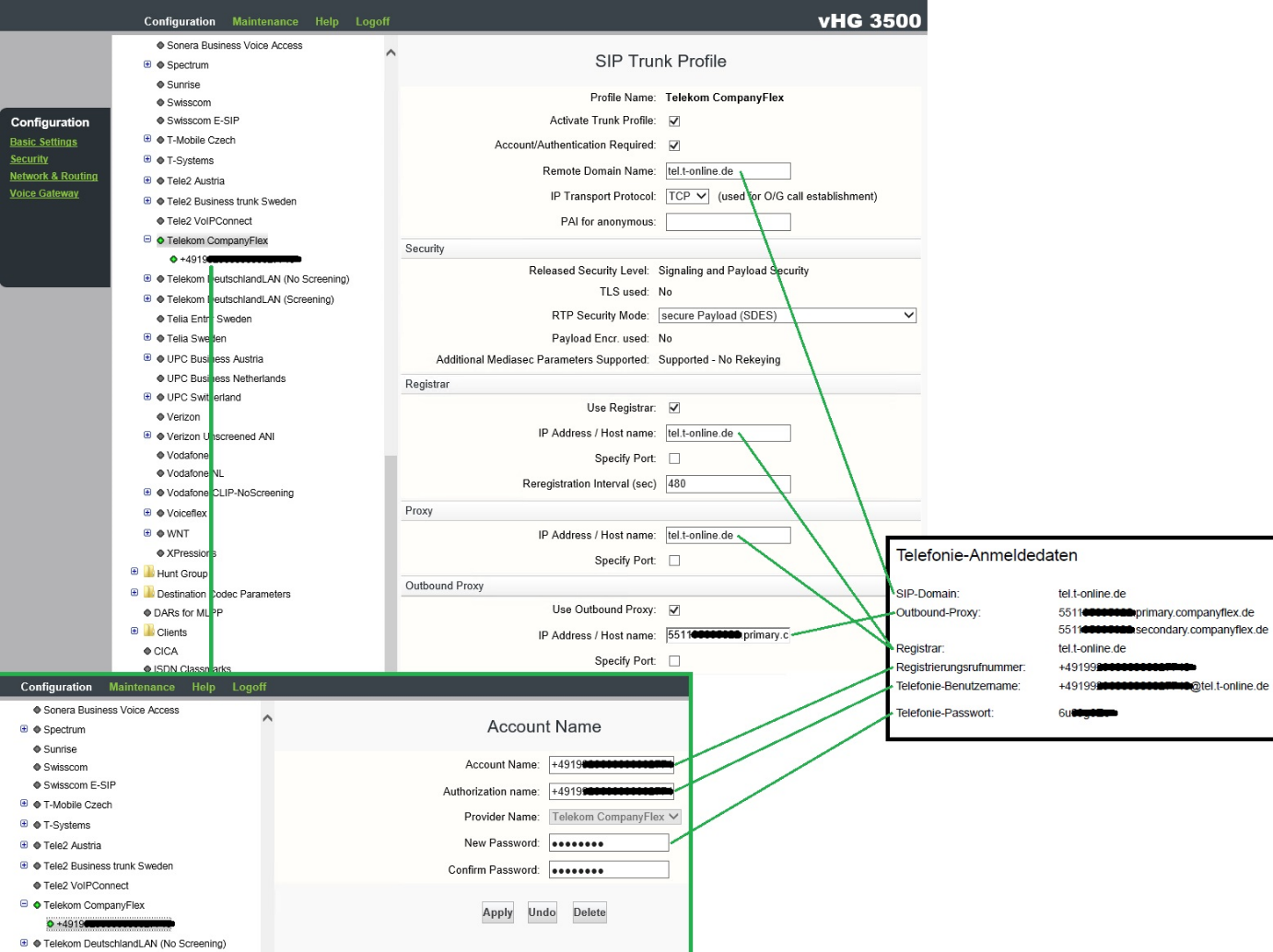
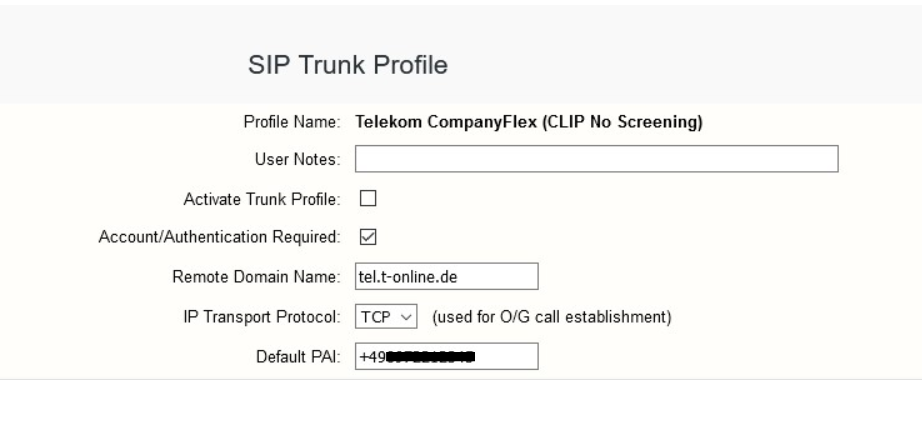
For CLIPnoScreening (if PUBNUM is not used) a different profile has to be used for
CompanyFlex “CompanyFlex (CLIP No Screening)” and the parameter Default
PAI needs to be configured.
The PUBNUM entries in SDAT and ACSU have to be configured in the format ISDN INTERNAT.
Due to the use of host names and DNS SRV the OS4K Gateway must be provided with a
reachable DNS server. The DNS server must be able to resolve the Telekom addresses
(see above). AMO CGWB is used to configure the DNS server.
To separate the customer LAN from the SIP trunk CompanyFlex/DeutschlandLAN, the trunk
can be connected via a separate interface i.e. eth1. The build-in SBC function of
the vSTMI is active automatically. The CGWB path MANLANIF has to be used to
configure the administration connectivity.
Example:
DIS-CGWB:21,16,GLOBIF;
H500:  AMO CGWB   STARTED
--------------------------------------------------------------------|
CGW BOARD DATA
--------------------------------------------------------------------|
HG3550
--------------------------------------------------------------------|
LTU = 21 SLOT = 16 SMODE = NORMAL POOLNO: 0
--------------------------------------------------------------------
GLOBAL DATA AND ETHERNET INTERFACE DATA - CONFIGURABLE VALUES:
--------------------------------------------------------
IPADR     = 88 .217.251.213        TCPP   =       (4060)
NETMASK   = 255.255.255.240        VLAN   = NEIN  (NEIN)
DEFRT     = 88 .217.251.209        (0.0.0.0 = NICHT KONFIGURIERT)
BITRATE   =         (SIEHE OS)     VLANID = 0     (0)
MUSTER    = 213 (213)              TLSP      = 4061  (4061)
TRPRSIP   = 1   (0)                TRPRH323  = 0  (0)
TRPRSIPQ  = 0   (0)                TPRH323A  = 0   (0)
DNSIPADR  = 212.18 .0  .5          SIPTCPP   = 5060 (5060)
DNSIPADR2 = 212.18 .3  .5          SIPTLSP   = 5061 (5061)
USEWANIF  = JA  (NEIN)
WPUBIP    = 0  .0  .0 .0
The OpenScape 4000 default values for RTP packet length and Type Of Service for
signaling (TOSSIGNL) must be manually changed with AMO CGWB in the branch ASC to
match Telekom requirements. RTP for G711 must be changed to 20ms and TOSSIGNL to
104. The TOS payload does not need to be changed.
HINT: The QoS settings are taken over by the routers in the Telekom-Portfolio for
the
WAN-Interface. At this point correct QoS marking is particularly important as here
exists the bottle neck of the connection.
Configuration
example:
ADD-CGWB:LTU=[LTU],EBT=[EBT],SMODE=NORMAL,IPADR=[IP-address],NETMASK=[netmask];

CHA-CGWB:MTYP=CGW,LTU=[LTU],EBT=[EBT],TYPE=GLOBIF,DEFRT=[IP-address],TRPRSIP=[number of parallel calls],DNSIPADR=[DNS IP-address],USEWANIF=YES;

CHANGE-CGWB:MTYPE=CGW,LTU=[LTU],
SLOT=[EBT],TYPE,TYPE=ASC,TOSSIGNL=192,PRIO=PRIO1,CODEC=G711A,VAD=NEIN,RTP=20;

CHANGE-CGWB:MTYPE=CGW,LTU=[LTU],SLOT=[EBT],TYPE=MANLANIF,
MIPADR=[IP-address administration LAN],MNETMASK=[netmask],MDEFRT=[Default Router administration LAN];
Example:
DIS-CGWB:21,16,ASC;
H500:  AMO CGWB  STARTED
----------------------------------------------------------------------
|  CGW BOARD DATA
-----------------------------------------------------------------------
|   HG3550 |
-----------------------------------------------------------------------
|  LTU = 21      SLOT = 16     SMODE = NORMAL           POOLNO: 0 |
-----------------------------------------------------------------------
 ASC DATA - CONFIGURABLE VALUES:
----------------------------------
TOSPL    = 184   (184)    TOSSIGNL = 192   (104)
UDPPRTLO = 29100 (29100)  UDPPRTHI = 30099 (30099)
T38FAX   = YES   (YES)    REDRFCTN = YES   (YES)
RFCFMOIP = NO    (NO)     RFCDTMF  = YES   (YES)
PRIO1 :  CODEC = G711A   VAD = NO     RTP-SIZE = 20
In general connections to SIP providers should use international format an dialed
national telephone number (e.g. mobile) must be sent to the CO in international
format (NPI = ISDN, TON = INTERNAT).
Configuration Example international numbers:
ADD-LDPLN:LCRCONF=LCRPATT,DIPLNUM=0,LDP="0"-"W"-"00"-"X"-"Z",LAUTH=[LBER];
ADD-LODR:ODR=[LODR NUMMER],CMD=NPI,NPI=ISDN,TON=INTERNAT;
National
numbers:
ADD-LDPLN:LCRCONF=LCRPATT,DIPLNUM=0,LDP="0"-"W"-"0"-"X"-"Z",LAUTH=[LBER];
ADD-LODR:ODR=[LODR NUMMER],CMD=OUTPULSE,DGTS=[LANDESVORWAHL DES ANSCHLUSSES];
ADD-LODR:ODR=[LODR NUMMER],CMD=NPI,NPI=ISDN,TON=INTERNAT;
Reference chapter: Section 5.3.2.1,
“Configuration with ISDN Numbering Plan (recommended)”.
LCR has to be configured in international format and the reachability of special rate
numbers with prefix codes has to be considered .
COT and COP in TDCSU have to be configured in a suitable
way.
ADD-COT:COTNO=[COT number],
PAR=ANS&CEBC&BSHT&BLOC&LWNC&NLCR&TSCS&DFNN&NLRD&NOFT&NTON;
CHANGE-COP:COPNO=[COP NUMMER],COPTYPE=COPADD,PAR=T311,TRK=TA,TOLL=TA;
In case of CLIP No Screening the parameter PDL2 has to be set:
CHANGE-COT:COTNO=[COT NUMMER],PAR=PDL2;
Example
TDCSU:
ADD-TDCSU:OPT=NEW,PEN=1-2-3,COTNO=[COT number],COPNO=[COP number],
CCT="COMPANYFLEX",PROTVAR=ECMAV2,SEGMENT=8,TRTBL=GDTR,FWDX=5,CLASSMRK=EC&G711&G729AOPT,
TGRP=1,SRCHMODE=DSC,INS=Y,SECLEVEL=SECURE,DEV=HG3550CO,BCGR=1;
Local numbers dialed without area code.
ADD-LDPLN:LCRCONF=LCRPATT,DIPLNUM=0,LDP="0"-"W"-"X"-"Z",LAUTH=[LBER];
ADD-LODR:ODR=[LODR number],CMD=OUTPULSE,DGTS=[country code + area code];
ADD-LODR:ODR=[LODR NUMMER],CMD=NPI,NPI=ISDN,TON=INTERNAT;
Call-by-Call
010
ADD-LDPLN:LCRCONF=LCRPATT,DIPLNUM=0,LDP="0"-"W"-"010"-"Z",LAUTH=[LBER];
ADD-LODR:ODR=[LODR NUMMER],CMD=NPI,NPI=ISDN,TON=NATIONAL;
In Telekom DeutschlandLAN SIP-trunk case there are special rate numbers with prefix
codes which (not in E. 164-format) must be sent to the Telekom. These (nine) special
rate numbers/-pre selection codes are:
110, 112, 115, 116-X, 118-X, 010-X, 0137-X, 0138-X and 0900-X
Example for special numbers:
ADD-LDPLN:LCRCONF=LCRPATT,DIPLNUM=0,LDP="0"-"W"-"11"-"0",LAUTH=[LBER];
ADD-LDPLN:LCRCONF=LCRPATT,DIPLNUM=0,LDP="0"-"W"-"11"-"2",LAUTH=[LBER];
ADD-LDPLN:LCRCONF=LCRPATT,DIPLNUM=0,LDP="0"-"W"-"11"-"5",LAUTH=[LBER];
ADD-LDPLN:LCRCONF=LCRPATT,DIPLNUM=0,LDP="0"-"W"-"116"-"Z",LAUTH=[LBER];
ADD-LDPLN:LCRCONF=LCRPATT,DIPLNUM=0,LDP="0"-"W"-"118"-"Z",LAUTH=[LBER];
ADD-LODR:ODR=[LODR NUMMER],CMD=NPI,NPI=ISDN,TON=SUBSCR;
Please consider also the corresponding hints regarding emergency routing published
from the
German Telekom:
To use Signaling and Payload Encryption (SPE) activate following the chapter from
the
service documentation IP Solutions - Signaling and Payload Encryption (SPE).
Telekom provides their own certificates (CA) for DeutschlandLAN SIP-Trunk. The
provided Telekom CA certificates must be imported on the OS4K Gateway. Due to the
OS4K SPE design, the Gateway also requires an "own server" certificate (e. g. *.p12)
in addition to these CA certificates to activate SPE (TLS). For this purpose any
private server certificate can be created (for example using OS4K Assistant) which
then must be imported to the OS4K Gateway. The entered data in the server's
certificate is irrelevant.
SIP Providers expect all digits en-bloc and do not support overlap dialing.
LCREOD should be changed on demand to a higher value:
CHANGE-CTIME:TYPESWU=CP1,LCREOD=5;
If Media-Security is used between OS-SBC and OS4K-GW as well, the following
configuration needs to be changed in the SIP provider Profile for CompanyFlex:
- Set Additional Mediasec Parameters Supported to "Not supported".
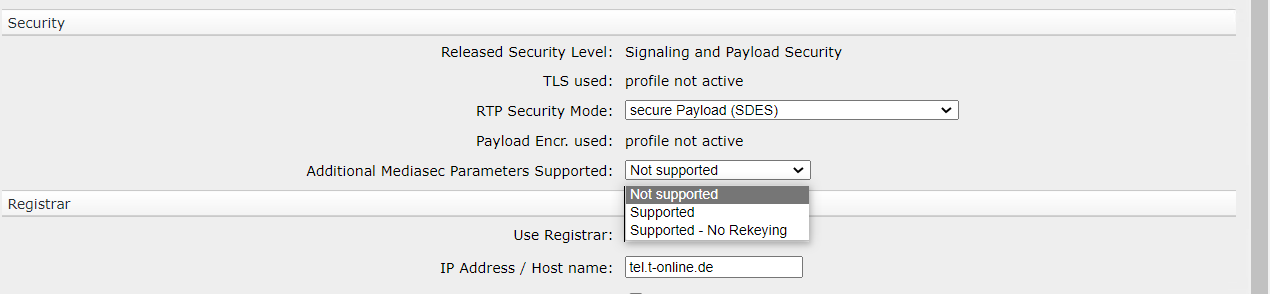
INFO:
This parameter needs to be set to "Supported - No Rekeying" in case of direct connectivity between OS4K and SSP (default).