14.3.2.4.1.1. Monitoring availability of SIP Trunks 


There a two possibilities to monitor SIP trunk connectivity, either SIP OPTION pings
or SIP loop calls. SIP OPTIONs give no guaranty about the reachability of the provider,
because
they are only exchanged between the PBX and the Carrier Ethernet Router (CER). Also,
the CER
router acts as an SBC, but it doesn’t pass the SIP OPTIONs from one side to the other
side. The
only way to monitor a native SIP trunk (similar to the predecessor PRA trunks) is
to use loop
calls generated by the PBX and routed through the SSP back to the PBX.
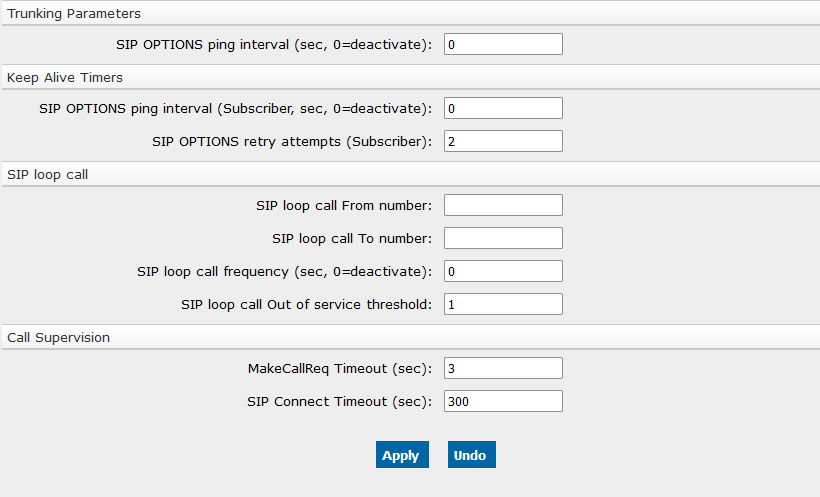
The configuration of a native SIP trunk is the following:
Configuration -> Voice Gateway -> SIP Parameters -> Trunking Parameters
- SIP loop call frequency (sec, 0=deactivate): 0
-
SIP loop call To number: empty string by default
-
SIP loop call From number: empty string by default
- SIP loop call Out of service threshold: default=1
Figure 242. Configuration of a native SIP trunk
HINT: Since the complete configuration for this feature is in the HG, it is recommended
to ensure the DDI number is reserved also in the system to avoid it being used for
anything else
e.g. create a SCSU FLOAT with a PERSI entry of "SIP LOOP CALL" to ensure the number
is reserved.
A HISTA L1 Error is generated, if the Loop-Call fails:
F5749 E8 N8265 NO ACT BPA BOARD LW REQUEST 20-04-07 11:42:32
 ALARM CLASS:CENTRAL:002
 ** :LTG1 :LTU30:009: 0 : 0 Q2330-X vHG3500 BST:01 PLS:-07
 FORMAT:43
 REASON:00H ONLY SIGNALING
 SIP loop call failed

F5412 E8 N8266 OUT SERV BPA CIRCUIT L1 ERROR 20-04-07 11:42:32
 ALARM CLASS:SWU-PER:001
 ** :LTG1 :LTU30:009: 0 : 0 Q2330-X vHG3500 BST:01 PLS:-07
 REASON:03H LOST FRAME (RED) (LOCAL ALARM)
 FORMAT:36 DEVICE NAME: HG3550IP

F5749 E8 N8267 NO ACT BPA BOARD LW REQUEST 20-04-07 11:47:03
 ALARM CLASS:CENTRAL:002
 ** :LTG1 :LTU30:009: 0 : 0 Q2330-X vHG3500 BST:01 PLS:-07
 FORMAT:43
 REASON:00H ONLY SIGNALING
 SIP loop call resumed

F5418 E8 N8268 IN SERV BPA CIRCUIT LX ACTIVE 20-04-07 11:47:03
 ALARM CLASS:SWU-PER:001
 ** :LTG1 :LTU30:009: 0 : 0 Q2330-X vHG3500 BST:01 PLS:-07
 REASON:07H LAYER 1 ACTIVE (GREEN)
 FORMAT:36 DEVICE NAME: HG3550IP

F5418 E8 N8269 IN SERV BPA CIRCUIT LX ACTIVE 20-04-07 11:47:03
 ALARM CLASS:SWU-PER:001
 ** :LTG1 :LTU30:009: 0 : 0 Q2330-X vHG3500 BST:01 PLS:-07
 REASON:09H LAYER 3 ACTIVE
There is no de-registration after a L1 error - registration will be handled via standard
timeouts.
SNMP-traps will be generated if an outage is detected. MSG_SIP_TRUNK_ERROR if the
monitoring fails and MSG_SIP_TRUNK_OK if trunk connectivity is possible again.