9.1.1. Mobility Session 


This feature is an enhancement to the static HFA (HiPath Feature Access).
HFA Mobility is supported network-wide and was introduced with HiPath
4000 V2.
The idea of mobile HFA is to use the characteristics (classmarks,
name, number, keys, ...) of one subscriber (mobile user) on different
phones, which might be spread all over the world. We call such a user
a “mobile user”.
The mobile user has a phone at his home office and travels to another
place (other office or an other country). There he uses a phone (visited
phone) as a visitor. He enters a code for the activation of “Mobile
HFA” , his home number, his PIN and a possible password to use the
visited phone with the characteristics of his phone at home.
If this procedure ends successfully (sufficient classmarks, phone
types, ...) his home phone is placed in an out of order state (forced
log off). The mobile user can then use the visited phone like his home
phone. E.g. the home phone number/name are displayed if a call is established
by or to the mobile user, the home phone’s classmarks are valid ...
If the visitor cancels the mobile HFA logon by a logoff, the original
characteristics of the home phone and the visited phone are reactivated.
The time between a mobile HFA logon and logoff at a visited phone is
called “mobility session”.
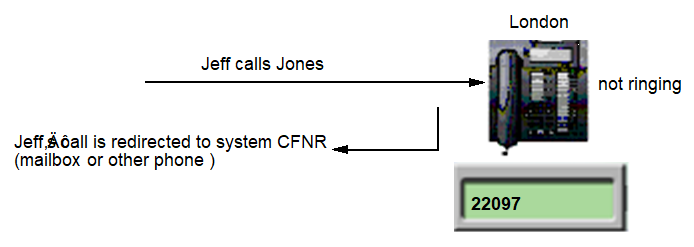
The owner of the visited phone is no longer reachable in this case.
All calls to the owner of the visited phone are redirected to a CFNR
destination.
Activation of feature
Figure 163. Activation of feature
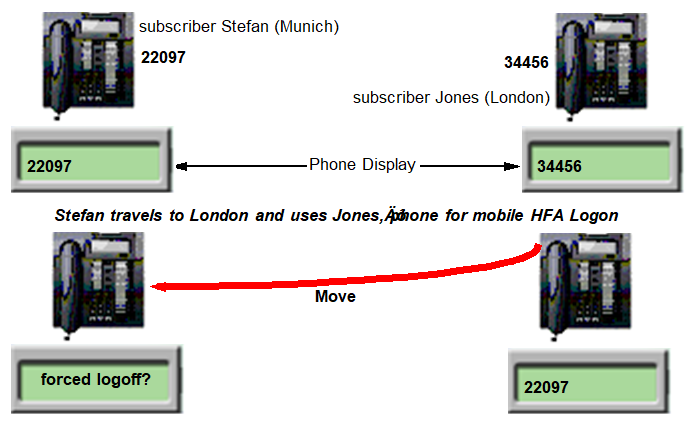
All calls dialed for 34456 are now forwarded to the system CFNR (Call
forwarding no reply) for subscriber Jones (admin by AMO ZIEL).
If Stefan travels back to Munich he performs the mobile logoff in
London (DAR or menu) , or if he forgets he can also cancel it in Munich.
In both cases the original status of both phones are redone within seconds.
While the London phone is in mobile use nobody can use Stefan’s
device in Munich.
Any call to Jones does not ring at Jones’ device.
The feature can be protected against misuse with passwords, feature
blocking and line dependent classmarks.
Call to mobile user
Figure 164. Call to mobile user
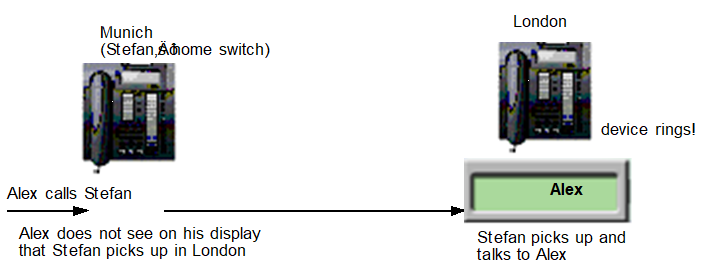
Call to visited phone
Figure 165. Call to visited phone