13.1.2.1. Signaling Survivability via PSTN Network 


IPDA
with signaling survivability
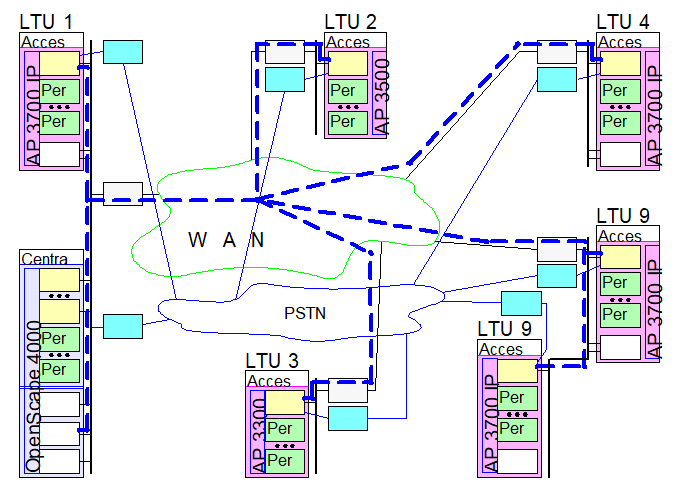
With signaling survivability via the PSTN network, an alternative
route for signaling via the ISDN network (PSTN) is set up as soon
as a fault in the IP path is detected. The messages are then routed via
a PSTN router to the central system (for example, router with IP >
S2 or STMI2/4 board with WAML function) and an ISDN modem on the access
point/OpenScape 4000 SoftGate. The signaling messages are sent via this
alternative path once it is established (approx. 30 ... 60 seconds).
This ensures that none of the messages that may be in a backlog are lost.
As a rule, an access point/OpenScape 4000 SoftGate with signaling
survivability generally requires a telephone connection for this purpose.
The connection should be in the public PSTN network. Alternatively, it
may be in a private network, insofar as the connection is not routed
via the (IP) network whose fault is to be bypassed via the alternative
route.
IMPORTANT:
The modem may not access the public network
via the access point/OpenScape 4000 SoftGate. It requires a separate
connection independent of the access point/OpenScape 4000 SoftGate. If
the LAN connection fails, the access point/OpenScape 4000 SoftGate can
no longer be controlled. If the alternative route to the modem is routed
via the access point/OpenScape 4000 SoftGate, it cannot be switched before
the alternative route is activated. However, the alternate route cannot
be activated before being switched in the access point/OpenScape 4000
SoftGate.
The access point/OpenScape 4000 SoftGate is equipped with
an RS 232/ V.24 interface on the HG 3575 module in order to connect a
modem, via which the alternative signaling route into the telephone network
is routed.
The counterpart to this modem is a special router at the OpenScape
4000 LAN segment, referred to here as the survivability router. This
router also requires access to the telephone network.
If the LAN/WAN-based connection to the access point fails, a modem
connection is established via CO. The access point is controlled via
this connection until the LAN/WAN connection is reestablished.
If every access point features an individual modem (and the central
system has reserved enough router connections via CO (PSTN)), signaling
survivability can cover even the total failure of the WAN infrastructure.
The only critical factor here are the connection between the active CC
and the survivability router(s) in the OpenScape 4000 LAN segment and
the independence of (failed) WAN from the PSTN used for survivability.
Details on the transmission methods between router and modem:
The transmission methods between the router and the modem must be
compatible. Whenever possible, a digital link between the router and
the modem should be used (ISDN modem), as analog modems require a long
time to measure the route and agree on a transmission method. If the
supervisory timer of the CC or access point/OpenScape 4000 SoftGate expires
during the link establishment time, there is a danger of messages being
lost. The access point/OpenScape 4000 SoftGate then resets itself. In
addition, transmissions rates are substantially lower with analog modems
than via ISDN. This can lead to delays with signaling messages and to
the supervision timer expiring during bottleneck situations, in which
case the access point/OpenScape 4000 SoftGate resets itself in the end.
Approximately 64 Kbps are generally considered to be sufficient for
the maximum transmission capacity required in the signaling path. The
transmission rate offered by ISDN modems comes sufficiently close to
this value. In the case of analog modems, at most half of the transmission
bandwidth can be achieved. This can lead to the limitations described.
A transmission bandwidth of at least 28.8 Kbps must be guaranteed. A
path is considered unsuitable for survivability if a lower bit rate is
used for modem connects due to low-quality links.