12.3. Generation Example 


- The following example covers different DTZ configuration possibilities:
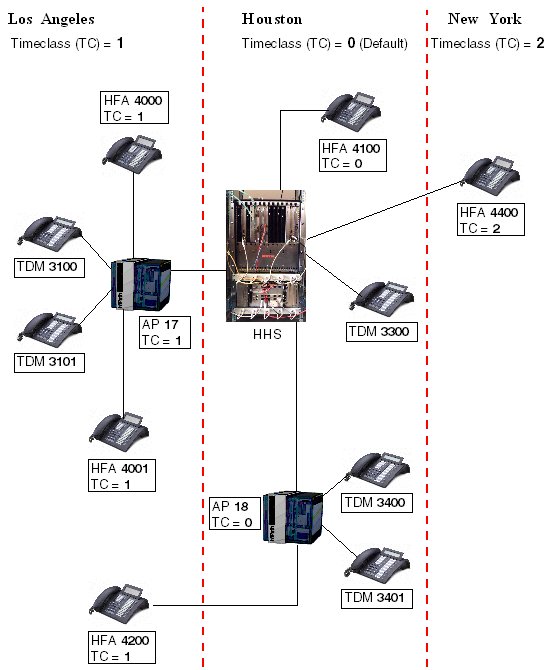
- The HHS is in Houston, Texas and has two AP shelves configured. HFA
stations 4000 and 4001 are in AP shelf 17, which is located in Los Angeles
and assigned time class 1. Because of the different time zones, AP shelf
17 is given the time class 1, which provides for a time difference of
two hours to the west.
- HFA station 4100 is located in Houston station, 4100 is configured
directly on the HHS. The AP shelf 18 is also located in Houston (Direct
link). Neither AP shelf 18 nor the station configured directly on the
HHS requires a special time class - the default settings are entirely
sufficient.
- Although the HFA station 4400 is configured in the HHS in Houston,
it is physically located in New York. This station is given the time
class 2, which means a time difference of one hour in the easterly direction.
- Another configuration option involves the HFA station 4200 that is
configured in AP 18 but that is physically located in Los Angeles. Therefore
the HFA station 4200 has to be assigned to time class 1. If the station
would be located in New York, the time class 2 has to be assigned to
this station.
- All TDM stations get the time class depending on their locations.
Stations 3100, 3101, 3400 and 3401 get the time class of the AP shelf
configuration (AMO UCSU). Station 3300 gets the system time.
- Furthermore, an HFA station could also be configured in AP 17 (in
Los Angeles), but be physically located in New York. Then time class
2 would have to be configured for this station in the AMO SDAT. This
configuration is not pursued any further in this example.
- Overview diagram for the following configuration possibilities: