14.4.1. General SBC specifications (Source Wikipedia) 


A Session Border Controller (SBC) is a network component for safe
coupling of different computer networks or computer networks with different
security requirements. SBC are mainly used in IP telephony networks (VoIP)
to connect external (insecure) data networks with internal (secure) IT
structures or to implement so-called sessions.
An SBC enables control and monitoring of signaling and media streaming
as well as setup, execution and termination of telephone conversations
or other interactive media that are involved in a communication.
An SBC is, as the name implies, used at network boundaries and couples
internal and external networks. The SBC analyzes the various data streams
(sessions) and acts on the different data streams (here: media data or
signaling data) depending on the configuration. Within the telecommunications
area (VoIP) signaling data and voice / video data are transmitted separately.
Figure 255. Operating principle of the Session Border Controller in VoIP environment
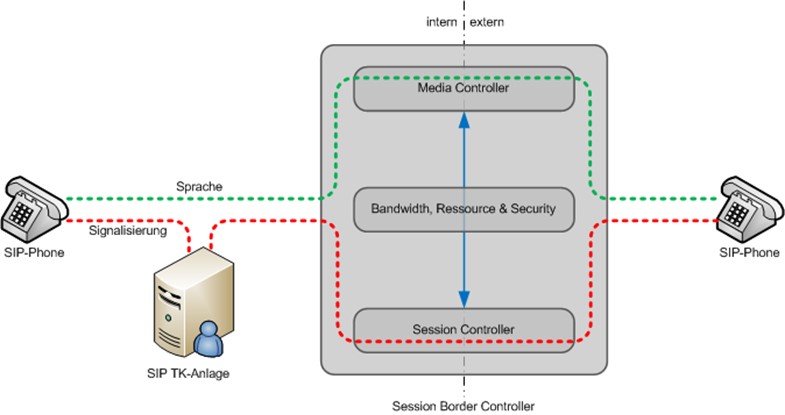
In general a SIP-based phone sends the signaling data to the telephone
system, while the voice data is usually transmitted via the shortest
route directly from phone to phone. By decoupling of signaling and voice
data on the one hand the advantages of IP-based data networks can be
used but on the other hand, the transmission of voice (media) data cannot
be affected by the telephone system.
- Security Offloading Support of encryption techniques (TLS, SRTP)
- Media Pinholing Specific activation of UDP / TCP ports for the transmission of media data
- Transcoding Transcoding of different voice / video codecs such as G.711 to G.729
- Protocol Translation Conversion and adjustments of various signaling protocols such as SIP to SIP-Q (QSIG over SIP)
- Header Manipulation Adaptation of SIP and SDP header in order to convert e.g. phone number formats (E.164) or IP addresses
- Media Anchoring Coupling of voice data of SIP terminals that can only be reached via Network Address Translation. Secured coupling of voice / video data.