11.8.3. AMO Usage Examples 


Figure 121. Call flow (routing) for INGHTACT = 4 in PBX(A)
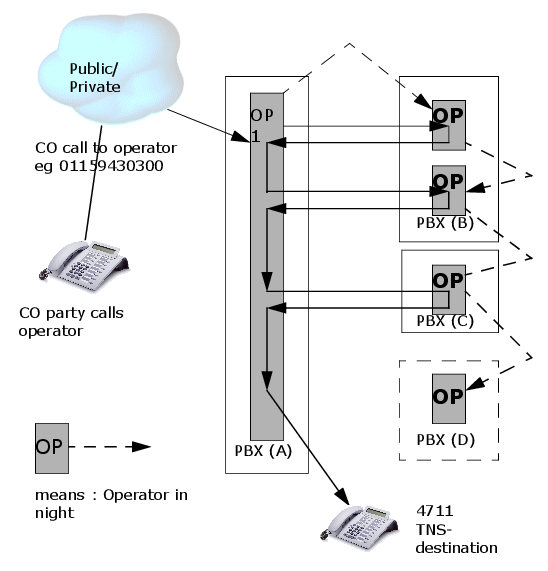
Figure 125
illustrates the call flow (routing) for INGHTACT = 4 in PBX(A).
Operator (OP1) in PBX(A) has activated night mode to external centralized
attendant OP2 in PBX(B). This attendant group in PBX(B) is in night mode
to internal centralized attendant OP3, which is in night to another centralized
attendant (OP4) in PBX(C). This attendant group in PBX(C) has also activated
night mode to another external centraized attendant OP5 in PBX(D).
Assuming, there's only a trunk night service destination on the
CO-trunk configured(not on tie lines), INGHTACT in PBX(A) marks an attendant
group, whichs night mode causes the diversion to the trunk night service
destination in the originating switch.
- INGHTACT = 0: trunk night destination 4711 is always called (independent of night / day mode of OP1)
- INGHTACT = 1: trunk night destination 4711 is called, if called attendant group OP1 is in night mode.
- INGHTACT = 2: trunk night destination 4711 is called, if the centralized attendant OP2 is in night mode.
- INGHTACT = 3: trunk night destination 4711 is called, if 2nd centralized attendant OP3 is in night mode.
- INGHTACT = 4: trunk night destination 4711 is called, if 3rd centralized attendant OP4 is in night mode.
IMPORTANT:
A device will not change its authorization level (COS), if used as trunk
night destination. Furthermore, no parallel call situation will be supported at the
trunk
night destination.
The parameter INIGHTPR (AMO VFGR) controls, whether the trunk night service activation
should depend on the activated night variant number 7 or not:
- INIGHTPR = NO :trunk night service is only active, if the activated night variant number equals #7 (this can give the attendant some measure of control)
- INIGHTPR = YES: trunk night service is always active.TNS is independent of the active NAVAR number and always has priority over the GNS.
If a trunk call is night-diverted to a busy trunk night destination, the call will
be queued
into the call queue of the final diversion initiating attendant / centralized attendant.
By
timer expiration a next diversion request will be started to the busy TNS destination.