6.1.13.1. Immediate Output 


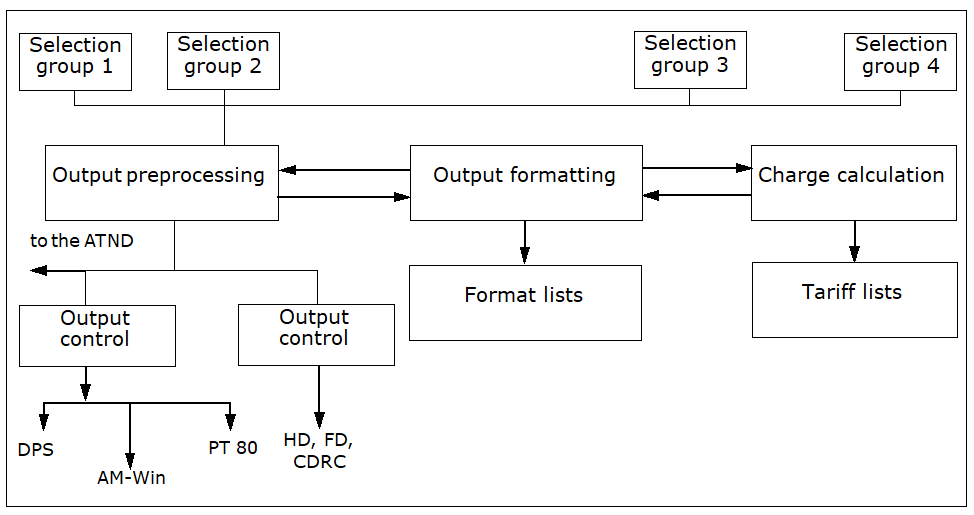
Immediate output is divided into the following components:
- Data preprocessing
- Formatting
- Output control
- Charge calculation
Figure 86. Overview of the selection
- Data preprocessing
The job of the data preprocessing is to configure the data records or formatted data blocks in an output block according to the parameters entered in the selection group.The relevant output control takes over the output of this output block to the requested output medium, depending on the selection group entries.The following restrictions have been made for treating the attendant console as an output device:
- An attendant group can have n-1 ATNDs.
- The maximum number of attendant groups is 16
If the base device is the same as the attendant console (ATND), no reserve device is permitted. If the base device is another output device, the reserve device can be an attendant console (ATND).FormattingThe formatted (EBCDIC or ASCII code) CDR records can be transferred at any time via fast file transfer (FT SINX and other file transfer programs that are released for OpenScape 4000) to DMS or other applications. The OpenScape 4000 call detail recording files that the CDR records are filed in the requested customer format in an FT file (file transfer file). You can configure the format of the data records in the file with the help of AMOs. At a time specified by the customer or when the file has reached its maximum size, the file is closed and copied under a name specified by the customer. This file is then available for file transfer. After this file has been transferred with file transfer, it must be deleted, but not by call detail recording function.If the file is still present at the time of the copy operation, an alarm message is issued. The new file is then attached to the old file. If the file is not picked up, attachments are made until the memory capacity limits are reached. After this, data is lost.When there is a restart or reload during the copy operation, the appropriate data must be saved in a scratch file to prevent any duplicate or incomplete data records when attaching. This data is used so that the file does not contain any mutilated data records.The storage in the "FT file" is done either by the selection (for immediate output) or by output of the call charge data from the CDRC file to the "FT file".The output records resulting from the formatting can be transferred to any device controller and any transfer procedure (including DPS channel), even if there is no device-specific data. The outputs that run to the ATND contain data that is converted in the switching unit to code appropriate for output. The processing and compilation of the variable output format data is laid out in format lists. These format lists consist of individual elements (see AMO FTBL).Output controlEach output control uses programs, which vary according to the device to be connected, for configuring and processing different types of files. The files are output in any computer units or programs to the following:- TTY (asynchronous terminals)
- DPS (connection of a data processing system)
The task of charge calculation is to calculate the charges for each connection on the basis of the call data recorded in the CDR record using the tariff from the selection table. The type of charge calculation differs for the different communication services and is therefore handled in several subcomponents (see AMO TTBL). - Notes on the output devices
The zone parameter of the CDR record has 54 domestic and 99 foreign zones and 9 zones for internal, incoming, and tie trunk traffic.Because of the large amount of data when recording the internal connections, it may be necessary to output the call charge data quickly to a fast output device. To do this, use an AMO to enter the appropriate notice ("output to fast output device") in the call data recording bit string. If this bit is set, the call charge data selection is done only with the first selection group. The remaining selection groups are deactivated. In this case, temporary storage in a CDRC file (as reserve device) is also not possible. This limitation to one output device and one selection group makes it possible to achieve a considerably higher output speed.You can configure one basic and one reserve device for this one output. Possible or useful combinations:
- DPS and magnetic tape (MT)
- DPS and FT file (file transfer)
- Magnetic tape (MT) and FT file
- FT file and MT
Storage for later retrieval (CDRC file) is not possible.