8.12.1. General Information 


The feature Parallel Ringing – One Number Service (ONS) is used
for one person using different phones. Incoming calls are signalled at
more than one destination in parallel (simultaneously).
Also a typical scenario is also the use of One Number Service for
service deliveries. Depending on who is on duty, the responsible service
technician is reachable over one fixed number. If the responsible engineer
needs to recall the customer via the SIP device, the server number of
the help desk is shown in the customer's display. His own mobile phone
number cannot be seen. This ensures that the customer always reaches
an employee when calling this number.
Figure 94. Parallel Ringing with one number
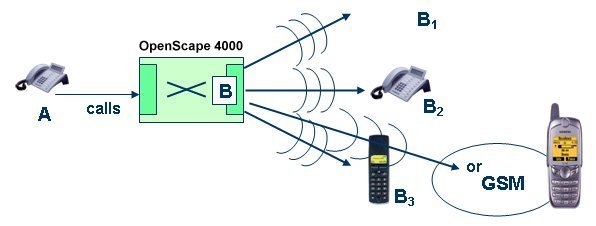
An incoming call is blocked by busy, if one station of the parallel
ringing station group is busy.
All internal ONS members have the same idle display showing the ONS
master number.
Exception: If a CMI mobile was configured as ONS slave, the idle display
does not show the ONS master number. The CMI phones keep in idle state
their own numbers on display.
For a basic incoming call to the ONS group the call is signalled at
all ONS members. All ONS members see the calling party information. After
answering the call by one ONS member all other group members are disconnected
from the call. The whole ONS group is called no matter whether the ONS
master number or a secondary ONS number has been dialed.
If the ONS master is out of service any incoming call to the ONS group
is blocked. If one of the secondary ONS phones is out of service the
other phones shall work as usual.
For the ONS call to the external number no CFNR is honored; in this
case the external call is released but the internal ONS members are still
ringing. The purpose of this processing is to avoid that the ONS call
only reaches the mailbox of the GSM network although the ONS person is
near one of the internal ONS phones. Trunks who cannot receive reliable
answer and disconnect signalling must not be used for the ONS call to
the external member. The information from the GSM via the CO is not as
detailed as within the PBX network (especially in negative cases when
the mobile phone cannot be alerted) and therefore it is recommended that
the mobile phone is always turned on.