5.5.3.2. Feature Parameterization 


If the feature is activated (see Section 25.3.1,
"Feature Activation / Deactivation"), you can make certain
adjustments. However, the basic settings suffice in virtually all cases.
- Configuring the polling interval (handling of the Polling Timer is described in Section 25.3.1, "Feature Activation /
Deactivation"):
CHA-ZAND:TYPE=ALLDATA3, NWTOPTIM=<time in seconds>;
The default setting is 20 seconds. If the polling interval is shortened, the poll is performed faster, which results in the partner table being adjusted faster in the event of changes in the topology. However, this increases the network load. The opposite happens if a longer polling interval is selected. - Configuring the Multiplexer Timer of a circuit / B-channel group:
CHA-TDCSU:PEN=ltg-ltu-slot-circuit,NWMUXTIM=<time in seconds>;
The default setting is 10 seconds. This allows you to specify the time windows in which further partner node messages are to be awaited once a partner node has reported to a line / B-channel group. This is only of significance if several partner nodes are connected to a line / B-channel group via a multiplexer or another CorNet-NQ transport system (e.g. ViNet).If, in this instance, an excessively small time windows is selected, partner nodes might not be detected until after many polling cycles, with this in turn being dependent on the switching situation (if the partner node is frequently busy with calls, be it in transit or as a terminating node of a connection, there is a high probability that the call will fall within a time window and thus be detected).If an excessively large time windows is selected, the processor load is increased, as every call within the time windows is processed by the program. The load in the D-channel of the networking protocol is likewise increased.IMPORTANT:
The standard setting of the NWMUXTIM in the AMO TDCSU should only be altered in exceptional cases. - The number of repetitions of unanswered messages to the partner node before
the node is deleted from the partner table is fixed at a value of 5 and
cannot be administrated via AMO.
Figure 12. Timing parameterization
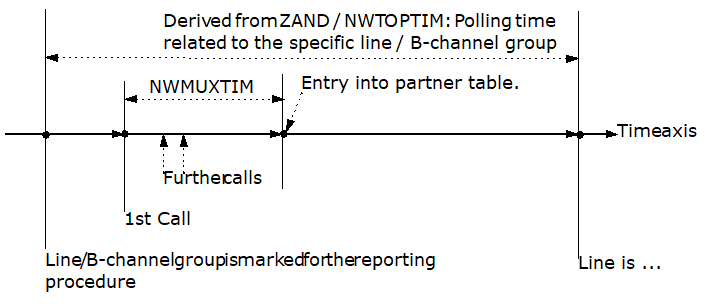
Figure 13. View across several polling cycles
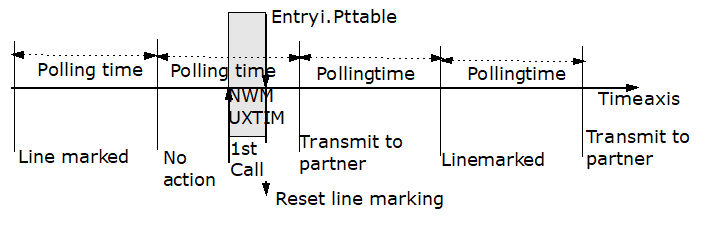
Figure 12, Timing parameterization
shows the effect of the two timers NWTOPTIM and NWMUXTIM within a polling
period. The NWMUXTIM does not start until after the line or B-channel
group has been marked (this takes place automatically on every 2nd poll)
and a call has been established via the marked line. In this procedure,
an entry is made in the partner table (either a new entry is made, or
an old one overwritten).
It must be noted that the polling time does not correspond to the
ZAND value NWTOPTIM, but is instead derived from it: NWTOPTIM is the
polling time between 2 successive lines / B-channel groups. The respective
line is not due again until all lines in the system have been processed
(this means that the time, in relation to the line, is yielded by a multiplication
of NWTOPTIM with the number of CorNet-NQ lines / B-channel groups in
the system).
Figure 13, View across
several polling cycles illustrates the behavior across several
polling cycles in relation to the line. Let us assume there is, as yet,
no entry in the partner table for this line. You see that a transmission
is started to the partner (provided this is already known in the partner
table) with every 2nd polling cycle. Only via this mechanism are nodes
deleted from the partner table automatically in the event of repeated
failure (partner does not answer). In the case of multiplexers / ViNet,
i.e. whenever several partner nodes are "connected" to one line, the
further Calls for the nodes connected via the line must fall within the
NWMUXTIM time windows (highlighted field in the diagram), in order for
them to be adopted in the partner table.