5.13.2. Calling and Connected Number Displays (CLIP/CLIR and COLP/COLR)


Connections via EURO-ISDN exchange lines transport various info-numbers
in as additional connection information, which include the "calling line
information" and the "connected line information" (respectively shortened
to "calling number" and "called number"). These info-numbers not only
appear in the telephone displays of the connection parties; many system
features use these info-numbers as destination numbers at later stages
in a call setup, e.g. for recall, callback, etc. For this reason, an
Info-Number Signalling system exists (INS), whose function is to ensure
that any node-specific modification of these numbers for transport is
carried out in such a way that the info number string (including the
necessary route codes etc.) can be reconstructed by any system or node
at any stage in the connection setup path. Networks transport the info-numbers
in explicit format throughout, wherever possible. Explicit info-numbers
do not contain the full dialled number string, but only the root number
and additional information elements indicating the breakout codes, prefix
codes, area codes, the numbering plan identifier (NPI=ISDN for EURO-ISDN)
and Type of Number (TON, i.e. INTERNAT, NATIONAL or LOCAL). Since call
number information of this type is not suitable for display or further
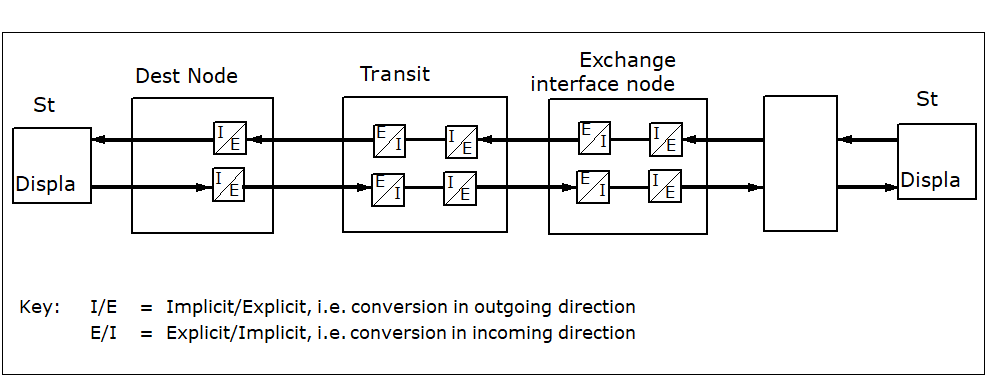
processing within a system or node, each node converts incoming explicit
calling number information into an implicit format for internal purposes.
The implicit calling number information will contain all the appropriate
code digits (breakout and prefix codes) and have the type of number attribute
TON = UNKNOWN. In the outgoing direction, the implicit format is converted
back into an explicit format. The conversion is always carried out with
the station number modification function, i.e. depends on AMO settings
specific to each node. The following example shows an ISDN exchange and
a destination node, with the intervening network.
Figure 21. Format dependant information number signalling
Two parallel methods exist for modifying the calling number information
(calling line number and connected line number): the new format-dependent
station number modification (AMOs KNFOR, KNPRE and TDCSU) and the 'old'
source/destination-dependent method as administered with the KNMAT AMO.
Hicom 300 E V1.0 nodes with the ISDN numbering plan (NPI=ISDN) should
always use the format-dependent method. To this end, the ISDN exchange
must be assigned a virtual node number in order to be able to configure
the outgoing trunk groups for routing (DNNO parameter of RICHT AMO) and
incoming trunk groups for identification (NNO parameter of TDCSU AMO).
The own node number must always be entered in the central PABX data administered
with the ZAND AMO (parameter NNO). The virtual node number must have
the same hierarchical level structure (i.e. single-level, 2-level or
3-level) as the NNO specified in the ZAND AMO.