5.16.17.1. Feature Description 


The reservation of circuits for traffic dependent dynamic routing
(seizing B-channels for direct connections) can be activated or deactivated
per trunk group with the AMO BUEND. This results in the threshold value,
i.e. the minimum number of free B-channels as of which the trunk group
can be used as an alternative route in the path selection, being automatically
computed and stored pursuant to the number of configured (n) B-channels
in the trunk group according to  .
.
.Table 8. Threshold Value as a Function of the Number of Configured Circuits
|
Number of configured circuits
|
Threshold value
|
Number of configured circuits
|
Threshold value
|
|
1
|
1(1)
|
529 - 624
|
12
|
|
2 - 8
|
1
|
625 - 728
|
13
|
|
9 - 24
|
2
|
729 - 840
|
14
|
|
25 - 48
|
3
|
841 - 960
|
15
|
|
49 - 80
|
4
|
961 - 1088
|
16
|
|
81 - 120
|
5
|
1089 - 1224
|
17
|
|
121 - 168
|
6
|
1225 - 1368
|
18
|
|
169 - 224
|
7
|
1369 - 1520
|
19
|
|
225 - 288
|
8
|
1521 - 1680
|
20
|
|
289 - 360
|
9
|
1681 - 1848
|
21
|
|
361 - 440
|
10
|
1849 - 2000(2)
|
22
|
|
441 - 528
|
11
|
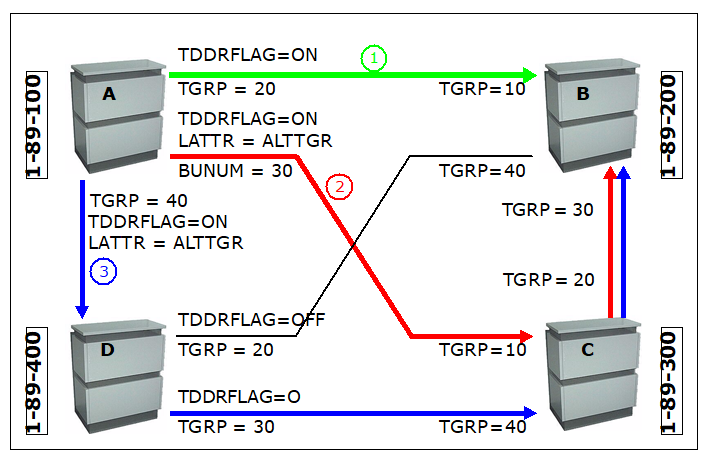
In order to distinguish between direct connection and alternative
connections, the alternative paths of a route must be labelled. This
is realized by setting the attribute ALTTGR ("variable trunk group")
in AMO LDAT for the respective LCR route elements which serve as alternative
paths.
This can prevent direct connections no longer being possible via a
trunk group (e.g. Trunk Group No. 30, i.e. Connection AC as depicted
in diagram below), as this connection is seized upon overflow of Route
AB. A so-called overflow or a call setup via an alternative route element
can then only take place if more channels are still free than the reservation
threshold value specifies.
Figure 39. Traffic Dependent Routing
| (1) | Special case: trunk group with one circuit - no rerouting possible. |
| (2) | Max. number of circuits per trunk group |