5.21.2.1.1. Closed-numbered area with digital ISDN CO connection 


Figure 50. Example: Closed-numbered area with digital ISDN CO connection
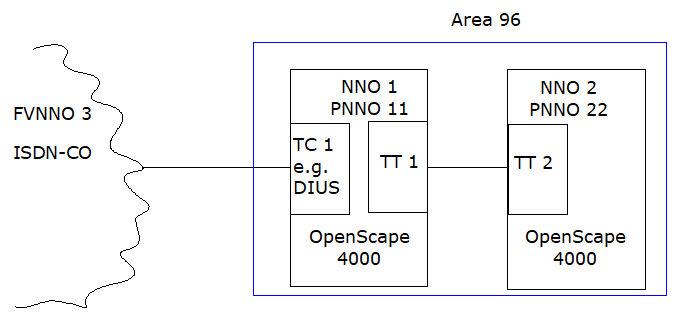
A closed-numbered area consisting of Nodes 1 and 2 through which the
digital trunk circuit TC1 is connected to an ISDN-CO is located in Figure 52.
The fictive node number 3 was assigned to the central office. Both OpenScape
4000 nodes are connected via tie trunks QS1/QS2:
In the example, the format-dependent number modification configured
with AMO TDCSU, AMO KNFOR, AMO KNDEF, and AMO KNPRE should be effective.
IMPORTANT:
With AMO KNMAT, no modification should be set
in this case.
Configuration in physical node 11
Configure the physical node with PNNO=11 as follows:
- Set the node table (define the virtual own NNO):
ADD-KNDEF:NNO=1,TYPE=OWN,ISDNCC=49,ISDNAC=89,
ISDNLC=722,ISDNSK=3,ISDNUL=EXT,NODECD=96;
- Set the node prefix table:
ADD-KNPRE:DPLN=0,NPI=ISDN,TON=INTERNAT,EXIT=0,PREFIX=00;

ADD-KNPRE:DPLN=0,NPI=ISDN,TON=NATIONAL,EXIT=0,PREFIX=0;

ADD-KNPRE:DPLN=0,NPI=ISDN,TON=SUBSCR,EXIT=0;
- Set the central system data:
CHANGE-ZAND:TYPE=ALLDATA,PNNO=11, PNODECD=888811;
- Set the digital trunk circuit:
ADD-BUEND:NO=30,TGRP:=44;

ADD-TDCSU:OPT=NEW,DEV=VCCOD,BCGR=1,COTNO=11,COPNO=2,
TGRP=44,LCOSV=1, LCOSD=1,PROTVAR=EDSGER,NNO=3,ISDNIP=00,
ISDNNP=0;
- LCR route configuration:
With AMO RICHT, you can set up LCR routes for the central office and tie line according to the "LCR Description." Enter 3 as the destination node for the CO route and 2 as the destination node for the tie line route.
ADD-RICHT:MODE=LRTENEW,LRTG=710,LSVC=ALL,TGRP=44,DNNO=3;
With AMO LODR, you can configure the outdial rules for CO connections. In outdial rule 10 for the CO route, numbering plan NPI=ISDN and the TONs for the called numbers must be included (UNKNOWN in this example). The NPI numbering plan, which is always determined from the LCR, is important for the modification of the calling number.ADD-LODR:ODR=10,CMD=ECHO,FIELD=2; ADD-LODR:ODR=10,CMD=NPI,NPI=ISDN; ADD-LODR:ODR=10,CMD=TON,TON=UNKNOWN; ADD-LODR:ODR=10,CMD=END;
The outdial rule is assigned to the route elements using AMO LDAT.ADD-LDAT:LROUTE=710,LSVC=ALL,LVAL=1,TGRP=44,ODR=10,LAUTH=1;
With AMO WABE, enter the routing code into the dial pattern plan:ADD-WABE:CD=0,DAR=TIE;
With AMO LDPLN, enter the route elements into the dial pattern plan:ADD-LDPLN:LDP=0-X,DPLN=0,LROUTE=710,LAUTH=1;
- Set the node format table:
- Normally, the node format table must not be set. In this case, the "calling number"
is always sent to the central office in international format. If the central office
wants a national number with the test attribute SCRE=NOTDEF, enter the following
command:
ADD-KNFOR:DNNO=3,NPI=ISDN;,TONOUT=NATIONAL,SCRE=NOTDEF;
The NPI parameter in AMO KNFOR is the selection parameter. The NPI is determined from the LCR outdial rule (AMO LODR). - Without setting the node format table with DNNO=1 (own node), the
"shortest" possible number is displayed for the subscribers connected to Node 1 in
case the subscriber is called from the central office. The extent of the shortening
is
determined by the codes set by AMO KNDEF (see above). If the calling number should
always be displayed in a certain format (e.g. international) for the subscriber, enter
the following
command:
ADD-KNFOR:DNNO=1,NPI=ISDN;,TONIN=INTERNAT;
Please observe that, for this function, the own node should be entered as the destination node. In this example of the closed-numbered subsystem (NNO 2) without the CO connection, this number format also applies in Node 2.
- Normally, the node format table must not be set. In this case, the "calling number"
is always sent to the central office in international format. If the central office
wants a national number with the test attribute SCRE=NOTDEF, enter the following
command:
Configuration in physical node 22
Configure the physical node with PNNO=22 as follows:
- Set the node table (define the virtual own NNO):
ADD-KNDEF:NNO=2,TYPE=OWN,ISDNCC=49,ISDNAC=89,
ISDNLC=722,ISDNSK=3,ISDNUL=EXT,NODECD=96;
- Set the central system data:
CHANGE-ZAND:TYPE=ALLDATA,PNNO=22, PNODECD=888822;
Since Node 22 has no CO connection and is addressed in a cross-closed-numbered manner, no number modification must be configured. For this reason, the specification of NIP in the LCR outdial rule is no longer necessary:ADD-LODR:ODR=10,CMD=ECHO,FIELD=1; ADD-LODR:ODR=10,CMD=ECHO,FIELD=2; ADD-LODR:ODR=10,CMD=END;
The LCR route, route elements, and dial pattern plan are configured as in Node 1. The tie trunk group is assigned for CO lines as the trunk group. - AMO KNPRE and AMO KNFOR are not called in Node 2.