5.26.2.4. Reducing Level Numbers 


It is easy to reduce the number of levels by wider networking. However,
this is sometimes not possible for topological and/or economic reasons.
If necessary, the number of levels can be reduced by synchronizing
the transmission equipment (the transmission network) from the system
on level = 1 or = 0. In this way, all systems directly synchronized by
the transmission equipment are assigned to level = 2 or = 1. Due to the
fact that a connection can go from one system to a third bypassing the
second, the actual route can become longer. This is only possible since
the route length of the transmission can, theoretically, be up to 27,000
km according to the standards. However, this shifts responsibility for
network synchronism to the transmission system. It should also be noted
that in the case of intelligent transmission networks - where automatic
changeover includes synchronization - the transmission network must be
included into the network synchronization plan and into network management.
Therefore, the network must be treated as a separate hierarchical level
as known from the OpenScape 4000 system. This treatment reduces the number
of possible OpenScape 4000 levels; for the transmission equipment networking
clock generators may become necessary.
( --> SDH, Special cases)
Figure 62. Hierarchy levels with OpenScape 4000/HiPath 4000 networks
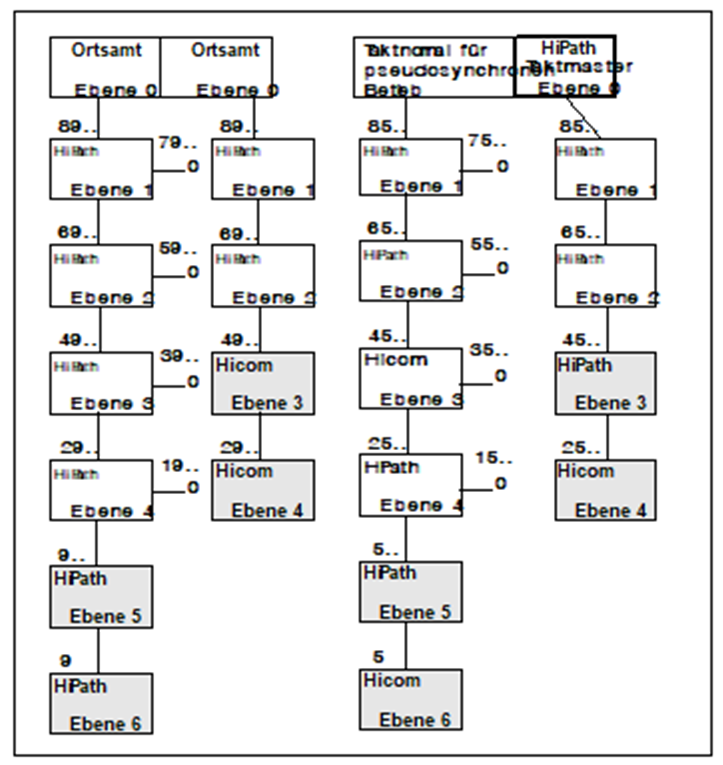
Annotation 1: Networking clock generator in level 1 or 1 and 2 necessary
Annotation 2: Connecting lines _______ represent clock-transparent digital connections
between the systems. Analog and VoIP connections must not be displayed as connecting
lines in
the clocking plan.
Annotation 3: The numbers at the connections between the systems are a suggestion
for
priority assignment in the reference clock table (REFTA)