5.28.1. Feature Description 


The purpose of this function is to prevent the unnecessary use of
alternative routes and the unnecessary seizure of lines. To this end,
a "more favorable" alternative path is hunted as a replacement
for the standard route which has been selected for a particular call
processing situation; the system performs changeover to this new route.
This feature applies to the voice service for both open and closed
numbering schemes in homogeneous OpenScape 4000 networks. The generic
name for this QSIG feature is Path Replacement as detailed in protocol
specifications ISO 13874, ECMA-176 and ETSI 300-259.
It is recommended to use TDCSU protocol either ECMAV2 or PSS1V2, however
the feature is also working with CORNV33 and ECMA1.
The devices can be analogue or digital phones, or analogue or digital
trunks.
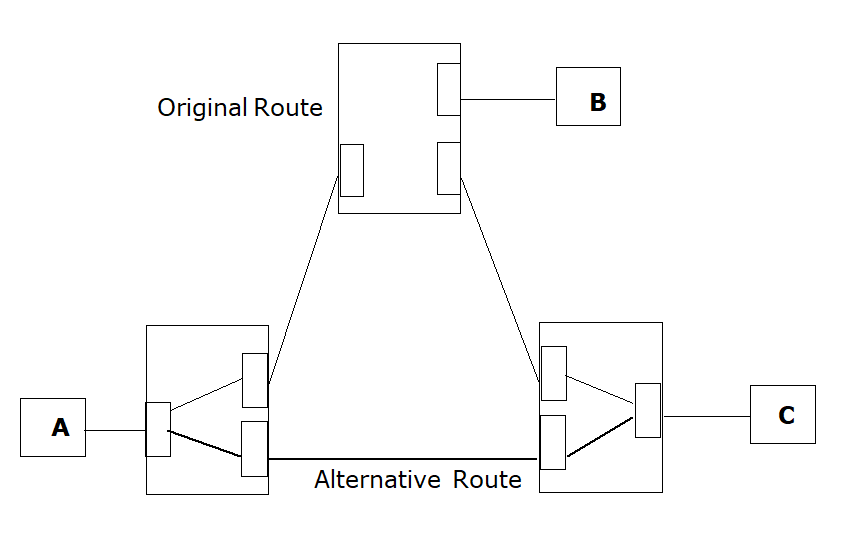
Route Optimization starts when:
The Route optimization process starts, when two stations after a transfer
enter normal two party talking state i.e.:
- after a call transfer or pickup from a consultation call that is in talking state
- after a call transfer from an attendant to a consultation call that is in talking state
- after a transfer from consulted ringing or busy state after the connection of the requested station
- after attendant transfer from consulted ringing or busy state after connection of the requested station
- when a three-party conference is reduced to a two-party call
IMPORTANT:
The station user cannot influence the Route Optimization
function.
Route Optimization does NOT start when:
The Route optimization process does not start if:
- one of the stations A or C is an:
- Attendant
- VMS/VMX
- S0PP Functional Device (ISDN or SIP). UFIP SIP stations however are supported.
- If stations A and B are in the same Node
- If stations B and C are in the same Node
- If station B received two incoming calls and transfers them together
- If the call is not a Voice call e.g. Data Call
- Route Optimization is not executed for consultation calls (i.e. it makes no sense, because another transfer is expected).
- Route Optimization is not executed when the second subunit of the phone is busy e.g. second call. The reason is that no features are allowed during Route Optimization execution e.g. AUN, Toggle etc.
- Route Optimization is not supported for Reroute Internal.
Route optimization Message Flow:
- The Route Optimization is initiated from the Node where the held station
resides in the form of a route optimization Request (PRPropose). Before
sending the request it is checked if the Route Optimization feature is
disabled centrally:
AMO ZAND:ROUTOPTD:YES
- Then in every node for every route it will be checked if the Route Optimization
is permitted to the next partner:
AMO COT:ROPT
- The search for a new route can also be administered by:
AMO ZAND ROUTOPTP=YES (Route Optimization Only Primary Route), or if set to NO all routes can be used for alternate routing. There will be no overflow to Central Office because the signalling required for route optimization is not supported.
- With the setup to a new route it will also be checked if the route supports
Route optimization which is done through:
AMO RICHT ROUTOPT=YES, this check is in addition to the AMO COT parameter ROPT.
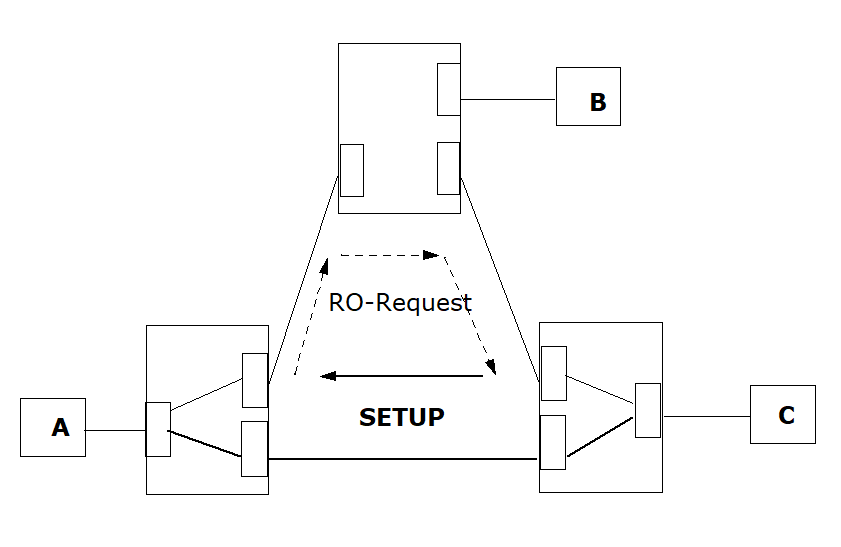 When using number modification, the Physical Node Number from AMO ZAND is used for modification.To prevent call interruption by the switching to the new connection, during the route optimization phase both paths will be switched (broadcasting).