5.36.5.2. VNR with Code Calling/Multiple Code Calling (CC/MCC) 


In a OpenScape 4000 that is divided into several virtual nodes, there
is one central MCC configuration and thus just one central MCC search
table.
Consequently, the station number entries must be unique, which means
they must be entered with the node code.
The same applies for the administration of the station number/code-calling
number evaluation table in the AMO PERSI for station number entry. The
original limitation of the station number length to six characters was
extended to twelve.
A user can basically select either an MCC paging job or an MCC callback
job with or without node code. The relevant virtual node code is automatically
added for the selected station number depending on the PEN of the user
(virtual node or HHS).
If the paging party is in the same virtual node as the paged party,
node codes are not displayed; the node code is displayed if the parties
are in different virtual nodes.
Call forwarding to MCC can only be programmed over the menu by entering
the MCC code. The associated station number is automatically generated
(always with the node code).
If MEETME is set as the operating mode, the paging job can also be
extended to include the A BLOCK (paging party's station number).
This is done by assigning a length to the MABLK parameter in TSCSU. The
station number is generated following VNR rules within this length specification.
If the paging and paged parties are in the same virtual node, then
generation takes place without a node code. If the paging and paged parties
are in different virtual nodes, then generation takes place with the
node code.
Another parameter specifies at which end the station number generated
should be truncated if it exceeds the preset length setting.
In DISPLAY mode, the paging job consists of the paged party's
station number. Here again, the station number is generated with or without
the node code depending on the PENs of the paging and paged parties.
If you set "Long code-calling number > 0", the MCC operates without
digit analysis for the code-calling number which means VNR interaction
is not performed for it.
The same rules apply for CC.
GUI impact
- The station number/code-calling number table is always administered with station number + node code. In contrast to the station number, the code-calling number remains restricted to a maximum of six digits.
- Paging and callback jobs within a virtual node continue to omit the node code.
- The node code must always be entered for paging and callback jobs across virtual nodes.
- The format of the paging job issued and the paging display always depends on virtual node assignment for the paging and paged parties.
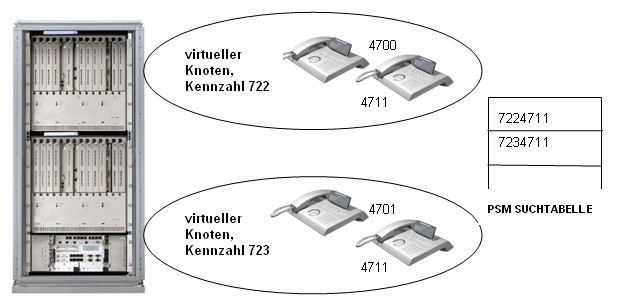
Scenario:
STN 4711 from virtual node 722 is paged and appears in the search table with node
code
722.
STN 4711 from virtual node 723 is paged and appears in the search table with node
code
723.
- STN 4700 can register on STN 7224711 without dialing the node code
- STN 4700 can only register on STN 7234711 when the node code is dialed
- STN 4701 can only register on STN 7224711 when the node code is dialed
- STN 4701 can register on STN 7234711 without dialing the node code