2.2.1. Overview 


The following description of the new overlay handling concept is based
on the AMO overlay handling, but the concept in general effects all kind
of overlays.
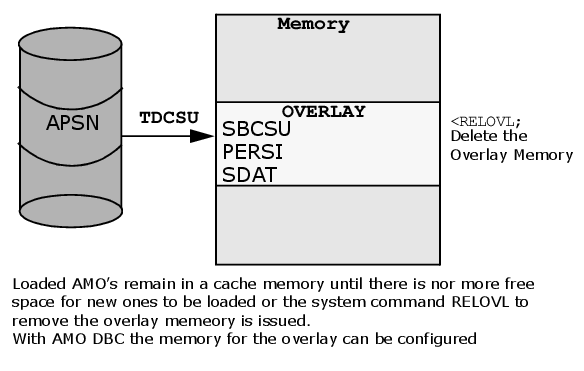
AMO Subsystems are
kept loaded until a predefined limit is exceeded even if they are still
not in use. The limit is defined by the number of slots (selectors) and
the amount of memory all loaded subsystems occupy.
The limits for SLOT and MEM can be defined with new parameters of
AMO DBC processor specific (ADPSLOT, SWUSLOT, MONOSLOT, ADPMEM, SWUMEM,
MONOMEM). If the parameter values are set to zero, the old behaviour
is performed.
System command RELOVL
The new overlay handling concept requires the new command RELOVL
to release all currently loaded overlays by user request. RELOVL
is a system command like the well known system commands TSN, BREAK,
etc. and can be entered any time these commands can be entered. This
is at
- session input prompt "<"
- system session prompt "PLEASE ENTER COMMAND <<"
RELOVL will also work in the case of old overlay handling behaviour
(zero values for SLOT and MEM).
When RELOVL is entered by a user
- all overlays that are still not in use are released immediately
- all overlays which are still in use are marked to be released after the last using process ended
- a new process which wants to use a marked overlay will be delayed or rejected until the marked overlay is released