2.1.5.1. Jitter Buffer Functionality 


Transfer packets can arrive with different delays in TCP/IP-based
networks. Because these delays cause interruptions, packets entering
the data stream must be verified. The jitter buffer provides temporary
storage for IP packets. It can balance out IP packet delays to a certain
degree.
IP packets enter the jitter buffer in the order in which they arrive.
Each packet contains a time stamp, which is stored in the RTP header
of the packet. The actual order is determined using the packet time stamps.
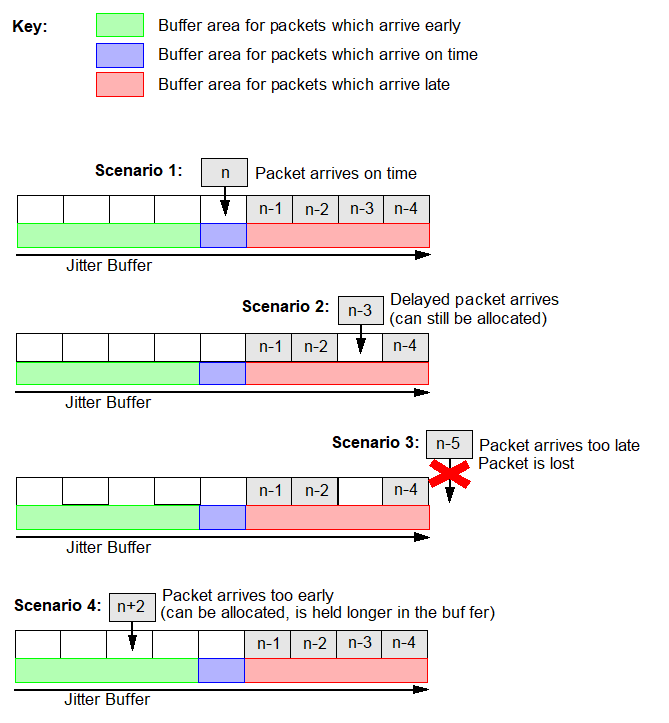
The jitter buffer ensures that packets leave in the right order and in
sync. An average time (average delay) defines how long packets, which
arrive at the expected time, are held in the jitter buffer. Packets which
arrive later than expected are held for a shorter period in the jitter
buffer; packets which arrive earlier than expected are held longer. If
a packet arrives so late that it can no longer be assigned, it is lost.
In theory, packets can also arrive so early that they cannot be assigned.
This is, however, rarely the case in practice.
Figure 4 Jitter buffer functionality
illustrates the jitter buffer functionality.
If one or two packets are lost during voice transmission, this is
not an immediate problem. However, the delay should be as short as possible,
as delays which are too long compromise voice quality when making calls.
To ensure data integrity, the number of packets lost during data transfer
should be kept to a minimum. Delays, on the other hand, do not play a
major role here.
Figure 4. Jitter buffer functionality