10.2.8. Source Dependent Routing 


With IP distributed architecture, it is possible to position parts
of a OpenScape 4000 system in different local networks. In this way,
the OpenScape 4000 CC could be located in Munich, with linked access
points in Berlin and Frankfurt.
Now, if all calls were to be subject to uniform routing, this would
result in a call from the Frankfurt access point being routed into the
Frankfurt local network - with LCR from the point of view of the CC in
Munich - via IP to Munich and from there back to Frankfurt as a long-distance
call. This would not be particularly cost-effective.
If a subscriber at the access point in Berlin were to call the fire
service, the call would arrive at the fire service in Munich, which would
not only be prohibited, but also dangerous.
The solution to this problem is to assign the access points in Berlin
and Frankfurt a connection to the respective local network and to route
them on a subscriber-dependent basis.
This “source dependency“ always applies to multiple subscriber
lines, CO circuits or tie trunk circuits. In order to identify a group
requiring the same routing behavior, the source group ID is introduced.
Every access point must be assigned to a source group. If the subscriber
line, CO or tie trunk circuits are configured with source group ID “0“
(default value), they adopt the settings of the access point. If necessary,
a source group ID which deviates from the access point can be assigned
to individual subscriber lines, CO circuits or tie trunk circuits.
Figure 193. Source-dependent routing
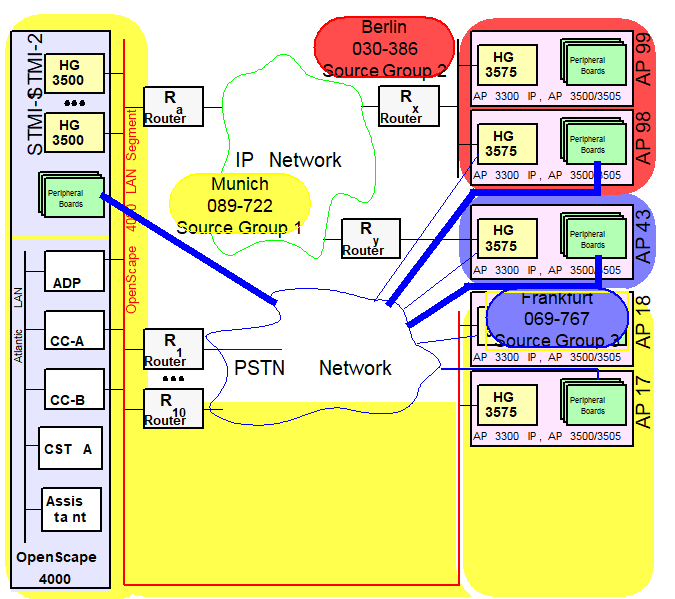
In the example, access points AP 17 and AP 18 in Munich have been
assigned to Source Group 1, which is also always the default setting
for all LTUs (1..15) of the central OpenScape 4000 system. The two access
points in Berlin (AP 98 and AP 99) have been assigned to Source Group
2. The Frankfurt access point AP 43 has Source Group 3.
The number of the source group is specified as the source group index
with ADD-UCSU (see parameter SRCGRP
in Table
6 “APNW: AMO UCSU parameters in ADD branch under TYPE=AP”).
In order to realize source dependent routing, LCR had to be extended.
While routing numbers (LROUTE) have previously been assigned in the
digit pattern plan with the AMO LDPLN for one digit pattern, taking into
account DPLN groups, class of service etc., source dependent routing
requires that the index of an LCR profile (PROFIDX) be specified instead
of the LROUTE. In the LCR profile, an LROUTE can be branched to as a
function of the source group index. LCR profiles are configured with
the AMO LPROF.
Figure 194. Interaction between LDPLN and LPROF
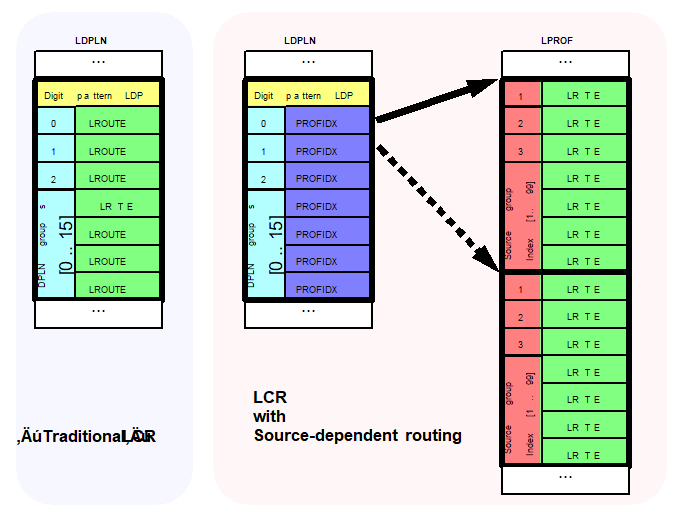
As PROFIDX indicates an LCR profile in the digit pattern plan, this
must be configured first.
An LCR profile for emergency calls to the fire service is to be generated.
In Munich, LRTE 722 leads to the CO; in Berlin, LRTE 386 and in Frankfurt,
LRTE 767.
 |
Configuration Management > Least Cost
Routing > LCR Profiles
Click New, enter the Profile
Name, Source Group, and LCR Route and Save.
The
profile index is calculated and returned.
|
 |
ADD-LPROF:PROFNAME=FEUERWEHR,SRCGRP=1,LRTE=722;The
AMO returns the profile index, provided it is 12.
Additional source
groups can be supplemented with:
CHANGE-LPROF:PROFIDX=12,SRCGRP=2,LRTE=386; CHANGE-LPROF:PROFIDX=12,SRCGRP=3,LRTE=767; |
Next, an entry can be made in the digit pattern plan for emergency
calls to the fire service, indicating the LCR profile number 12 just
configured.
|
|
Configuration Management > Least Cost
Routing > Digit Pattern
Click New, enter 112
for Digit Pattern. On the Data tab, enter the LCR Profile
Number configured above under profile index and SAVE.
|
|
|
ADD-LDPLN:LDP=112,PROFIDX=12, ...; |
Additional functions of the AMO LPROF:
|
|
DELETE-LPROF:PROFIDX=12,SRCGRP=3; |
Deletes the entry for a source group from the specified LCR profile.
If no source group is specified, the entire profile is deleted.
|
|
DISPLAY-LPROF:PROFIDX=1&&33,INFOPAT=FEUER,FORMAT=K; |
All parameters are optional. A specific index or range can be specified
for PROFIDX. INFOPAT allows a search pattern to be specified.
If the pattern is found in a profile name, the profile is output. FORMAT
is used to choose between short or long output format.
Notes:
- Every subscriber line, CO circuit or tie trunk circuit is automatically assigned the source group index 0 upon configuration. This means that the LTU source group index is used. However, it can be changed individually. A maximum of 99 source groups are available.
- The source group index used for a subscriber is output when the AMO
SDAT is called up. The output
SRCGRP =(1)means that the subscriber uses the LTU source group index. The subscriber is configured withSRCGRP=0. If the subscriber moves in an LTU that is assigned to another source group, it is assigned this source group. - The output
SRCGRP = 1means that the subscriber uses the value 1 independent of the LTU source group index. The subscriber is configured withSRCGRP=1. The user-specific source group that is set thus remains the same if the subscriber moves to another LTU. Check if this allocation is still useful.
Table 46. AMO LPROF parameters
|
AMO
|
Parameter
|
Sprache/ Language
|
Beschreibung/ Description
|
|
LPROF
|
FORMAT
|
d
|
Abhängig vom Parameter Format werden die Profile
in einem gekürzten Format angezeigt (nur die Service Information) oder
in einem langen Format (alle für LCR Profile relevanten Informationen)
K
Ausgabe LCR Profile, Service Information - Kurz
L Ausgabe LCR Profile
Einträge - Lang.
|
|
FORMAT
|
e
|
According to the parameter format, the profiles
are displayed in a short format (only the Service Information) or a long
format (all LCR profile releated info).
S Display LCR Profile,
Service information - Short
L Display of LCR Profile related info
- Long
|
|
|
INFOMUS
|
d
|
Bestimmt das Muster nach dem das Profil angezeigt
wird. Wenn das im Parameter INFOMUS angegebene Muster im Profil Namen
gefunden wird, wird das folgende Profil angezeigt.
|
|
|
INFOPAT
|
e
|
Specifies the pattern according to which profiles
will be displayed.If the pattern given in the INFOPAT parameter is found
in the profile name, the following profile is displayed.
|
|
|
LRTG
|
d
|
LCR Richtung
|
|
|
LRTE
|
e
|
LCR route
|
|
|
PROFIDX
|
d
|
LCR Profil-Index
|
|
|
PROFIDX
|
e
|
LCR profile index
|
|
|
PROFNAME
|
d
|
LCR Profilname
|
|
|
PROFNAME
|
e
|
LCR profile name
|
|
|
SRCGRP
|
d
|
Source Group Index
|
|
|
SRCGRP
|
e
|
Source Group Index
|