8.2.1. Feature Description 


HiPath Feature Access (HFA) allows the smooth migration of the communication
platform from a wire-connected to IP-based infrastructure. Consequently,
it is sufficient for the customer just to install and operate an efficient
Local Area Network (LAN) that supports Quality of Service (QoS). Data
and voice communication share the available network bandwidth where the
throughput rate is important for data traffic and the real-time capability
is important for telephony. This means that, before the installation
of an HFA system, the appraisal and actualization of the IP infrastructure
regarding bandwidth and QoS-supporting LAN components (Router, Switch,
Gateway) is crucial for the subsequent quality of the voice connections.
Figure 154. HFA infrastructure
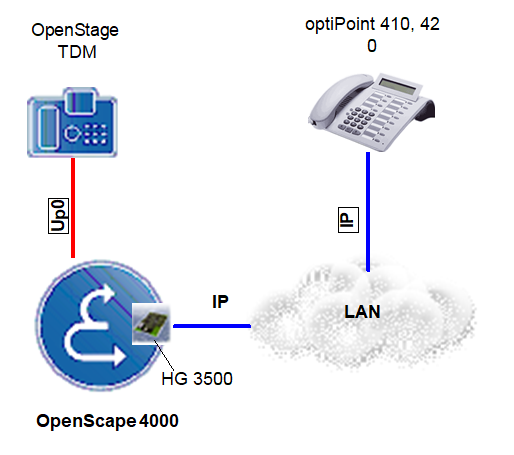
To guarantee good voice quality even when the network is very busy
the LAN segment that is used must consist of QoS-supporting LAN components.
The use of a 100Mbit Ethernet is also recommended.
Supporting Quality of Service in the IP network through prioritization
- IEEE 802.1 p/q (VLAN tagging) on Layer 2
- IETF RFC 2474 (DiffServ) on Layer 3.
There are no significant restrictions for the user, only Autoset-Relocate and Teleworking are not supported. Otherwise the IP terminals provide the same functionality as UP0e-based terminals. However, no S0 or a/b adapters are supported.G.711, G.723 and G.729 are supported with HG 3500. With a Direct Media Connection (DMC), the optiPoint 410 / 420 terminals also control G.722 with CD quality.