8.2.1.1. Technical background 


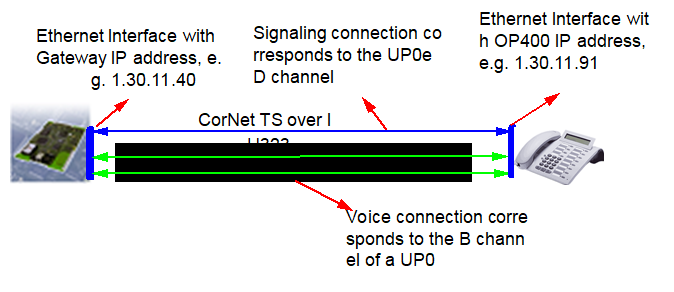
In UP0e-based user connections the signaling connection (D channel)
is separated from the voice connection (B channel) by subdividing the
physical medium into time slots and assigning the two connections different
time slots. In HFA, the two-wire line is replaced by an IP-based LAN
as the physical medium of the digital user connection. The signaling
connection between the terminal and HFA (Common) Gateway uses a secure
TCP connection and the voice data are transferred via an H.323 connection
using the RTP/RTCP protocol. Both connections can now be routed differently
in a single LAN. This means it is possible for there to be signaling
although the voice connection is temporarily interrupted.
Figure 155. Technical relationship between UP0e and HFA user connection
In order to configure an HFA user, primarily it is necessary to determine
the following points beforehand:
- IP address, subnetwork mask, subnetwork Gateway IP address of the Common Gateway
- IP address, subnetwork mask, subnetwork Gateway IP address of the HFA terminal