13.1.1. How is the Fault Detected? 


The control link (-> signaling link) between the CC and access
point/OpenScape 4000 SoftGate is a TCP connection. Alternatively, it
also can be a connection using UDP packages (feature “HSR via UDP”,
see Section 1.3,
“HSR via UDP”). The original TCP packages are part
of these UDP packages. Therefore in this case both connection types can
be considered as a TCP connection.
TCP connections (thus also the control link between CC and access
point/OpenScape 4000 SoftGate) are generally subject to permanent monitoring
of their functionality. Transmitted packets are acknowledged. If the
acknowledgment does not arrive within a certain time, the packet is repeated.
In the case a packet cannot be sent regardless of TCP retransmissions
(i.e. no acknowledgment during defined time frame) the sender must assume
packet loss. Even if no packets are currently being transmitted, TCP
checks that the connection is functional. To this end, so-called “Keep
Alive” messages are sent at predetermined intervals, which have to
be answered.
When a fault is reported on a signaling link, a relatively long period
(e.g. more than 30 seconds) has already passed since the first indication.
If it is assumed that signaling messages for a OpenScape 4000 switch
have to be delivered within a specified time (e.g. 60 seconds), the difference
between these two times is available to find and establish an alternative
route and re-transmit the messages.
The time can be shortened by drastically reducing the time between
the error index and the message.
Therefore, a supervisory link is always established in OpenScape 4000
between the CC and the access point/OpenScape 4000 SoftGate parallel
to the signaling link as soon as signaling survivability is configured
for the access point/OpenScape 4000 SoftGate.
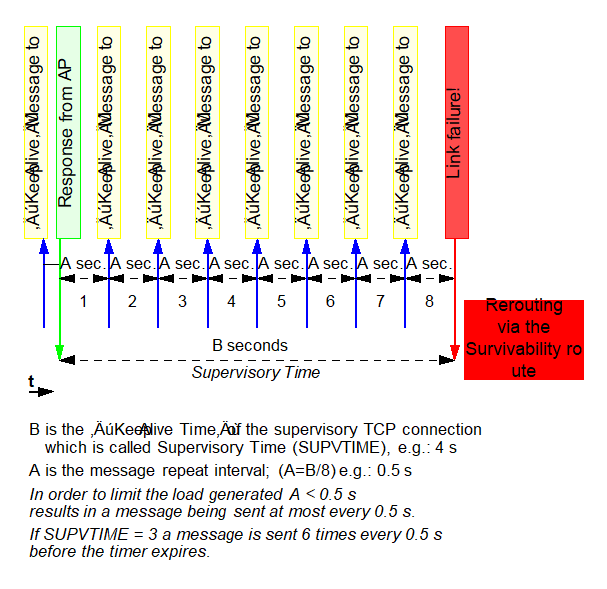
This supervisory link is used exclusively to exchange “Keep Alive”
messages at very short intervals (e.g. every second).
If the CC fails to receive a response to a “Keep Alive” message
within a definable time interval (supervisory time), it switches the
routing of the signaling messages to this access point/OpenScape 4000
SoftGate from the IP router to the survivability router.
Figure 224. Supervisory message flow for signaling survivability in the CC
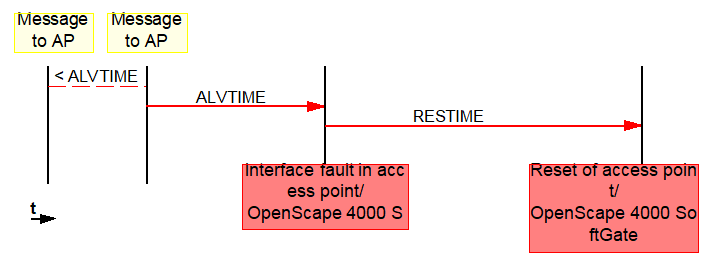
An escalation strategy is also triggered in the access point/OpenScape
4000 SoftGate.
An interface fault is reported if, irrespective of the supervisory
link, messages do not reach the access point/OpenScape 4000 SoftGate
on the signaling link within the set time interval (ALVTIME),
either via the IP network or the alternative route.
After the interface fault report (ALVTIME) the access point/OpenScape
4000 SoftGate is taken out of attendant list and will be reset within
a definable time interval (RESTIME). It then waits for a renewed
contact through the OpenScape 4000 CC.
Up to end of ALVTIME, all signaling messages queued in the
CC and in the access point/OpenScape 4000 SoftGate for transmission are
buffered. If the alive time (ALVTIME) expires, it can be assumed
that the stored messages are outdated and may no longer be delivered.
However, this means that the message flow between the CC and the access
point/OpenScape 4000 SoftGate is no longer consistent.
The time constants can be changed with the AMO SIPCO in the TIMING
branch. (see IP Distributed Architecture > Section 2.1,
“OpenScape 4000 LAN Segment” > System timing (TIMING))
Figure 225. Message flow for signaling survivability in the access point/OpenScape 4000 SoftGate