11.1.2. Access Point Emergency and Signaling Survivability 


The AP Emergency feature and the signaling survivability feature are
not alternatives. Instead, they complement each other. A reliable layer
concept for system stability can be implemented in all scenarios containing
WAN routes.
- Signaling survivability guarantees access point/OpenScape 4000 SoftGate operation over the central control unit in the event of a WAN malfunction. The signaling survivability path is switched over without interruption.
- AP Emergency takes over access point/OpenScape 4000 SoftGate operation if the central control unit fails.
Notes:
- The HSR signaling connection from the APE to the Access Point/OpenScape 4000 SoftGate is always only a pure TCP/IP connection as opposed to a "HSR over UDP" connection (regardless of the SIGMODE configuration in AMO UCSU).
- There is always only a single HSR signaling connection over a defined path between the APE and Access Point/OpenScape 4000 SoftGate and no alternative survivability path.
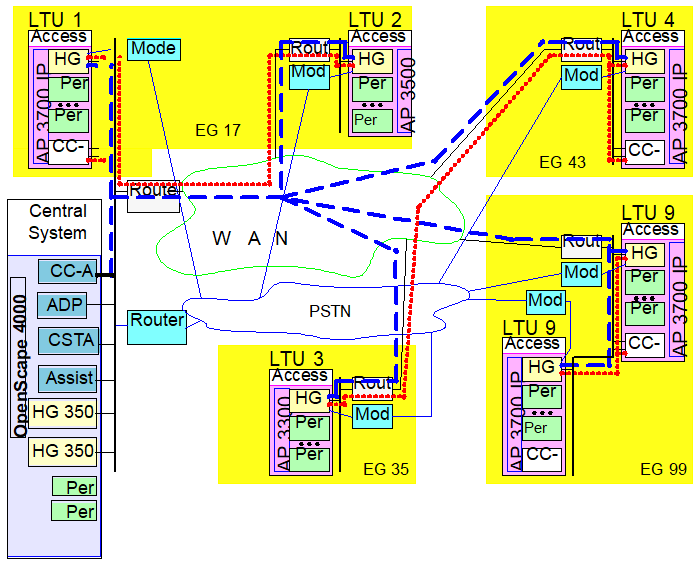
Figure 53 “AP Emergency scenario”
illustrates a mixed scenario that will be referred to throughout the
manual. In this figure, the broken blue lines represent the communication
paths between the central control unit and the access points/OpenScape
4000 SoftGates and the red dotted lines represent communication between
the survivability units and the access points/OpenScape 4000 SoftGates
allocated to them.
Figure 211. AP Emergency scenario