20.3. Scenarios 


OpenScape 4000 allows using T.38, also on the master channel. The
following figures show some supported scenarios:
Scenario 1: OpenScape 4000 SoftGate - OpenScape 4000 host system
Figure 431. OpenScape 4000 SoftGate - OpenScape 4000 host system
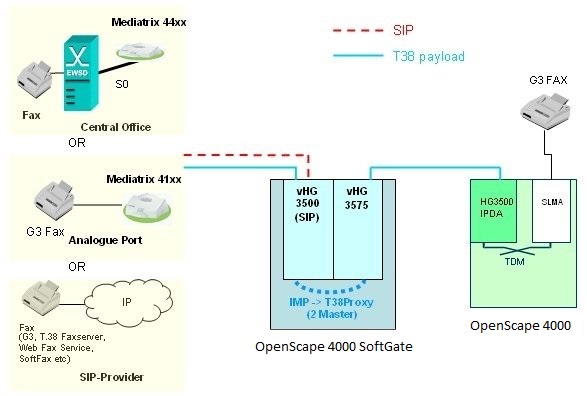
This scenario shows a typical fax call from a small site with OpenScape
4000 SoftGate at the main site. Usually the connection will be established
as a voice call. After tone detection, a switchover to T.38 will be initiated.
Scenario 2: Fax between SMP enabled endpoints
Figure 432. Fax between SMP enabled endpoints
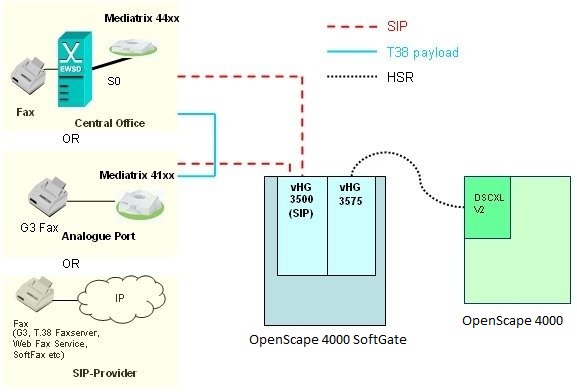
This scenario shows a fax call between SMP (SIP Message Proxy) enabled
endpoints. The media negotiation is performed end to end, i.e. the OpenScape
4000 SoftGate is not involved in media handling.
Scenario 3: Media routing in IPv6 scenario
Figure 433. Media routing in IPV6 scenarios
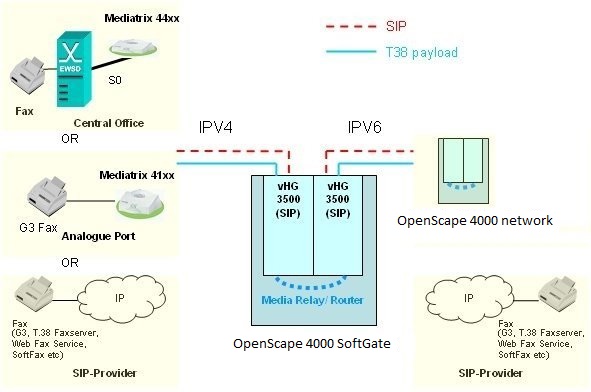
This scenario shows a fax call between IPV4 and IPV6. The conversion
between IPV4 and IPV6 is performed by the OpenScape 4000 SoftGate, which
functions as media relay.
Scenario 4: Media relay scenario with DMC (Direct Media Connection)
Figure 434. Media Relay scenario with DMC
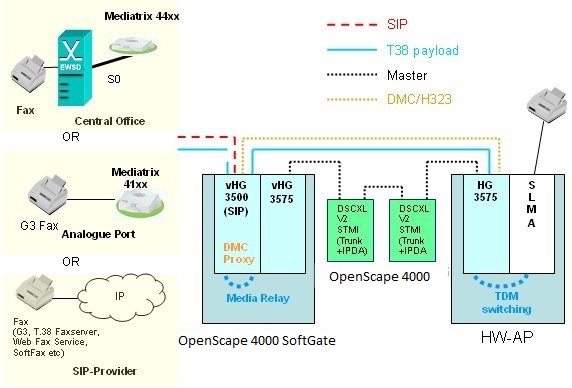
This scenario shows a fax call from an OpenScape 4000 SoftGate through
an OpenScape 4000 network (either SIP-Q or TDM) to a hardware access
point.
A DMC is initiated. In case the fax tones are detected before the
DMC has been established, the DMC is canceled, and the master channel
is used instead. The OpenScape 4000 SoftGate will install a media relay
between SIP and H323.