13.3.3. Help for Setting Synchronized Announcements 


General
When using synchronized announcements wait times for the beginning
of announcements should be as brief as possible for economic reasons.
After all, charges are usually applied from the moment the request is
entered - even before the announcement has been activated. The examples
and diagrams in this document should provide some help for optimizing
synchronized announcement settings.
The wait time for announcement begin depends on various events, their
time sequence and also on parameter settings in SYNCA AMO.
The most influence have:
- traffic.
- length of the announcement text.
- number of announcement units allocated to an announcement type.
- set operating mode (Start/Stop or Continuous)
- set announcement delay time with Start/Stop operating mode
If the operating mode is CONTINUOUS then the wait time cannot be shortened by
administrative interventions or by jumpering. Even additional announcement units will
have
no effect on the wait times.
Additional announcement units will only increase the number of callers for a specific
announcement (50 callers more per additional announcement unit).
The CONTINUOUS operating mode results in the following unchangeable wait times:
- maximum possible wait time in individual case: length of text announcement
- average wait time: half of text length
Depending on the traffic situation, wait times can only be optimized in the START/STOP
operating mode by setting a start delay time and the number of announcement units
per
announcement type.
If the synchronized announcement is operated in START/STOP mode and traffic shows
too few
announcement units per announcement, the operating mode is automatically switched
to
temporary CONTINUOUS mode, if no idle announcement unit can be found.
If bit 11 of the diagnosis bit string is set the system always outputs diagnosis advisory
messages at the point of switch-over. These messages contain information about the
capacity
of individual announcement units in order to allow system owners to react to the problem.
The following diagrams show the changes of wait times for certain suppositions depending
on
the number of announcement units (for a certain announcement type) and the selected
delay
time.
Suppositions:
- traffic: number of calls per sec = 1
- text length: 10 sec.
- set operating mode: Start/Stop
Actions:
- modification of start delay time: (0 - 1 - 2 - 3 - 4 - 5) sec
- connection of announcement units for an announcement type: (1 - 2 - 3 - 4 ) units
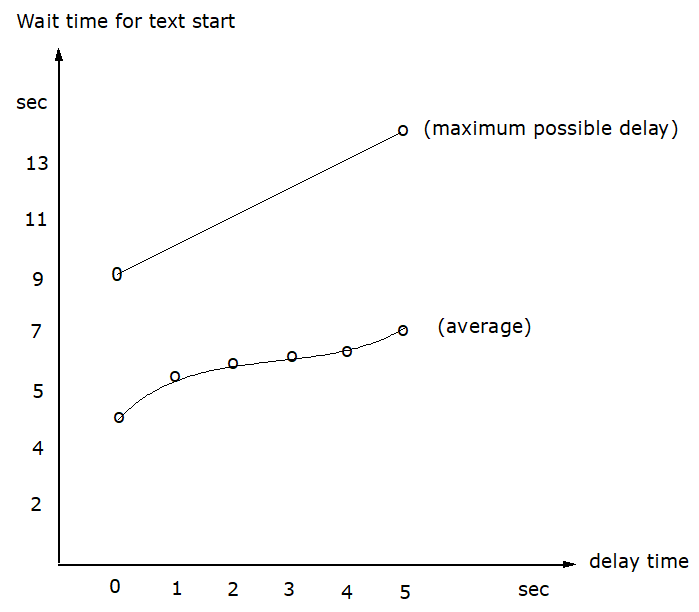
Example: Number of announcement units = 1
Comment: A synchronized announcement with start delay for only one
announcement unit is unreasonable. With an increasing start delay, both
the average wait time and the maximum wait time show near linear increase.
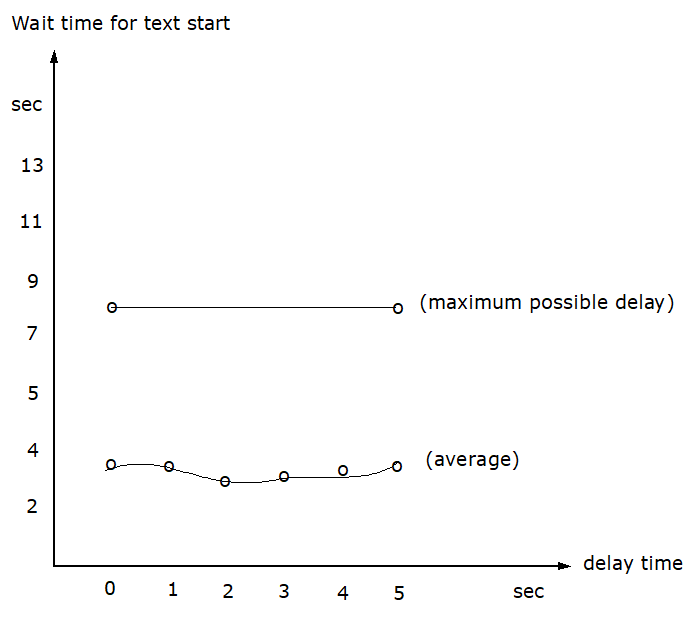
Example: Number of announcement units = 2
Comment: In this case the maximum possible delay time is constant
at 8 seconds. The shortest wait time (2.7 seconds) is achieved with a
start delay time of 2 seconds.
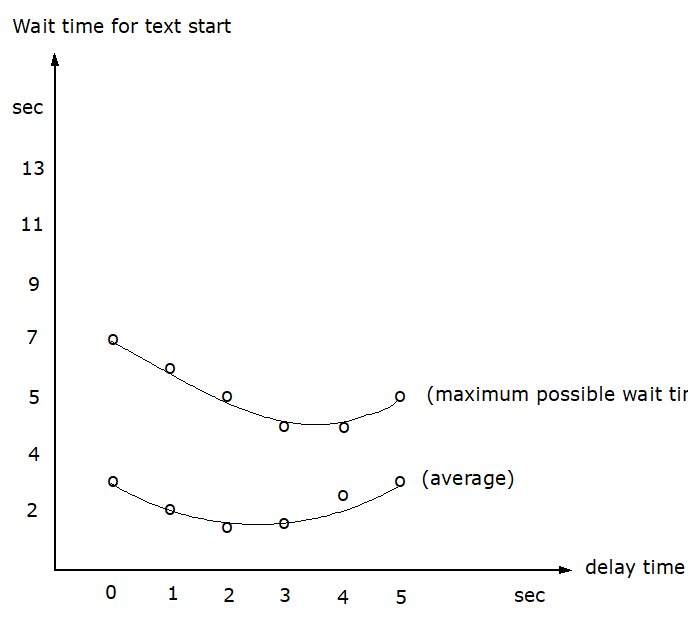
Example: Number of announcement units = 3
Comment: In this case the maximum possible wait time can obviously
be influenced by the start delay time. With a start delay time of 2 seconds
the average wait time for text start (1.5 seconds) reaches its minimum.
The optimum is a start delay time of 3 seconds.
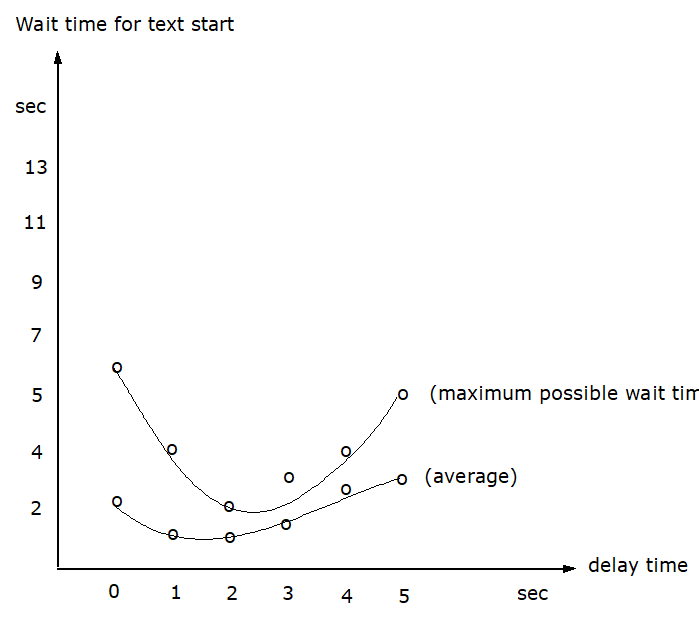
Example: Number of announcement units = 4
Comment: In this case the maximum possible wait time reaches its minimum
of 2 seconds with a start delay time of 2 seconds. The average wait time
reaches its minimum of 1.5 seconds also with a start delay time of 2
seconds.
Rule of thumb:
Calculation of the optimum timing for synchronized announcements,
in order to achieve briefer wait times for text start using different
text lengths, is facilitated by the following consideration.
The text length of the first active announcement unit must be covered
by the result of the start delay time and the number of additional announcement
units.
Ergo: Text length = start delay time multiplied by the number of announcement
units.
Example:
- Text length: 40 sec
- Start delay time: 5 sec / 10 sec / 20 sec
- Number of announcement units: 8/4/2
|
In figures:
|
40 sec =
|
5 sec multiplied by 8
|
or
|
|
10 sec multiplied by 4
|
or
|
||
|
20 sec multiplied by 2
|
or ...
|
The number of necessary announcement units in relation to the set
delay time results from the following formula:
Number of announcement units = text length/begin delay time + 1
|
In figures:
|
number of announcement units
|
= 40 sec /5 sec + 1 = 8 + 1 = 9
|
or
|
|
= 40 sec /10 sec + 1 = 4 + 1 = 5
|
or
|
||
|
= 40 sec /20 sec + 1 = 2 + 1 = 3
|
or ...
|
If this procedure is used
- the maximum possible wait time for text start is always equal to the set start delay time.
- the average wait time for text start is equal to half the maximum possible wait time.
Which value combination is used depends on how many announcement units
should be used (matter of costs) to reduce the wait times for text start
to which justifiable value.
The following tables show possible combinations for different text
lengths and the resulting wait times for text start.
|
No. of announcement units
|
Start delay time
|
Max. possible wait time
|
Average wait time
|
|
1+1 = 2
|
40 sec
|
40 sec
|
20 sec
|
|
2+1 = 3
|
20 sec
|
20 sec
|
10 sec
|
|
4+1 = 5
|
10 sec
|
10 sec
|
5 sec
|
|
5+1 = 6
|
8 sec
|
8 sec
|
4 sec
|
|
8+1 = 9
|
5 sec
|
5 sec
|
2.5 sec
|
|
10+1 = 11
|
4 sec
|
4 sec
|
2 sec
|
|
20+1 = 21
|
2 sec
|
2 sec
|
1 sec
|
Example: Text length = 40 sec.
|
No. of announcement units
|
Start delay time
|
Max. possible wait time
|
Average wait time
|
|
1+1 = 2
|
30 sec
|
30 sec
|
15 sec
|
|
2+1 = 3
|
15 sec
|
15 sec
|
7.5 sec
|
|
5+1 = 6
|
6 sec
|
6 sec
|
3 sec
|
|
6+1 = 7
|
5 sec
|
5 sec
|
2,5 sec
|
|
10+1 = 11
|
3 sec
|
3 sec
|
1.5 sec
|
Example: Text length = 30 sec.
|
No. of announcement units
|
Start delay time
|
Max. possible wait time
|
Average wait time
|
|
1+1 = 2
|
20 sec
|
20 sec
|
10 sec
|
|
2+1 = 3
|
10 sec
|
10 sec
|
5 sec
|
|
4+1 = 5
|
5 sec
|
5 sec
|
2,5 sec
|
|
5+1 = 6
|
4 sec
|
4 sec
|
2 sec
|
|
10+1 = 11
|
2 sec
|
2 sec
|
1 sec
|
Example: Text length = 20 sec.
|
No. of announcement units
|
Start delay time
|
Max. possible wait time
|
Average wait time
|
|
1+1 = 2
|
10 sec
|
10 sec
|
5 sec
|
|
2+1 = 3
|
5 sec
|
5 sec
|
2,5 sec
|
|
5+1 = 6
|
2 sec
|
2 sec
|
1 sec
|
|
10+1 = 11
|
1 sec
|
1 sec
|
0,5 sec
|
Example: Text length = 10 sec
Comment:
It is possible to allocated several announcement units to the same announcement type
by
assigning the same announcement type when configuring the TMOM announcement board
(TSCSU).
A maximum of 64 announcement units can be configured in the PBX. They can be combined
to
any announcement types.
Extreme cases using 64 different announcement types with one announcement unit each
or only
1 announcement type with 64 assigned announcement units are possible.