11.1.6.1.1. Feature Description 


There is a flexible mechanism to direct incoming calls over different
trunks or with different call types to the call answering queues of the
Attendant Groups. This mechanism can be used to adapt each customer specific
profile for incoming calls to the defined Attendant groups.
For every Attendant group eight priority levels per queue can be configured
:
- DQ mode : Priority level 1...8 for answer key L1 and 1...8 for answer key L2,
- MQ mode : Priority level 1...8 for each Source Queue key SQ01...SQ12.
Incoming calls can be freely assigned to an Queue key and a priority level.
The highest priority level is 1.
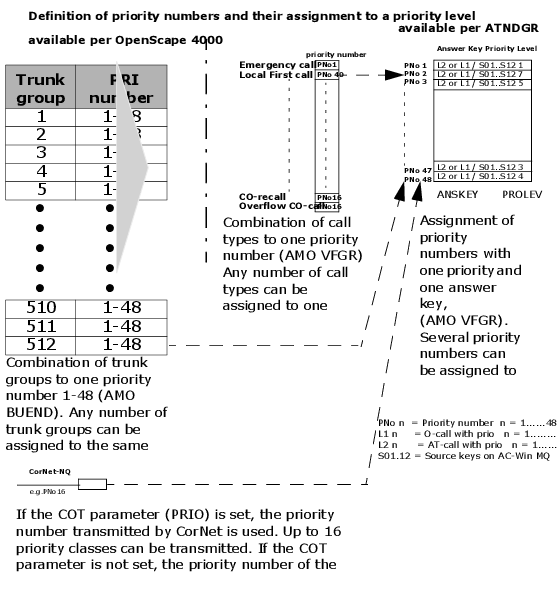
The priority level
for incoming calls are assigned in two steps
Incoming calls are assigned to priority numbers (0-48) The priority
number of incoming calls can be established in various ways.
- With external first calls (including calls by intercept) according to their origin, i.e. trunk group specific (AMO BUEND). The established priority number is then the same for all AC groups within one PBX.
- With external first calls via transit connections (CASMCF) using CorNet-NQ,the priority number of the originating node can be transmitted (can be administrated in the destination node using COT parameter PRI).
- With transmission via CorNet NQ, they also apply within a system network. Transmitted via CorNet NQ will be the priority numbers 1...16 only. Higher priority numbers (17...48) are mapped to priority number 16. The priority level can then be determined from the priority number. The originating node must be a homogeneous OpenScape 4000/HiPath 4000 network. In transit nodes the priority number is switched transparently through, subject to the COT parameter PRI being set in the transit node for the incoming trunk. With internal calls from an originating node the priority number of the outgoing trunk group is transmitted. The COT parameter PRI is an old parameter (transmission of the priority number via CorNet-NQ in homogeneous OpenScape 4000/HiPath 4000 networks) but changes function with this new usage.
- For all other calls the priority numbers are assigned according to the call type.
Calls with the same priority level within a call queue (answer key ) are
answered by the Attendants according to the FIFO principle. The longest
waiting call is the first transferred to a free station (AC Win or Night
station).