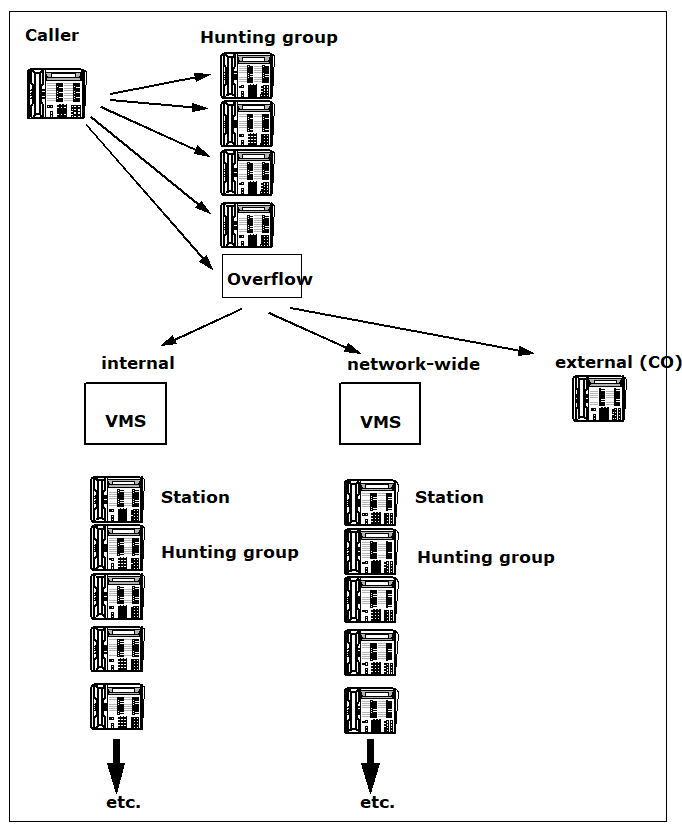
8.9.1. Expansion of the Call Queue Overflow Function 


AMO SA permit input of a station number with up to 22 digits as an
overflow destination. This means that all internal, external, and network-wide
stations can be configured as overflow destinations. An overflow to a
PhoneMail via S2 connection functions like an overflow to a network-wide
VMS. The mailbox number is limited to 7 digits.
- Possible overflow destinations
- none
- station number
- network-wide VMS
- PhoneMail
- Station number for overflow destinations
- station number (1 - 22 digits for station numbers)
- station number (1 - 7 digits for VMS/PhoneMail destinations)
If a network-wide VMS or PhoneMail number is entered, the entry in the VMX table (for network-wide VMS) or the SAN table (for PhoneMail) is the server station number. Mailbox station number output is similar to that of the internal VMS.Any calls to a hunting group during call queue overflow are treated as call forwarding to a hunting group station: after call forwarding by overflow a 'ring no answer or when busy' cannot be performed. Several call forwardings can only be performed if multiple call forwarding has been activated in the destination node (currently up to 10 levels).The only exception is when another hunting group is specified as the overflow destination. In this case, FNA (Forward If No Answer) is performed within the hunting group. The system will consider this hunting group's overflow destination, which can be an internal or network-wide station number, provided multiple call forwarding was activated in this node. The overflow destination can again be a hunting group. As call processing cannot check the number of network-wide hunting group links, the provider is responsible for their limitation. If the second hunting group's overflow destination is a VMS or PhoneMail number, call forwarding is always performed, even if multiple call forwarding has not been activated. This occurs regardless of whether the VMS or PhoneMail number is a network-wide or internal number.To distribute the traffic load evenly in the network, configure another hunting group in a second PABX as the overflow destination. This distributes the busy hour loads caused by call queue overflow.A hunting group station can configure a FWD destination. The usual tests to check the validity of the FWD destination are performed. No further checks for the validity of the FWD destinations are required.The overflow destination is configured using an AMO (=FWD destination). The AMO first checks whether the specified station number leads to a valid DAR. In other words, this eliminates incomplete (INCO) or impossible (NOPO) station numbers (only limited use for network-wide or external station numbers).If a call to a hunting group is forwarded to an external or network destination, then the call will not be forwarded within the originally called hunting group if the overflow destination does not answer or is busy. Optical camp-on by the call queue and the overflow destination is not used, as stations with active call forwarding to network or external station numbers are treated as free.Call forwarding destinations can only be checked if the destination is an internal station number. Forwarding to other station numbers cannot be checked.After call forwarding or if the station is located in another PABX, callers may only hear the busy tone if the destination is busy or the required resources (lines, paths) are currently unavailable.Stations in different PABXs can be configured as hunting group members.All station numbers which can be dialed internally, externally, and network wide and all internal and network-wide VMS and PhoneMail numbers can now be configured as overflow destinations.Figure 92. HG Overflow Destinations