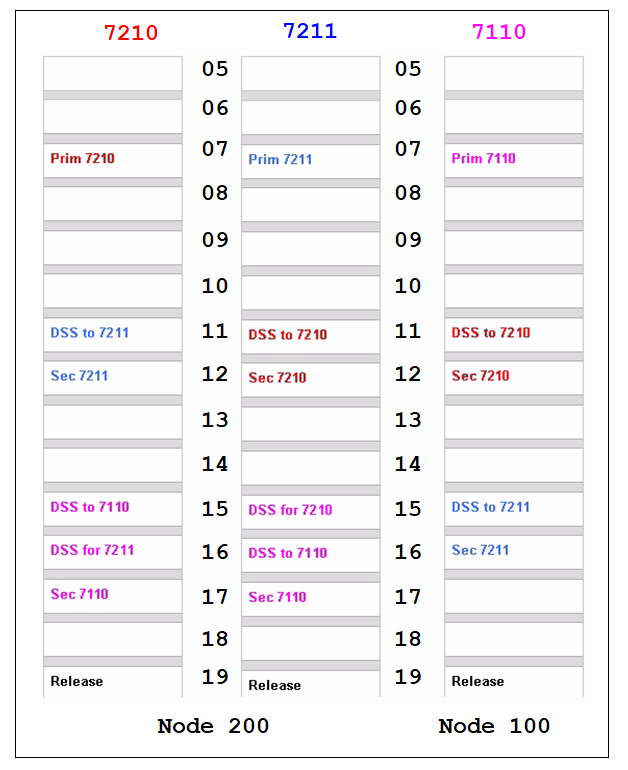
8.11.2.3.2. Direct station selection line 


- The direct call buttons or direct call line buttons are phantom lines which have a special feature. The direct call destinations are assigned to these lines as hotline destinations The hotline feature program must be activated for this in the system. If the direct call button is pressed, then the accompanying hotline destination is called.
- The phantom lines are always configured in pairs and always show the hotline destinations to each other.
- The number of direct call buttons is dependent on the number of configured lines at the Keysystem telephone. There can be maximum 29 line buttons on a Keyset i.e: the possible number of direct call buttons is 29 minus the existing Prime and Secondary lines.
- If the direct call line button is configured at several keysets, then it shall be signaled only at a single device (boss). This function corresponds to a status signalling. The LED of the direct call destination shall show only the condition of the configured terminal but not of the others (secretary). The remaining functionality of the direct call is independent of the terminal type (e.g. flash call, the Name display).
Expansion of the Keysystem group with the new Features:
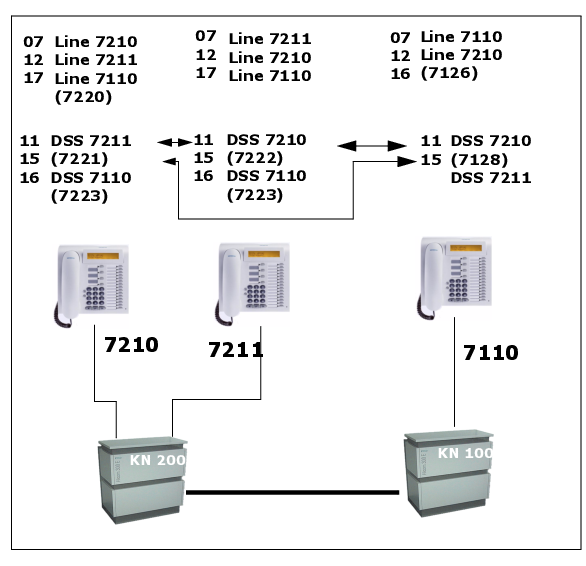
- Subscribers 7210 and 7211 are configured in node 30-200.
- Subscriber 7110 is configured in node 30-100.
- This three subscribers form one team.
- Node 200 (SYS 1)
Changing key layout (extend STD 127)
CHANGE-TAPRO:STD=127,DIGTYP=OPTIT19,KY11=LINE,
KY15=LINE,KY16=LINE;

CHANGE-TAPRO:STNO=7210&7211,STD=127;
Phantom subscriberADD-SBCSU:STNO=7221&&7224,OPT=OPTI,CONN=DIR, DVCFIG=OPTIP500,COS1=333,COS2=333,LCOSV1=9, LCOSV2=9,LCOSD1=9,LCOSD2=9,STD=127,INS=SIGNOFF;
Extend the KEYSYSTEM- primary
ADD-
KCSU:STNO=7221,TYPE=PRIM,PRIMKEY=7,RIOP=YES,ORLNPF=PRIME,TMLN
PF=RING,BUSYRING=ALERT,APRIVAT=NO,AICS=NO;
 ADD-
KCSU:STNO=7222,TYPE=PRIM,PRIMKEY=7,RIOP=YES,ORLNPF=PRIME,TMLN
PF=RING,BUSYRING=ALERT,APRIVAT=NO,AICS=NO;
 ADD-
KCSU:STNO=7223,TYPE=PRIM,PRIMKEY=7,RIOP=YES,ORLNPF=PRIME,TMLN
PF=RING,BUSYRING=ALERT,APRIVAT=NO,AICS=NO;
 ADD-
KCSU:STNO=7224,TYPE=PRIM,PRIMKEY=7,RIOP=YES,ORLNPF=PRIME,TMLN
PF=RING,BUSYRING=ALERT,APRIVAT=NO,AICS=NO;
- secondary
ADD-KCSU:STNO=7210,TYPE=SEC,KYNO=11,STNOSEC=7221,
RIOP=YES,AICS=NO,DSSLINE=YES;

ADD-KCSUSTNO=7210,TYPE=SEC,KYNO=15,STNOSEC=7223,
RIOP=YES,AICS=NO,DSSLINE=YES;

ADD-KCSU:STNO=7210,TYPE=SEC,KYNO=16,STNOSEC=7224,
RIOP=NO,AICS=NO,DSSLINE=NO;

ADD-KCSU:STNO=7211,TYPE=SEC,KYNO=11,STNOSEC=7222,
RIOP=YES,AICS=NO,DSSLINE=YES;

ADD-KCSU:STNO=7211,TYPE=SEC,KYNO=15,STNOSEC=7223,
RIOP=NO,AICS=NO,DSSLINE=NO;

ADD-KCSU:STNO=7211,TYPE=SEC,KYNO=16,STNOSEC=7224,
RIOP=YES,AICS=NO,DSSLINE=YES;
If a DSS line (e.g. Phantom 7223) configured on several terminals as a secondary line, the parameter DSSLINE could be set to "YES" only for one terminal. Therefor the "owner" of the line is marked. If a subscriber is defined as the owner, the DSS peer is informed by the LED at the DSS key, if the owner is in a "busy-state". - primary
Description:
The subscriber 7210 has a DSS-key (key 08) to subscriber 7212 and is defined as the
"owner"
for this line (DSSLINE=YES). This line is also added for subscriber 7211 (08). But
7211 is not
the "owner" of this line (DSSLINE=NO), but could get a call via this key from 7212
to 7110. This
possibility is signalized to 7211 by the blinking LED of key 08. Furthermore 7211
could activate
a three-party connection during an active call between 7210 and 7212. The LED of key
08 will
light constant, if 7210 calls 7212. Thus only the busy state is signalized.
The subscriber 7211 has a DSS-key (key 13) to subscriber 7212 and is defined as the
"owner"
for this line (DSSLINE=YES). This line is also added for subscriber 7210 (13). But
7210 is not
the "owner" of this line (DSSLINE=NO), but could get a call via this key from 7212
to 7111. This
possibility is signalized to 7210 by the blinking LED of key 13. Furthermore 7210
could activate
a three-party connection during an active call between 7211 and 7212. The LED of key
13 will
light constant, if 7211 calls 7212. Thus only the busy state is signalized.
LED signalizing for the DSS peer in case of a "Busy" state
CHANGE-ZANDE:TYPE=ALLDATA,DSSLINE=YES;
Define own name for DSS keys
CHANGE-ZAND:TYPE=KEYSYS,DISLNBAS=YES
e.g.
ADD-PERSI:TYPE=STN,STNO=7221,NAME="DSS FROM 7210";

ADD-PERSI:TYPE=STN,STNO=7222,NAME="DSS FROM 7211";

ADD-PERSI:TYPE=STN,STNO=7223,NAME="DSS FROM 7210";

ADD-PERSI:TYPE=STN,STNO=7224,NAME="DSS FROM 7211";
Activate Hotline
CHANGE-FEASU:TYPE=A,CM=HOTRCL;
Add Hotline destinations
ADD-HOTLN:TYPE=HOTDEST,HTLNIDX=1,DEST=7221;

ADD-HOTLN:TYPE=HOTDEST,HTLNIDX=2,DEST=7222;

ADD-HOTLN:TYPE=HOTDEST,HTLNIDX=3,DEST=7128;

ADD-HOTLN:TYPE=HOTDEST,HTLNIDX=4,DEST=7129;
Add the authorization for Hotline
CHANGE-COSSU:TYPE=COS,COS=333,AVCE=HOT; or

CHANGE-SDAT:STNO=7221&&7224,TYPE=ATTRIBUT,AATTR=HOT;
Add the Hotline index to the subscribers
CHANGE-SDAT:STNO=7221,TYPE=DATA1,HOTIDX=2;

CHANGE-SDAT:STNO=7223,TYPE=DATA1,HOTIDX=3;

CHANGE-SDAT:STNO=7222,TYPE=DATA1,HOTIDX=1;

CHANGE-SDAT:STNO=7224,TYPE=DATA1,HOTIDX=4;
Add additional authorization
CHANGE-SDAT:STNO=7221,TYPE=ATTRIBUT,AATTR=DSSLINE;

CHANGE-SDAT:STNO=7222,TYPE=ATTRIBUT,AATTR=DSSLINE;

CHANGE-SDAT:STNO=7223,TYPE=ATTRIBUT,AATTR=DSSLINE;

CHANGE-SDAT:STNO=7224,TYPE=ATTRIBUT,AATTR=DSSLINE;
Activate LED signaling in the network
CHANGE-ZAND:TYPE=VMI,MWIOPEN=YES; (for Xpression)

CHANGE-COT:COTNO=xx,COTTYPE=COTADD,PAR=TSCS;
- Node 100 (SYS 2)
Changing key layout (extend STD 127)
CHANGE-TAPRO:STD=127,DIGTYP=OPTIT19,KY11=LINE,
KY15=LINE;

CHANGE-TAPRO:STNO=7110&7126&7127,STD=127;
Phantom subscriberADD-SBCSU:STNO=7228&7229,OPT=OPTI,CONN=DIR, DVCFIG=OPTIP500,COS1=333,COS2=333,LCOSV1=9, LCOSV2=9,LCOSD1=9,LCOSD2=9,STD=127,INS=SIGNOFF;
Extend the KEYSYSTEM- primary
ADD-KCSU:STNO=7128,TYPE=PRIM,PRIMKEY=7,RIOP=YES,
ORLNPF=PRIME,TMLNPF=RING,BUSYRING=ALERT,APRIVAT=NO,
AICS=NO;

ADD-KCSU:STNO=7129,TYPE=PRIM,PRIMKEY=7,RIOP=YES,
ORLNPF=PRIME,TMLNPF=RING,BUSYRING=ALERT,APRIVAT=NO,
AICS=NO;
- secondary
ADD-KCSU:STNO=7110,TYPE=SEC,KYNO=11,STNOSEC=7128,
RIOP=YES,AICS=NO,DSSLINE=YES;

ADD-KCSU:STNO=7110,TYPE=SEC,KYNO=15,STNOSEC=7129,
RIOP=YES,AICS=NO,DSSLINE=YES;
LED signalizing for the DSS peer in case of a "Busy" stateCHANGE-ZANDE:TYPE=ALLDATA,DSSLINE=YES;
Define own name for DSS keysCHANGE-ZAND:TYPE=KEYSYS,DISLNBAS=YES
e.g.ADD-PERSI:TYPE=STN,STNO=7228,NAME="DSS TO 7110"; ADD-PERSI:TYPE=STN,STNO=7229,NAME="DSS TO 7110";
Unblock HotlineCHANGE-FEASU:TYPE=A,CM=HOTRCL;
Add Hotline destinationsADD-HOTLN:TYPE=HOTDEST,HTLNIDX=1,DEST=7223; ADD-HOTLN:TYPE=HOTDEST,HTLNIDX=2,DEST=7224;
Add the authorization for HotlineCHANGE-COSSU:TYPE=COS,COS=333,AVCE=HOT; or CHANGE-SDAT:STNO=7128&&7129,TYPE=ATTRIBUT,AATTR=HOT;
Add the Hotline index to the subscribersCHANGE-SDAT:STNO=7128,TYPE=DATA1,HOTIDX=1; CHANGE-SDAT:STNO=7129,TYPE=DATA1,HOTIDX=2; Add additional authorization CHANGE-SDAT:STNO=7128,TYPE=ATTRIBUT,AATTR=DSSLINE; CHANGE-SDAT:STNO=7129,TYPE=ATTRIBUT,AATTR=DSSLINE;
LED signaling in the networkCHANGE-ZAND:TYPE=VMI,MWIOPEN=YES; (for Xpression) CHANGE-COT:COTNO=xx,COTTYPE=COTADD,PAR=TSCS;
- primary
Key layout after generating this step