5.12.3. Service Information 


- The point-to-multipoint interface is a feature in its own right and
not part of the system interface.
- The EDSS1-T network features support the ETSI protocols.
- Adjustments for other providers or countries have not yet been implemented,
but can be realised at a later date.
- The following features were implemented:
- Direct Dialing In on the S0 or S2 interface.
- Calling Line Identification Presentation (CLIP) / Display of the
A station number.
- Call Screening is supported with regard to E.164 addressing. This
allows the validity check of the CLIP received on this line. Unambiguous
Call Screening using CLIP is highly important, as the customer is assigned
the call charges.
- Calling Line Identification Restriction (CLIR) / Calling stations's
number suppression at the called party.
- Connected Line Identification Presentation (COLP) / After CONNECT
the calling party sees the actual station number of the called party.
- Connected Line Identification Restriction (COLR) / Suppression of
the called party's line identification at the calling party.
- Malicious Call Identification (MCID) / Identification and registration. During
a trunk call the called PBX station can instigate the storage of connection-related
data in the ISDN CO. The facility message is then transparently transmitted
with BA or PRA via the DSS1 gateway system interface to the Telekom AG
DSS1 interface.
- The following options can be activated in the ISDN CO for the system
interface:
- Malicious Call identification immediately (MCII) / all incoming and
outgoing calls via the Telekom interface are registered at the ISDN CO.
- Malicious Call identification on request (MCIR) / calls and call
attempts are only registered, if MCID was specially activated using a
DSS1 gateway. All calls are registered, if MCID was activated in the
gateway system. Since a code must be dialled to activate MCID the feature
can only be used for 'voice' services.
- User to User Signalling 1 implicit (UUS1Ii) / D channel user data
transmission between two users during connection setup (setup message)and
clear down. A maximum of 128 bytes can currently be transmitted.
- User to User Signalling 3 (USS3) / D channel user information messages
transmission in active state. To prevent network overloading, every user
with UUS3 authorization is assigned a certain maximum number of user
information messages per period (Congestion Control).
- Advice of Charge During Call (AOC-D) / call charge information is
transmitted from the Telekom DSS1 access to the DSS1 gateway system.
The information is then processed in the OpenScape 4000 module INCDR.
The currently valid call charges are then calculated using tariff tables
and Least Cost Routing information. The derived call charges are then
transmitted to the CP for further transmission to the DSS1 gateway. Call
charges are accounted according to the INCDR regulations.
- AOC-E is included in AOC-D.
- The OpenScape 4000 does not only transmit call charge information
generated by the Telekom. AOC-D is also linked to the internal OpenScape
4000 INCDR interface and therefore allows accounting of PBXs connected
via the DSS1 interface. Advice of Charge End of call / Transmission
of call charge information at the end of the connection.
- The ISDN trunk interface was expanded by the following features:
- Completion of Calls to busy Subscribers (CCBS) / Callback on busy. Callback
on busy to external systems is supported.
- Call Diversion Partial Rerouting / Call forwarding using rerouting.
- Call Diversion Notification / Call forwarding information is signalled
to the involved stations.
- The features listed below supporting the DSS1 protocol, are either not
useable at the DSS1-T-network interface, or have not been implemented
for a system interface:
- Multiple Subscriber Number (MSN)/ Multiple subscriber number of a basic
access
- Terminal Portability (TP)
- Call Waiting (CW)
- Closed User Group (CUG)
- Three Party Service (3PTY)
- Conference Call Add-on (COF) / Conference call
- Freephone Service / 130 FPH Service
- Call Transfer (CT)
- User User Signalling 1 explicit (UUS1e) / Transmission of user data
1 e
- User User Signalling 2 (UUS2) / Transmission of user data 2
- Call Diversion (CFB, CFU, CFNR) for the entire T reference point
- Call Hold HOLD / Call parking
- Call Deflection (CD) / Call forwarding during call, activated by
B station
- Advice of Charge Start (AOC-S) / Call charge information during connection
setup
- Any local features which do not affect the EDSS1-T protocol can be activated
(conference, callback to internal station, etc. ).
- The COT parameters FWDN/FNAN/CFVA/CBFN may not be set at the system
interface, as the connected functions at the T-reference point (on the
network side) are not defined.
- Interworking between different protocols
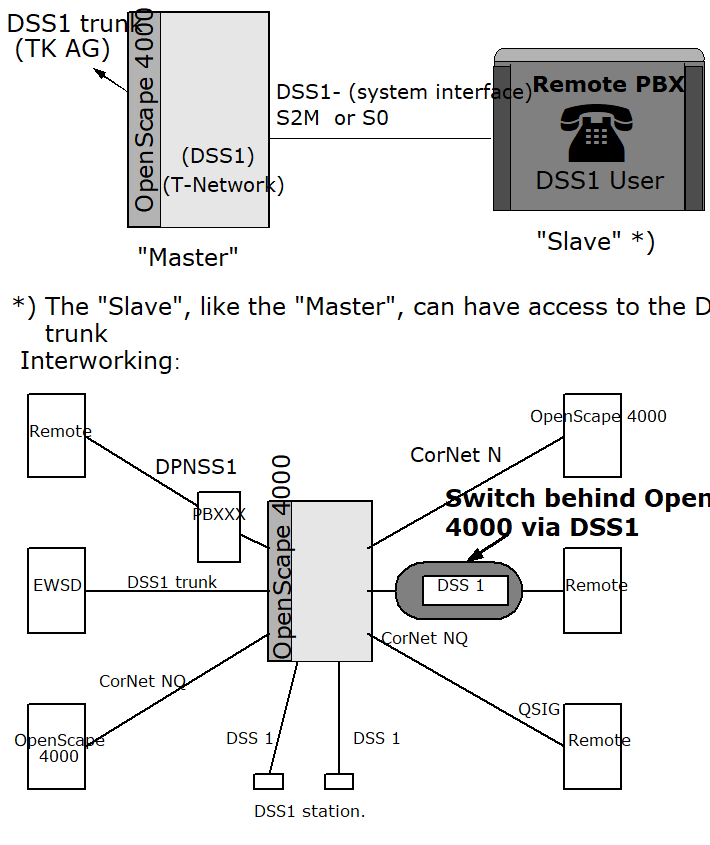
- The OpenScape 4000 supports the following numbering plans for EDSS1-T:
unknown and E.164. PBXs networked using E-DSS1-T should always use the
numbering plan E.164.
- A COP parameter (IMEX) can define, whether or not for incoming calls
with TON=unknown (implicit STNO) the TON is to be modified into an explicit
STNO with a different TON.