5.21.2.1.5. Source/destination-dependent number modification
in the ISDN or PNP numbering plan 


Normally, format-dependent number modification is configured for the
ETSI-E.164 (ISDN) and PRIVATE (PNP) numbering plans using AMO KNPRE,
AMO KNFOR, and AMO KNDEF. The reason for this is the simpler configuration,
especially in case of later changes in the network.
In this example, the source/destination-dependent modification configured
with AMO KNMAT should also be set for the ISDN and PNP numbering plans
(in the example above, KNMAT was also used, but only for the UNKNOWN
numbering plan, i.e. the open, OpenScape 4000 specific numbering).
For better understanding, the example refers to the ISDN numbering
plan. For PNP, however, its numbering plan applies accordingly (with
other exit codes, prefixes, and codes in AMO KNDEF and AMO KNPRE).
IMPORTANT:
Source/destination number modification with AMO
KNMAT should be applied for ISDN and PNP only in exceptional cases. Settings
with KNMAT prevent format-dependent number modification.
Figure 52. Example: Source/destination-dependent number modification in ISDN or PNP numbering plan
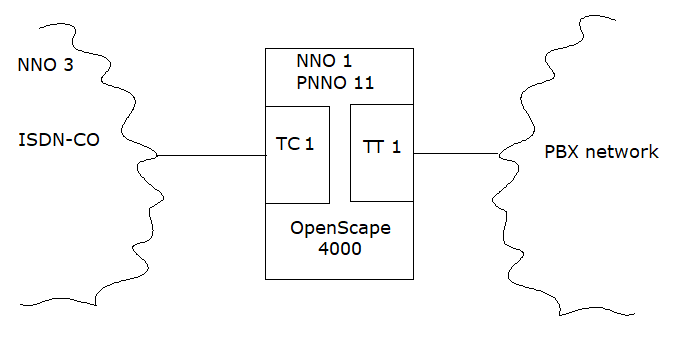
Configuration in physical node 11
- Set the node table:
ADD-KNDEF:NNO=1,TYPE=OWN,ISDNCC=49,ISDNAC=30,
ISDNLC=611,ISDNSK=3,ISDNUL=EXT,NODECD=96;NODECDSK=2;
- Set the node prefix table:
Even though only the node connection matrix is used for the modification of the calling number in this example, you must set the exit codes and prefixes with AMO KNPRE due to the conversation from explicit to implicit numbers and vice versa:
ADD-KNPRE:DPLN=0,NPI=ISDN,TON=INTERNAT,EXIT=0,PREFIX=00;

ADD-KNPRE:DPLN=0,NPI=ISDN,TON=NATIONAL,EXIT=0,PREFIX=0;

ADD-KNPRE:DPLN=0,NPI=ISDN,TON=SUBSCR,EXIT=0;
- Set the central system data:
CHANGE-ZAND:TYPE=ALLDATA,PNNO=1;
- Set of the digital trunk circuit TC:
ADD-BUEND:NO=30,TGRP=44;

ADD-TDCSU:OPT=NEW,DEV=VCCOD,BCGR=1,COTNO=11,COPNO=2,
TGRP=44,LCOSV=1, LCOSD=1,PROTVAR=EDSGER,NNO=3,ISDNIP=00,
ISDNNP=0;
- Set of the digital tie trunk TT1:
The node number does not have to be specified if it is transferred in this protocol.
ADD-BUEND:NO=30,TGRP=55;

ADD-TDCSU:OPT=NEW,DEV=S2CONN,BCGR=1,COTNO=11,COPNO=2,TGRP=55,
LCOSV=1,LCOSD=1,PROTVAR=ECMA1;
- LCR route configuration:
With AMO RICHT, you can set up LCR routes as shown in the examples above.With AMO LODR, you can configure the outdial rule for CO connections:
ADD-LODR:ODR=12,CMD=ECHO,FIELD=2; /* CO */

ADD-LODR:ODR=12,CMD=NPI,NPI=ISDN;

ADD-LODR:ODR=12,CMD=TON,TON=UNKNOWN;

ADD-LODR:ODR=12,CMD=END;
The outdial rule for tie line connections depends on whether the numbering is open or closed (see Chapter 36, "LCR (Least Cost Routing)").The outdial rules are assigned to the route elements with AMO LDAT.With AMO LDPLN, enter the route elements into the dial pattern plan:ADD-LDPLN:LDP=0-X,DPLN=0,LROUTE=...,LAUTH=1; /* CO */
- Set the node format table:
In this example, the central office should always demand a national number for the calling number. With AMO KNFOR, you thus make the following settings:
ADD-KNFOR:DNNO=3,NPI=ISDN;,TONOUT=NATIONAL,SCRE=NOTDEF;
- Set the node connection matrix:
To be able to modify ISDN or PNP numbers using KNMAT, you must know which format the number had before it was subjected to modification when both incoming and outgoing:
- The number of the incoming calling number contains exit codes and prefixes of the own node (Munich in the example; also see AMO KNPRE and AMO TDCSU). It always has an international, implicit format (e.g. 00049008907224711 for connections from Munich, 0004900303864711 for connections from Berlin, and 00041318184711 for connections from Zurich). With KNMAT, you can shorten the calling number by the superfluous part so that a dialable number remains (e.g. 07224711, 00303864711, 00041318184711).
- The number of the outgoing calling number for connections from the own node have the format entered in WABE (e.g. 4711). It is converted to an explicit format via the modification. In this example, the central office in Munich demands a national number so that the number is supplemented with 89722.
IMPORTANT:
If a certain format for a destination node is set using AMO KNFOR, you must convert the number to this format using the modification in AMO KNMAT.IMPORTANT:
In case of multi-level node numbers in a hierarchical network, enter the modification in the corresponding levels of the KNMAT (e.g. shortening of 00049 to Level 2, 0089 to Level 1, 0722 to Level 0).Commands:CHANGE-KNMAT:NPI=ISDN,LEVEL=0,ONNOL=OWN,DNNO=3,NUMEXT=89722; CHANGE-KNMAT:NPI=ISDN,LEVEL=0,ONNOL=OWN,DNNOL=ROW, NUMEXT=4989722; CHANGE-KNMAT:NPI=ISDN,LEVEL=0,ONNO=3,DNNOL=OWN, NUMRED=000490089; CHANGE-KNMAT:NPI=ISDN,LEVEL=0,ONNOL=ROW,DNNOL=OWN, NUMRED=00049;
The following setting results:------------------------------------------------------------------ NODE MATRIX FOR NPI = ISDN, LEVEL = 0, OWN NNO = 1 ------------------------------------------------------------------ ONNO |DNNO |CONN|MODCON| NUMEXT | NUMRED / ONNOL|/ DNNOL| | | | -------+-------+----+------+--------------------------+----------- 1 | 3 | A |ALL | 89722 | - 1 |ROW | A |ALL | 4989722 | - -------+-------+----+------+--------------------------+----------- 3 | 1 | A |ALL | | 000490089 -------+-------+----+------+--------------------------+----------- ROW | 1 | A |ALL | | 00049