5.21.2.3.3. Heterogeneous network with nodes that do not modify 


In this case, an OpenScape 4000/HiPath 4000 network (surrounded by
a dotted line in Figure 57)
is networked with nodes of the older versions Hicom 300 V3.4 or systems
of other manufacturers.
Figure 55. Example: Heterogeneous network with nodes that do not modify
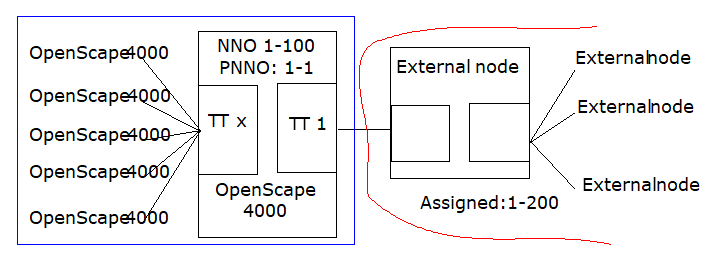
The external network is assigned its own area or node number. In the
example above, the external network is addressed from the OpenScape 4000
subnet with 1-200. Node number 1-200 is used for the configuration of
the LCR routes and for number modification in AMO KNMAT.
Configuration of tie trunk TT1:
Define a COT with parameter LINO (line with implicit number) and LWNC
(line without node number). The parameter DFNN (use preset node number
in the incoming direction) can be set if no reconstruction of the node
numbers is desired using dial analysis. A single node number (that is
set in AMO TDCSU, TACSU) is then assigned to the external network and
the numbers can no longer be modified for each external node.
ADD-COT:COTNO=12,PAR=LINO&LWNC&DFNN&...;
Assign this COT to the tie trunk and set the fictive node
number:
ADD-TDCSU:OPT=NEW,DEV=S2CONN,COTNO=12,
NNO=1-200,...;
Routes are also set up for this fictive destination node
number:
ADD-RICHT:MODE=LRTENEW,LRTE=103,LSVC=ALL,
NAME=UNKNOWN,TGRP=84,DNNO=1-200;
Configuration of the node connection matrix:
If, for example, the external system reaches Code 77 from the viewpoint
of the virtual node 1-100, set the following additional digits in Node
1-1:
CHANGE-KNMAT:NPI=UNKNOWN,LEVEL=0,ONNO=200,DNNOL=OWN,
NUMEXT=77;
Code 77 is thus placed before the numbers coming from
the external network at the entry node. In all other nodes, no modification
is set for the external network.