5.21.2.3.6. US EPNP network with overlapping L0 codes for extension, without
exit or prefixes 


Figure 59. US EPNP with overlapping L0 code/extension
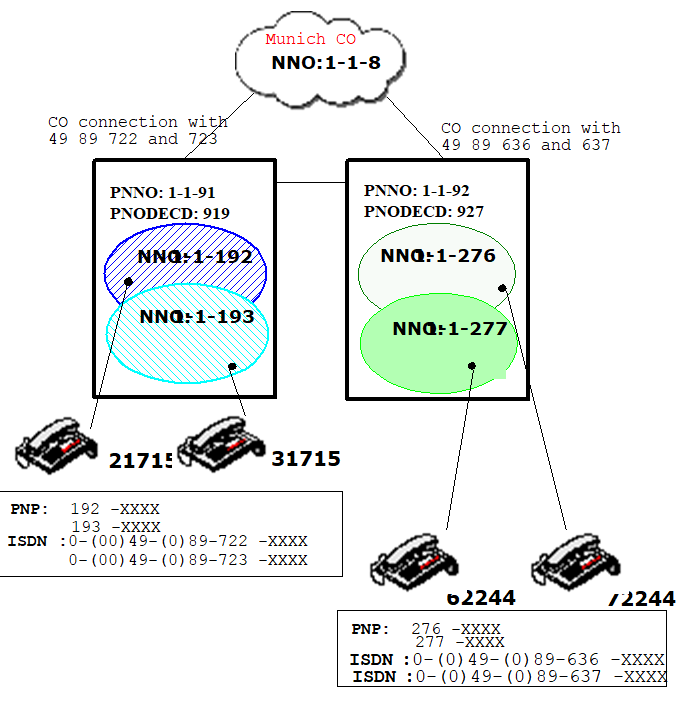
Here, a one-level PNP is used for internal network, as usual in the
U.S. networks. No exit or prefixes are used for PNP. It looks like a
OpenScape 4000 numbering plan and the configuration is a mixed form of
open numbering and PNP. Signaling takes place in PNP and both the called
party and information numbers should be transferred in LOCAL format.
In addition, the overlapping feature is shown between extensions and
L0 code. For PNNO 1-1-91, the customer has purchased two CO numbers with
extension 0 to 9999, 722 and 723. To cover the customer's extension
requirements of about 19,000, the customer has created an extension range
of 20000 to 29999 and 30000 to 39999 through the overlapping of the last
digit. The overlapping must thus also be transferred to the PNP.
Configuration in physical node 1-1-91
ADD-KNDEF:NNO=1-1-192,TYPE=OWN,

ISDNCC=49,ISDNAC=89,ISDNLC=722,ISDNSK=2,ISDNUL=EXT,

PNPLC=192,PNPSK=2,PNPUL=EXT;

CHANGE-KNDEF:NNO=1-1-192,DFLT=Y;
 ADD-KNDEF:NNO=1-1-193,TYPE=OWN,

ISDNCC=49,ISDNAC=89,ISDNLC=723,ISDNSK=2,ISDNUL=EXT,

PNPLC=193,PNPSK=2,PNPUL=EXT;
The subscribers are assigned to the virtual node, whereby
only the ones that are not in the default node must be explicitly configured.
CHANGE-SDAT:STNO=21715,TYPE=DATA1,NNO=1-1-192;

CHANGE-SDAT:STNO=31715,TYPE=DATA1,NNO=1-1-193;
The subscribers are normally set up as subscribers in
WABE, whereby the overlapping digit belongs to the extension, i.e. 21716
and 31715.
Set the node prefix table:
ADD-KNPRE:NPI=ISDN,TON=INTERNAT,EXIT=0,PREFIX=00;

ADD-KNPRE:NPI=ISDN,TON=NATIONAL,EXIT=0,PREFIX=0;

ADD-KNPRE:NPI=ISDN,TON=SUBSCR,EXIT=0;
For PNP, no entry may be made since no exit or prefixes
are used for processing.
You can set the format of the outgoing information number in KNFOR.
ADD-KNFOR:DNNO=1-1-276,NPI=PRIVATE,TONOUT=LOCAL;

ADD-KNFOR:DNNO=1-1-277,NPI=PRIVATE,TONOUT=LOCAL;
If information numbers should also be displayed with L0
code in the own node, use this command: This only effects the number
transferred in the network, however, not for internal calls:
ADD-KNFOR:DNNO=1-1-192,NPI=ISDN,TONIN= LOCAL;

ADD-KNFOR:DNNO=1-1-193,NPI=ISDN,TONIN= LOCAL;
In the digit analysis, forward the local code of the partner
to the TIE digit analysis result. Normally, the PNP exit is referred
to TIE here, but since there is no exit, the local code is configured
like a tie line code of the OpenScape 4000 UNKNOWN numbering plan.
ADD-WABE:CD=276,DAR=TIE;

ADD-WABE:CD=277,DAR=TIE;
When needed, you can set up the own local codes as OWNNODE.
In contrast to open numbering, this entry is not required in the UNKNOWN
station for incoming calls through the network since the called party
is shortened via the AMO KNDEF table in case of network-wide calls. They
cannot enable dialing with codes for subscribers, however, which is recommended
for a constellation with two virtual nodes. Subscriber 21715 can thus
reach Subscriber 31715 by dialing 31715 or 1931715. The skip digits are
not specified in WABE; they are automatically determined from the entries
in the AMO KNDEF table.
ADD-WABE:CD=192,DAR=OWNNODE;

ADD-WABE:CD=193,DAR=OWNNODE;
 ADD-LDPLN:LDP=276-X,LROUTE=1408,...;

ADD-LDPLN:LDP=277-X,LROUTE=1308,...;
For the transfer of the called party (and thus the information
numbers) in PNP, you need a relevant outdial rule.
ADD-LODR:ODR=60,CMD=NPI,NPI=PRIVATE,TON=LOCAL;
 ADD-LODR:ODR=60,CMD=ECHO,FIELD=1;
 ADD-LODR:ODR=60,CMD=ECHOALL;
 ADD-LODR:ODR=60,CMD=END;
Define routes with the virtual node of the partner as
the target node and assign the outdial rule.
ADD-RICHT:MODE=LRTENEW,LRTE=1408,...,DNNO=1-1-276;

ADD-RICHT:MODE=LRTENEW,LRTE=1308,...,DNNO=1-1-277;


 ADD-LDAT:LROUTE=1408,.., ODR=60;

ADD-LDAT:LROUTE=1308,.., ODR=60;
Comment: If you do not want to transfer the called party
in local format, but rather as an extension in subsystem and if you also
want to use the overlapping of the local code for an extension, observe
the following: The outdial rule must divide the dial pattern into fields
in such a way that the specification of a field for the extension is
possible in the outdial rule. For this purpose, the check in AMO LDPLN
was changed so that a splitting of the local code into skip digits and
overlapping portion is now possible as well.
ADD-LDPLN:LDP=27-X,LROUTE=1408,...;

 /* The 6 of local code 276 is a part of Field 2 */
The corresponding outdial rule would be:
ADD-LODR:ODR=60,CMD=NPI,NPI=PRIVATE,TON=UNKNOWN;
 ADD-LODR:ODR=60,CMD=ECHO,FIELD=2;
 ADD-LODR:ODR=60,CMD=ECHOALL;
 ADD-LODR:ODR=60,CMD=END;
The number modification takes place with data from AMO
KNDEF.
Service information
- No settings for KNMAT are required.
- In this example, the overlapping digits between NPI ISDN and PRIVATE must be identical.
- The digit pattern for the connection between the systems in PNP must possible be set up individually for the overlapping digits.
Configuration in physical node 1-1-92
The physical node 1-1-92 is configured analogously to 1-1-91.