5.21.2.3.5. Three-level, open-numbered network/one-level OpenScape 4000 specific
numbering plan, overlapping virtual nodes with ambiguous extensions 


This example should show that a network with overlapping nodes can
also only be configured with open numbering. This has the advantage that
the extensions do not have to be unique3 throughout the network.
IMPORTANT:
Rule: Extensions, however, have to be unique
for each physical node and each virtual node!
- The following configuration is thus valid (with Station: 4711):
Figure 58. Non-unique extensions in the network
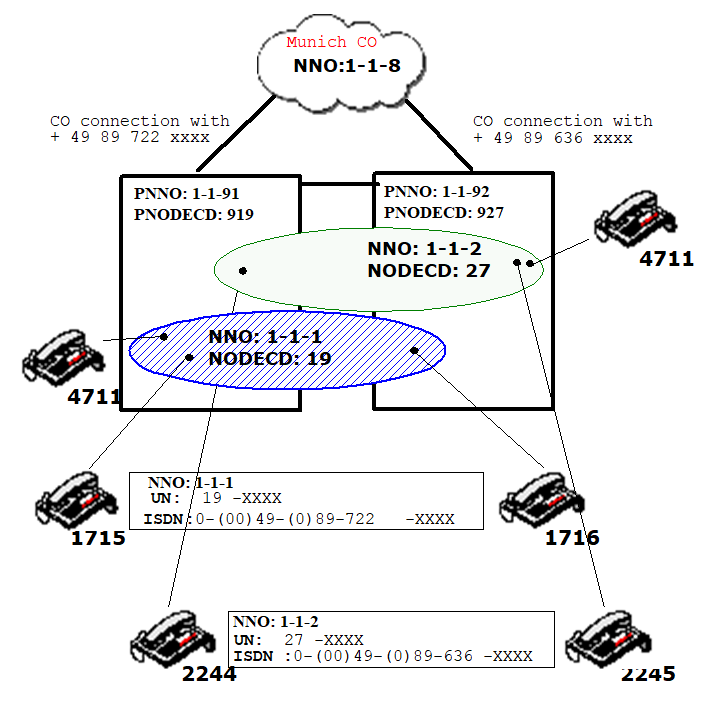
- The configuration of 4711 to VNNO 1-1-2 and PNNO: 1-1-91 or of 4711 to VNNO 1-1-1 and PNNO 1-1-92, on the other hand, is not valid.
Both subscribers 4711 (in NNO 1-1-1 and PNNO 1-1-91 and in NNO 1-1-2 and
PNNO 1-1-92) are permissible, but not unique throughout the network!
Uniqueness is achieved only with their ISDN L0 codes. This leads us to
the concept of the lowest unique level. The lowest unique level of the
ISDN number is the subscriber level. This effects calls from other networks,
for example. Let's assume that there is a further network, e.g.
with nodes in other areas, only via Node 1-1-91 (1-1-92 can only be reached
as a transit node via 1-1-91). The called party may not be shortened
below the lowest unique level. The called party 49 89 636 4711 would
otherwise be incorrectly identified, namely as a subscriber of the transit
node.
The configuration is based on the basic principle that the digit analysis
can provide no general statement as to whether a number that consists
of more than one extension refers to an internal or external destination.
For this reason, the first digit analysis procedure always refers to
TIE to evaluate the dial plan. TIE can analyze the entire number and
process the number and transfer a second digit analysis procedure in
case of the recognition of an internal destination or determine an external
destination. Losses in performance, however, occur due to this loop.
Configuration in physical node 1-1-91
Due to non-unique extensions, a change must be made in AMO KNDEF. The ISDN unique
level
must be raised from the station to the subscriber. From the point of view of the software,
you thus prevent the called party from being shortened in the device handler under
the
subscriber level. At the same time, however, you must then set up the dial plan in
such a
way that called parties can be analyzed in subscriber format.
ADD-KNDEF:NNO=1-1-1,TYPE=OWN,ISDNCC=49,ISDNAC=89,
ISDNLC=722,ISDNSK=3,ISDNUL=EXT,NODECD=19,NODECDSK=2;

CHANGE-KNDEF:NNO=1-1-1,DFLT=Y;

ADD-KNDEF:NNO=1-1-2,TYPE=OWN,ISDNCC=49,ISDNAC=89,
ISDNLC=636,ISDNSK=3,ISDNUL=EXT,NODECD=27,NODECDSK=2;
The subscribers are assigned to the virtual node, whereby only the ones that are not
in the
default node must be explicitly configured.
CHANGE-SDAT:STNO=1715,TYPE=DATA1,NNO=1-1-1;

CHANGE-SDAT:STNO=2244,TYPE=DATA1,NNO=1-1-2;
/* Expl. conf. reqd.*/

CHANGE-SDAT:STNO=4711,TYPE=DATA1,NNO=1-1-1;
The subscribers are usually set up as a subscriber in WABE .
As usual, set the node prefix table using AMO KNPRE, and enter the own physical node
number
and code in the ZAND data and the own physical code in AMO WABE Enter DAR=OWNNODE.
Virtual codes 19 and 27 may not be entered as OWNNODE, but rather as TIE so that the
dial
plan analysis can be transferred. The reason for this is the same as for the determination
of the lowest unique level for ISDN numbers: OWNNODE is used to shorten the called
party.
Since 4711 is only unambiguous due to his or her tie line code, however, it may not
fit in a
transit node. Of the entire called party, the dial plan can recognize whether a certain
call
is internal or external.
ADD-WABE:CD=19,DAR=TIE;/*NODECD*/

ADD-WABE:CD=27,DAR=TIE;/*NODECD*/
Set CO exit codes in WABE:
ADD-WABE:CD=0,DAR=TIE;
You can set up the trunk groups for direct CO connection, the trunk circuit, and the
tie
trunk as show in the previous examples.
Set up tie routes, outdial rules, and route elements for the ISDN numbering plan in
the
normal manner. Routes are required for each virtual destination node, however, as
shown
above. The dial plan is shown here. The specified entries are absolutely necessary.
Entries
for a selection of the internal or external subscribers in national or international
format
may continue to be necessary.
ADD-LDPLN:LDP=0-722-X,LROUTE=route to own node 1-1-1;
This route aims at the own "normal" subscriber of the default node. It may receive
only one
route element for which the RERTEINT attribute is set. The outdial rule may contain
only the
extension.
ADD-LDPLN:LDP=0-722-1716,LROUTE=route to partner node 1-1-1;
These routes really lead to the outside and aim at the "exception subscriber," Subscriber
1716 who moved.
ADD-LDPLN:LDP=0-636-X,LROUTE=route to partner node 1-1-2
These routes are the configuration for the "normal" subscriber on the partner node
and
really lead to the outside.
ADD-LDPLN:LDP=0-636-2244,LROUTE=route to own node 1-1-2
This route only applies for the "exception subscriber" 2244, who has moved here. The
route
may receive only one route element for which the RERTEINT attribute is set. The outdial
rule
may contain only the extension.
Set the tie route, outdial rules, route elements for the UNKNOWN numbering plan as
usual.
Routes are required for each destination node, however, as shown above. The dial plan
is
shown here. The specified entries are absolutely required. Entries for a selection
of the
internal or external subscribers in national or international format may continue
to be
necessary.
ADD-LDPLN:LDP=19-X,LROUTE=route to own node 1-1-1;
This route aims at the own "normal" subscriber of the default node. It may receive
only one
route element for which the RERTEINT attribute is set. The outdial rule may contain
only the
extension.
ADD-LDPLN:LDP=19-1716,LROUTE=route to partner node 1-1-1;
These routes really lead to the outside and aim at the "exception subscriber," Subscriber
1716 who moved.
ADD-LDPLN:LDP=27-X,LROUTE=route to partner node 1-1-2
These routes are configuration for the "normal" subscriber on the partner node and
really
lead to the outside.
ADD-LDPLN:LDP=27-2244,LROUTE=route to own node 1-1-2
This route only applies for the "exception subscriber" 2244, who has moved here. The
route
may receive only one route element for which the RERTEINT attribute is set. The outdial
rule
may contain only the extension.
You must set the node connection matrix only for the UNKNOWN numbering plan according
to
the rules in Section
41.2.1.5, "Source/destination-dependent number modification in the ISDN or PNP numbering
plan". The use of ##### for the specification of the digits to be
supplemented or abbreviated in combination with the logical NNO OWN extracts all virtual
nodes and their codes from AMO KNDEF:
CHA-KNMAT:NPI=UNKNOWN,LEVEL=0,ONNOL=OWN,DNNOL=ROW,
NUMEXT=#####;

CHA-KNMAT:NPI=UNKNOWN,LEVEL=0,ONNOL=ROW,DNNOL=OWN,
NUMRED=#####;
The following setting results:
----------------------------------------------------------------
NODE MATRIX FOR NPI = UNKNOWN, LEVEL = 0
----------------------------------------------------------------
ONNO   |DNNO   |CONN|MODCON| NUMEXT                 | NUMRED
/ ONNOL|/ DNNOL|    |      |                        |
-------+-------+----+------+------------------------+-----------
  1    |ROW    | A  |ALL   | 19                     | -
  2    |ROW    | A  |ALL   | 27                     | -
-------+-------+----+------+------------------------+-----------
  ROW  | 1     | A  |ALL   | -                      | 19
  ROW  | 2     | A  |ALL   | -                      | 27
Configuration in physical node 1-1-92
Analogously to 1-1-92