5.36.3.3.6. Brief Description of 2-Level LCR 


LCR level 1 - internationalization
Location-dependent modification:
The station number dialed is transformed into a unique international
station number using source groups based on reroute internal.
Dialed station number -> international station number transformation
The station number dialed is converted to an international station
number in accordance with the entries in the AMO KNPRE and the AMO KNDEF:
Format definition:
- Exit code (no prefix (PF)) = local area
- Exit code + national prefix (no international prefix) = national
- Exit code + international prefix = international
The station number dialed is extended to an international ISDN station
number by prefixing it with the exit code, the international prefix,
the relevant country code, and, in the case of local calls, with the
relevant area code. Dialed prefixes are left out.
Example:
|
Exit code
|
= 0
|
|
National prefix
|
= 0
|
|
International prefix
|
= 00
|
|
Country code
|
= 49
|
|
Area code
|
= 30
|
|
Digit Pattern
|
-> Modification
|
|
0-W-0-X
|
-> 0 00 49 + X
|
|
0-W-X
|
-> 0 00 49 30 + X
|
Definition for this example:
|
Local station number
|
-> LODR /LRTE 1xx, LPROF 1
|
The LRTE and LODR values 1xx (100 to 199)
are used to extend local station numbers. They are summarized in LPROF
1.
|
National number
|
-> LODR /LRTE 2xx, LPROF 2
|
The LRTE and LODR values 2xx (200 to 299)
are used to internationalize national numbers. They are summarized in
LPROF 2.
LCR level 2 - routing
Source-based routing:
The international station number is routed to the destination, depending
on the source group.
Routing international numbers
Internal station numbers are routed back to the local node based on
reroute internal. The other station numbers are routed individually dependent
on the source group.
Internal routing:
- Standard with LRTE 300
- Reserved for special cases: LRTE 3xx (301 - 399)
External routing (dependent on the source group):
General outdial rules:
- 400 - for international destinations (4xx reserved for special cases)
- 500 - for national destinations (5xx reserved for special cases)
LCR routes:
- International destinations with LRTE 4xx (401 – 499)
- National destinations with LRTE 5xx (501 – 599)
LCR profile for international destinations:
LPROF 3 - contains only LRTG 4xx - for international destinations.
No local breakout.

LCR profiles per
country with CO breakout for national destinations:
Depending on the breakout country, LPROF 4 and those that follow contain
a combination of LRTE 4xx for international destinations and 5xx for
destinations within the local country.



Example
LCR level 1:
An LCR route is required for each local area network so as to convert
the dialing of local area codes into a unique international station number.
Since this station number is immediately to pass through LCR again
if it originates from LCR, it is not modified by the AMO KNPRE. This
is why the destination number must be entered implicitly in the outdial
rule, in other words, with an exit code and international prefix.
The following figure shows the digits to be expanded per location
or country. The small boxes containing numbers represent the source
groups.
Local numbers use the 100 outdial rules and LCR routings, national
number use the 200 outdial rules.
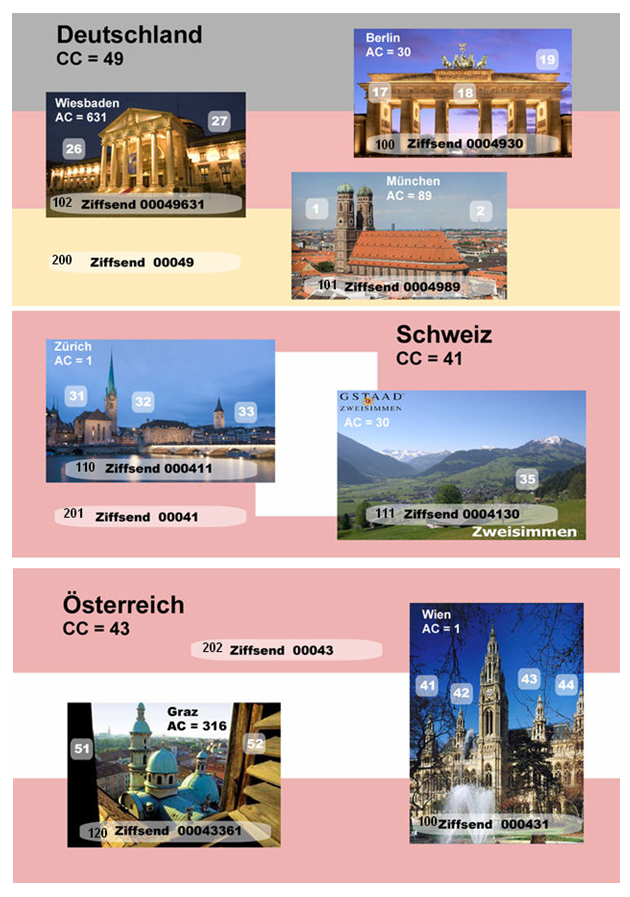
The diagram shows which
source group belongs to which local area and which digits are to be added
when dialing the local or national network.
For the remaining configuration, we will only consider "our own network"
to begin with.
Let's begin with the configuration of the outdial rules for reroute
internal: (With exit code and international prefix)
Outdial rules 1xx (100 -199) are provided for modifying local station
numbers:
- Outdial rule 100 for Berlin:
ADD-LODR:ODR=100,CMD=OUTPULSE,DGTS=0004930;

ADD-LODR:ODR=100,CMD=ECHO,FIELD=3;

ADD-LODR:ODR=100,CMD=NPI,NPI=ISDN,TON=UNKNOWN;

ADD-LODR:ODR=100,CMD=END;

ADD-LODR:ODR=100,INFO="LODR for Berlin";
- Outdial rule 101 for Munich
ADD-LODR:ODR=101,CMD=OUTPULSE,DGTS=0004989;

ADD-LODR:ODR=101,CMD=ECHO,FIELD=3

ADD-LODR:ODR=101,CMD=NPI,NPI=ISDN,TON=UNKNOWN;

ADD-LODR:ODR=101,CMD=END;

ADD-LODR:ODR=101,INFO="LODR for Munich";
- Outdial rule 102 for Wiesbaden
ADD-LODR:ODR=102,CMD=OUTPULSE,DGTS=00049631;

ADD-LODR:ODR=102,CMD=ECHO,FIELD=3;

ADD-LODR:ODR=102,CMD=NPI,NPI=ISDN,TON=UNKNOWN;

ADD-LODR:ODR=102,CMD=END;

ADD-LODR:ODR=102,INFO="LODR for Wiesbaden";
We use the 2xx (200 – 299) outdial rules to modify national station numbers: - Outdial rule 200 for Germany:
ADD-LODR:ODR=200,CMD=OUTPULSE,DGTS=00049;

ADD-LODR:ODR=200,CMD=ECHO,FIELD=4;

ADD-LODR:ODR=200,CMD=NPI,NPI=ISDN,TON=UNKNOWN;

ADD-LODR:ODR=200,CMD=END;

ADD-LODR:ODR=200,INFO="LODR FOR Germany";
LCR route configuration:
One LCR route is required per city. We use the numbers of the outdial
rule as an index for the LRTE. (1xx = 100 – 199)
ADD-RICHT:MODE=LRTENEW,LRTE=100,LSVC=ALL,
NAME="City Berlin",TGRP=6,DNNO=1-1-199;

ADD-RICHT:MODE=LRTENEW,LRTE=101,LSVC=ALL,
NAME="City Munich",TGRP=5,DNNO=1-1-199;

ADD-RICHT:MODE=LRTENEW,LRTE=102,LSVC=ALL,
NAME="City Wiesbaden",TGRP=7,DNNO=1-1-199;

ADD-LDAT:LROUTE=100,TGRP= 6,ODR=100,LAUTH=1,LATTR=RERTEINT;

ADD-LDAT:LROUTE=101,TGRP= 5,ODR=101,LAUTH=1,LATTR=RERTEINT;

ADD-LDAT:LROUTE=102,TGRP= 7,ODR=102,LAUTH=1,LATTR=RERTEINT;
An LCR route is also required for all countries (LRTE 2xx = 200 – 299):
ADD-RICHT:MODE=LRTENEW,LRTE= 200,LSVC=ALL,
NAME="Germany",TGRP=5,DNNO=1-1-299;

ADD-LDAT:LROUTE=200,TGRP= 5,ODR=200,LAUTH=1,LATTR=RERTEINT
We now come to the source-dependent LCR:
The LCR routes are summarized in LCR profiles. Each source group is assigned an LCR
route.
Reminder:
We have already made the following assignments:
|
Node
|
Source group
|
Local area
|
Local area Ã▪ LRTE
|
|
1-1-5
|
1
|
Munich
|
101
|
|
1-1-6
|
17
|
Berlin
|
100
|
|
1-1-7
|
26
|
Wiesbaden
|
102
|
|
1-1-8
|
2
|
Munich
|
101
|
We use LCR profile 1 to modify local station numbers:
ADD-LPROF:PROFNAME="SUBSCR TO INTERNAT",SRCGRP=1,
LRTE= 101,PROFIDX=1;

CHANGE-LPROF:PROFIDX=1,SRCGRP=2,LRTE=101;

CHANGE-LPROF:PROFIDX=1,SRCGRP=17,LRTE=100;

CHANGE-LPROF:PROFIDX=1,SRCGRP=26,LRTE=102;
We use LCR profile 2 to modify national
station numbers:
ADD-LPROF:PROFNAME="NATIONAL TO INTERNAT",SRCGRP=1,
LRTE= 200,PROFIDX=2;

CHANGE-LPROF:PROFIDX=2,SRCGRP=2,LRTE=200;

CHANGE-LPROF:PROFIDX=2,SRCGRP=17,LRTE=200;

CHANGE-LPROF:PROFIDX=2,SRCGRP=26,LRTE=200;
LCR level 1 will be complete as soon as the selected station numbers are assigned
to the LCR
profiles. The LCR required for this purpose can be derived from the AMO KNPRE:
- The exit code is "0".
- The national prefix is "0".
- The international prefix is "00".
If the ISDN exit code is now dialed and neither of the prefixes, then
a local station number is dialed. The associated digit pattern
is assigned to LCR profile 1:
ADD-LDPLN:LCRCONF=LCRPATT,DIPLNUM=0,LDP=0-W-X,
PROFIDX=1,LAUTH=1;
If the ISDN exit code is dialed, followed by the national prefix, but not by the international
prefix, then a national station number is dialed. LCR profile 2 is used for the
dialing process in this case:
ADD-LDPLN:LCRCONF=LCRPATT,DIPLNUM=0,LDP=0-W-0-X,
PROFIDX=2,LAUTH=1;
LCR level 1 is now fully generated. The international station number is evaluated
in LCR level
2.
LCR level 2:
Only station numbers in international format are evaluated in level
2. They have the same destination worldwide.
The following routing rules are defined for configuring LCR level
2:
- If the destination is an internal virtual node, the station number is routed back to the local node based on reroute internal.
- External breakout is always performed via the local trunk. A separate LCR is required for each source group in this case.
As some carriers do not permit national dialing with international station
numbers, an additional LCR configuration is required here.
The following routes should be covered by LCR level 2:
1. Internal destinations:
A single LRTE route is initially sufficient for all source groups
(see also Configuring "1.
Internal destinations")
2. External international destinations:
This requires a separate LRTE for each source group, combined in a
shared LCR profile.
3. External national destinations:
As certain carriers or countries do not permit connections to national
destinations using the international number format, a separate LCR configuration
per source group is also required for national destinations. A separate
LCR profile is then created for each country, in which the LCR routes
for national and international destinations are used accordingly.
In order to prevent confusion between LCR level 1 and level 2, we
will define in our example that the LRTE routes 300 – 399 should
be used for reroute internal. For international destinations we will
use LCR routes 400-499, and for national destinations LCR routes 500-599.
Configuring "1. Internal destinations"
- Configuring an outdial rule
Here we can use the general outdial rule for international destinations. To ensure uniform numbering, we will configure the outdial rule 300 for general reroute internal:
ADD-LODR:ODR=300,CMD=ECHO,FIELD=4;
ADD-LODR:ODR=300,CMD=ECHOALL;
ADD-LODR:ODR=300,CMD=NPI,NPI=ISDN,TON=INTERNAT;
ADD-LODR:ODR=300,CMD=END;
ADD-LODR:ODR=300,INFO="LODR FOR REROUTE INTERNAL";
- Configuring LRTE 300 for general reroute internal:
ADD-RICHT:MODE=LRTENEW,LRTE=300,LSVC=ALL,
NAME="SRC01 RERT INT",DNNO=1-1-195;

ADD-LDAT:LROUTE=501,ODR=300,LAUTH=1,LATTR=RERTEINT;
- Configuring LDPLN entries for the internal E.164 station numbers:
ADD-LDPLN:LCRCONF=LCRPATT,DIPLNUM=0,LAUTH=1,
LDP=0-W-00-49-89-7221-X,LROUTE=300,LAUTH=1;

ADD-LDPLN:LCRCONF=LCRPATT,DIPLNUM=0,LAUTH=1,
LDP=0-W-00-49-30-38645-X,LROUTE=300,LAUTH=1;

ADD-LDPLN:LCRCONF=LCRPATT,DIPLNUM=0,LAUTH=1,
LDP=0-W-00-49-631-7974-X,LROUTE=300,LAUTH=1;

ADD-LDPLN:LCRCONF=LCRPATT,DIPLNUM=0,LAUTH=1,
LDP=0-W-00-49-89-636123-X,LROUTE=300,LAUTH=1;
Internal availability via ISDN station numbers is now ensured. - Configuring outdial rules
As every source group uses different trunks for CO breakout, each source group requires separate LCR routes. As the outdial rules are usually the same for all LROUTES, it makes sense to share their usage.We have defined that we want to use LCR routes 400-499 for international destinations and routes 500-599 for national destinations.In the description that follows, we will use the numbers 400 and 500 for the general outdial rules and the LROUTES 4xx and 5xx for the LCR routes (xx represents the source group. This results in the LROUTE numbers 401 to 599).Defining the required outdial rules:
- Outdial rule 400 will be the general outdial rule for sending an explicit international E.164 station number.
- Outdial rule 500 will be the general outdial rule for sending an explicit national station number, which is necessary for destinations within the local country.
Additional information on assigning outdial rules:If other provisions apply for particular carriers or countries, the corresponding outdial rules 3xx and 4xx are kept free to enable the relevant outdial rules to be used for national and international station numbers.- Configuring an outdial rule for international dialing:
ADD-LODR:ODR=400,CMD=ECHO,FIELD=4;
ADD-LODR:ODR=400,CMD=ECHOALL;
ADD-LODR:ODR=400,CMD=NPI,NPI=ISDN,TON=INTERNAT;
ADD-LODR:ODR=400,CMD=END;
ADD-LODR:ODR=400,INFO="LODR INTERNATIONAL";
- Configuring the outdial rule for national
dialing:
ADD-LODR:ODR=500,CMD=ECHO,FIELD=5;

ADD-LODR:ODR=500,CMD=ECHOALL;

ADD-LODR:ODR=500,CMD=NPI,NPI=ISDN,TON=NATIONAL;

ADD-LODR:ODR=500,CMD=END;

ADD-LODR:ODR=500,INFO="LODR NATIONAL for INTERNATIONAL NUMBERS";
- Configuring LCR routes:
- LRTE numbers 4xx (401 to 499) are used for connections to external international
destinations.
ADD-RICHT:MODE=LRTENEW,LRTE=401,LSVC=ALL,,
NAME="SRC01 INTERNAT",TGRP=5,DNNO=1-1-195;

ADD-RICHT:MODE=LRTENEW,LRTE=402,LSVC=ALL,,
NAME="SRC02 INTERNAT",TGRP=8,DNNO=1-1-198;

ADD-RICHT:MODE=LRTENEW,LRTE=417,LSVC=ALL,,
NAME="SRC17 INTERNAT",TGRP=6,DNNO=1-1-196;

ADD-RICHT:MODE=LRTENEW,LRTE=426,LSVC=ALL,,
NAME="SRC26 INTERNAT",TGRP=7,DNNO=1-1-197;
- The subscriber's own trunk group is seized directly and the international station
number
(LODR 400) is
transmitted.
ADD-LDAT:LROUTE=401,TGRP=5,ODR=400,LAUTH=1;

ADD-LDAT:LROUTE=402,TGRP=8,ODR=400,LAUTH=1;

ADD-LDAT:LROUTE=417,TGRP=6,ODR=400,LAUTH=1;

ADD-LDAT:LROUTE=426,TGRP=7,ODR=400,LAUTH=1;
- The 5xx LRTE numbers (501 to 599) are used for connections to external national
destinations.
ADD-RICHT:MODE=LRTENEW,LRTE=501,LSVC=ALL,
NAME="SRC01 INLAND",TGRP=5,DNNO=1-1-195;

ADD-RICHT:MODE=LRTENEW,LRTE=502,LSVC=ALL,,
NAME="SRC02 INLAND",TGRP=8,DNNO=1-1-198;

ADD-RICHT:MODE=LRTENEW,LRTE=517,LSVC=ALL,,
NAME="SRC17 INLAND",TGRP=6,DNNO=1-1-196;

ADD-RICHT:MODE=LRTENEW,LRTE=526,LSVC=ALL,,
NAME="SRC26 INLAND",TGRP=7,DNNO=1-1-197;
- The subscriber's own trunk group is seized directly and the national station number
(LODR
500) is
transmitted.
ADD-LDAT:LROUTE=501,TGRP=5,ODR=500,LAUTH=1;

ADD-LDAT:LROUTE=502,TGRP=8,ODR=500,LAUTH=1;

ADD-LDAT:LROUTE=517,TGRP=6,ODR=500,LAUTH=1;

ADD-LDAT:LROUTE=526,TGRP=7,ODR=500,LAUTH=1;
Once the LCR routes have been configured, these are assigned to the LCR profiles.
- LRTE numbers 4xx (401 to 499) are used for connections to external international
destinations.
- Configuring the LCR profile
The simplest LCR profile is for connections to countries in which there is no separate CO breakout, but rather just general international breakout.As LCR profiles 1 and 2 have already been used for general modification in LCR level 1, we will use LCR profile 3 for the general international breakout, and assign this profile the corresponding 4xx LRTE numbers:
ADD-LPROF:PROFNAME="INTERNAT DIRECT",SRCGRP=1,
LRTE=401,PROFIDX=3;

CHANGE-LPROF:PROFIDX=3,SRCGRP=2,LRTE=402;

CHANGE-LPROF:PROFIDX=3,SRCGRP=17,LRTE=417;

CHANGE-LPROF:PROFIDX=3,SRCGRP=26,LRTE=426;
For every country where CO breakout is available, an additional LCR profile is required for national destinations. As we have defined that CO breakout should always be performed from the local CO, a separate LCR profile is required for every destination country for this purpose, comprising an individual combination of national and international LCR routes.Our example only includes breakouts in Germany. As a result, we require an LCR profile with uniform national destinations:LCR profile 4 is for external destinations in Germany (LRTE 5xx for direct breakout to the national network):ADD-LPROF:PROFNAME="CO GERMANY",SRCGRP=1,LRTE=501,PROFIDX=4; CHANGE-LPROF:PROFIDX=4,SRCGRP=2,LRTE=502; CHANGE-LPROF:PROFIDX=4,SRCGRP=17,LRTE=517; CHANGE-LPROF:PROFIDX=4,SRCGRP=26,LRTE=526;