192
TGER - Allocation of Subscriber Devices for Incoming Calls
Interrelationships
Parameter Description
Functions of the AMO
Error Messages and Advisories
The AMO TGER allocates non-voice devices, which are configurated byres for AMO
SCSU
/
SBCSU
, for incoming seizures. Thus one device can be called by more than one directory number.
Example
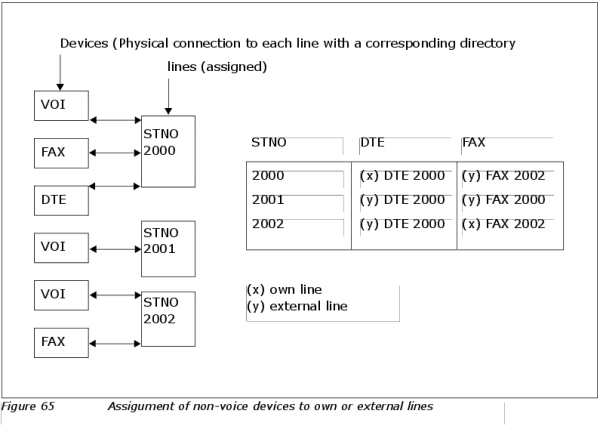
A non-voice device can be seized incoming on another line, as well as both incoming and outgoing on its own line (see example):
•
The FAX device at line 2000 is reached incoming via STNO 2001 because STNO 2001 is allocated the FAX having line number 2000 in the FAX column.
•
The FAX device at line 2002 can be reached incoming via its own line (under STNO 2002) as well as via an external line (under STNO 2000, in accordance with the allocation).
•
The DTE device at line 2000 can be reached incoming via its own line (under STNO 2000) as well as via an external line (under STNO 2002).
Following own or external lines may not be changed or regenerated by AMO TGER:
•
the allocation at the own line for ANATE&FAX, ANATE&DTEA
•
the allocation at th own line for a hunting group master
•
the allocation at the own line for S0
•
the association of a DCI (which is done by AMO
DCIC
)
•
the allocation of a SSCSU special subscriber (e.g. extension lines) as a station or device number.
OpenScape 4000 V10, Volume 1: AMO Descriptions, Service Documentation, Issue 20
, ID:
P31003H31A0S107207620
©
05/2026
Mitel Networks Corporation. - All rights reserved.
Mitel and the Mitel logo are trademarks of Mitel Networks Corporation. Unify and associated marks are trademarks of Unify Software and Solutions GmbH&Co. KG. All other trademarks herein are the property of their respective owners.