10.2.2.2. Configuring a “Direct Link“ Access Point 


Figure 180. Configuring a “Direct Link“ access point
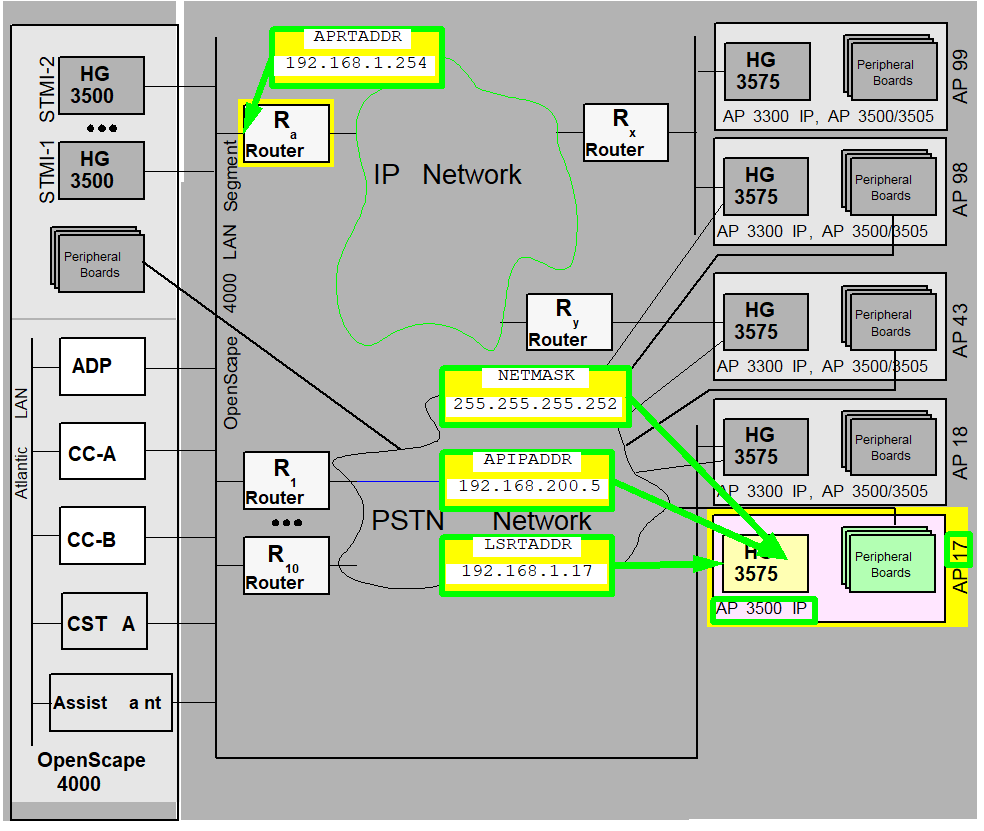
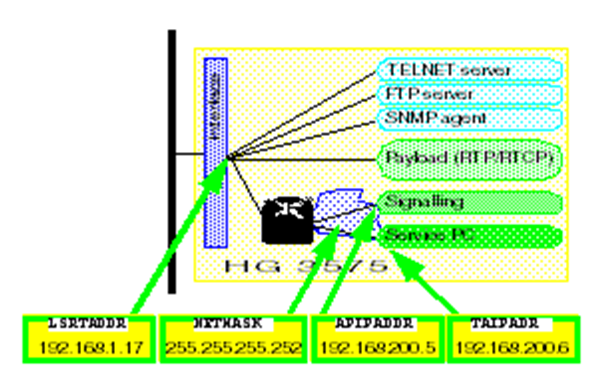
Figure 181. Internal address assignment of a “direct link“ access point
ADD-UCSU: |
UNIT=AP, |
LTU=17, |
LTPARTNO=Q2302-X10 |
SRCGRP=1, |
|
FRMTYPE=INCH19, |
CONNTYPE=APDL, |
|
LSRTADDR=192.168.1.17, |
APRTADDR=192.168.1.254, |
|
LOCID=1, |
LOCATION=“MCH MACHTLFINGERSTR.1 GEB.
7202-111”, |
|
PHONE=08972223456, |
FAX=08972265432, |
|
PLCHECK=YES, |
BCHLCNT=20, |
|
CONVLAW=NO; |
||
ADD-APRT: |
TYPE=APNET, |
LTU=17, |
APIPADDR=192.168.200.5, |
NETMASK=255.255.255.252; |
In the case of a “direct link“ access point, the Ethernet port
of the access point is connected directly to the OpenScape 4000 LAN segment
and can be reached from CC-A and CC-B without a router.
However, the signaling survivability feature requires the re-routing
of a link in the event of a fault (from LAN to modem). In order for this
to function, the access point may not be “logically“ present in the
OpenScape 4000 LAN segment. In this case, a router is activated within
the access point which forwards the packets from the OpenScape 4000 LAN
to the “logical“, internal address of the access point.
To this end, the access point contains a “logical“ IP network
in which only itself and possibly the TAP/Service PC connection have
an address. In order to save addresses, the netmask 255.255.255.252 can
be used for this address.
Even these mini-networks and their addresses must be coordinated with
the customer’s network administrator and, obviously, may not overlap.
Figure 15 “Configuring a “Direct Link“ access point”
shows the following fundamental information required for configuring
a direct link access point:
- The fact that the access point is linked with the OpenScape 4000 LAN segment: Link type APDL, i.e. “direct link“.
- The LTU number of the access point, i.e. 17.
- The LTU part number specifies the HG 3575 used.
- The access point’s shelf type is derived from the type designation.
- The internal IP address of the access point: 192.168.200.5.
- The IP address for the TAP/Service PC link at the access point: 192.168.200.6.
- The IP address of the own Ethernet port via which the AP17 accesses the OpenScape 4000 LAN segment: 192.168.1.17.
- The netmask in the internal segment of the AP17: 255.255.255.252.
- The IP address of the router (port) at the OpenScape 4000 LAN segment, via which the AP17 can reach access points which cannot be accessed directly at the OpenScape 4000 LAN segment (that is “networked“ APs), in this case router Ra: 192.168.1.254. This router is omitted if there are no networked APs in the entire configuration or if this is an isolated demo installation. The default router must be configured with the zero address 0.0.0.0.
- By limiting the number of B-channels, the bandwidth available to AP99 is indirectly reduced in the configuration example. This mechanism works independently of the bandwidth limitation performed by the Resource Manager in the “Large Enterprise Gatekeeper” Feature. For further information, please refer to Chapter 3, “Load Calculation”.
- Should Payload Quality Handling be activated? For details see Section 2.9, “Payload Survivability”
- The Source Group Index is explained in detail in Section 2.8, “Source Dependent Routing”.
Additional data is explained in more detail with the corresponding AMO
parameters.
Generation
An access point is configured with three AMOs (UCSU, APRT, STMIB)
and activated with USSU.
UCSU
With the AMO UCSU, the access point is configured as a new shelf in
the system and its reachability via routers is ensured.
 |
Configuration Management > System Data > IPDA > IPDA Access Point
Click New and enter the LTU of the access point.
Enter the relevant data on the General and IP Interface (DL) (Connect
Type=APDL) tab and Save.
|
 |
|
The parameters FRMTYPE and CONNTYPE cannot be changed
after the ADD!
IMPORTANT:
Prior to
ADD-UCSU, use ping
to check that the IP addresses given to you by the administrator are
reachable. APRTADDR must respond. LSRTADDR must not respond,
as this would indicate that the corresponding address had already been
assigned. LSRTADDR must be set differently for every “direct
link“ access point. The AMO does not verify if this rule is observed.Table 37. APNW: AMO UCSU parameters in ADD branch under ART=AP
|
AMO
|
Parameter
|
Sprache/ Language
|
Beschreibung/Description
|
||
|
UCSU
|
LTSACHNR
|
d
|
Sachnummer der LTU-Baugruppe,
hier die Sachnummer der verwendeten NCUI2+/NCUI4.
|
||
|
LTPARTNO
|
e
|
Part Number of the LTU Board,
here part number of the NCUI2+/NCUI4 used.
|
|||
|
SRCGRP
|
d
|
Source Group Index
Zuordnung
des Access Points in eine Source Group für “Source Dependent Routing”.
(Wegesuche in Abhängigkeit vom Rufenden) Dieser Parameter ist wichtig
für Source Dependent Routing und Payload Survivability und wird dort
näher beschrieben.
|
|||
|
SRCGRP
|
e
|
Source Group Index
Assignment
of the Access Point to a Source Group for “Source Dependent Routing”.
This parameter is relevant for Source Dependent Routing and Payload
Survivability and will be described in more detail there.
|
|||
|
FRAMETYP
|
d
|
Typ des LTU-Rahmens (Shelf Typ)
|
|||
|
AP-Typ
|
FRAMETYP
|
||||
|
AP 3300 IP
|
L80XF
|
||||
|
AP 3500 IP
|
INCH19
|
||||
|
AP 3700 IP
|
AP37009
|
||||
|
FRMTYPE
|
e
|
Type of the LTU Frame (Shelf Type)
|
|||
|
AP-Type
|
FRAMETYPE
|
||||
|
AP 3300 IP
|
L80XF
|
||||
|
AP 3500 IP
|
INCH19
|
||||
|
AP 3700 IP
|
AP37009
|
||||
|
VERBART
|
d
|
Art der Verbindung zwischen Access
Point und Zentrale Für IPDA kommen nur die Werte APDL und APNW in Frage.
APDL
- Access Point Direct Link: - Access Point ist direkt am OpenScape 4000
LAN Segment angeschlossen, d.h. im selben IP-Netz.
|
|||
|
CONNTYPE
|
e
|
Type of the Connection between
Access Point and the Central Switch
Only the values APDL and APNW
are possible for IPDA.
APDL - Access Point Direct Link: - Access
Point is connected directly to the OpenScape 4000 LAN Segment, i.e. in
the same IP network.
|
|||
|
LSRTADR
|
d
|
Adresse des Routers im OpenScape
4000 LAN Segment
VERBART=APDL:
Dies ist die IP-Adresse am
Ethernet-Port des Access Points, über den er mit dem OpenScape 4000
LAN Segment verbunden ist. Bei APDL enthält der Access Point einen lokalen
Router der die IP-Adresse des Access Points (in einem eigenen Netzwerksegment)
mit dem OpenScape 4000 LAN Segment verbindet. D.h. auch hier handelt
es sich um die Adresse eines (wenn auch unsichtbaren) Routers.
Diese
IP-Adresse muss zum OpenScape 4000 LAN Segment gehören (siehe NETADR
im AMO SIPCO).
LSRTADR muss für jede Baugruppe unterschiedlich
sein. Der AMO prüft nicht die Einhaltung dieser Regel.
|
|||
|
LSRTADR
|
e
|
Address of the Router in the OpenScape
4000 LAN Segment
CONNTYPE=APDL:
This is the IP address of
the Access Point’s ethernet port connected to the OpenScape 4000 LAN
Segment. With APDL the AP contains a local router that connects the own
IP address of the Access Point (in its own network segment) to the OpenScape
4000 LAN Segment. It’s a router’s address, even with the router invisible.
This
IP address must belong to the OpenScape 4000 LAN Segment (see NETADDR
in AMO SIPCO)
LSRTADDR must be different for every board. The AMO
does not check compliance with this rule.
|
|||
|
APRTADR
|
d
|
Adresse des Routers im Netzwerk
des Access Points
IP Adresse des Routers (Ports) im Netz, in dem
sich der Access Point befindet, über den der Access Point Adressen außerhalb
dieses Netzes erreicht.
VERBART=APDL:
Über diesen Router
muss der direkt am OpenScape 4000 LAN Segment angeschlossene Access Point
alle Access Points erreichen, die sich in anderen Netzen befinden. Meist
ist dies der Default-Router des OpenScape 4000 LAN Segments, welcher
mit dem Parameter DEFRT im AMO SIPCO eingerichtet wird*).
Sind
in der gesamten Konfiguration keine “networked“ APs enthalten, oder
ist dies eine isolierte Demo-Installation, so enfällt dieser Router.
Geben Sie dazu hier die Null-Adresse 0.0.0.0 an.
*)Ausnahmen für
Sonderrouten sind möglich und werden im Routing Table Zweig des AMO
APRT eingerichtet.
|
|||
|
APRTADDR
|
e
|
Address of the Router in the Access
Point’s Network
IP address of the router (port) in the network
where the Access Point is located, via which the Access Point reaches
addresses outside of this network.
CONNTYPE=APDL:
Via this
router an Access Point directly connected to the OpenScape 4000 LAN Segment
must be able to reach all Access Points that are located in different
networks. Usually this is the default router of the OpenScape 4000 LAN
Segment, administered in parameter DEFRT with AMO SIPCO*).
If
there are no “networked“ APs in the whole configuration or if this
is a stand-alone demo installation, this router is not needed. Give the
address 0.0.0.0 for this purpose.
*) Exceptions for special routes
are possible. They are administered in the routing table branch of AMO
APRT.
|
|||
|
STANDOID
|
d
|
Standort Identifikation
Schlüsselzahl
zur Identifikation des Standorts eines Access Points, der unterschiedlich
zum Standort der Zentralanlage sein kann. Der Parameter wird benötigt,
um den vertrieblichen Bestand (PARK-Daten) der Anlagenteile standortabhängig
zu pflegen. Der Wert wird vom Konfigurator-Tool vergeben und muss so
übernommen werden. Gegebenenfalls ist der Wert vom Systemplaner zu erfragen.
Ist kein Tool-generierter Wert verfügbar, z.B. bei Teststellungen, soll
der Wert 999 verwendet werden, um dies auszudrücken. Bei Erweiterungen
an einem Standort (zusätzlicher Access Point) kann der Wert des bereits
existierenden Access Points übernommen werden. Systemkomponenten in
einem anderen Raum, Stockwerk, oder Gebäude werden unter einer anderen
Standort-Identifikation geführt!
|
|||
|
LOCID
|
e
|
Location Identification
Key
number for identification of the location of an Access Point, which can
differ from the location of the central switch. This parameter is necessary
to maintain the sales database for the parts of the system, based on
locations. The value is determined by the Configurator tool and must
be taken over unchanged. If necessary, ask the system planner for the
value. If no tool-generated value is available, e.g. for test and demo
configurations, the value 999 shall be used to express this. For expansions
at a certain location (additional Access Point), the value of the already
exisiting Access Point can be taken. System components in another room,
floor or building are listed under a different location ID.
|
|||
|
STANDORT
|
d
|
Angabe darüber, wo der Access
Point zu finden ist.
z.B. Firma, Ort, Straße, Gebäude, Stockwerk,
Raumnummer, ...
Maximal 48 Zeichen können eingegeben werden.
|
|||
|
LOCATION
|
e
|
Info, where to find the Access
Point
E.g. Company, city, street, building, floor, room number,
...
A maximum of 48 characters is allowed.
|
|||
|
TEL
|
d
|
Telefonnummer am Standort des
Access Points
Nächstgelegenes Telefon, über das ein Techniker
vor Ort am Access Point erreicht werden kann.
|
|||
|
PHONE
|
e
|
Phone number at the Access Point
The
nearest phone, where a service engineer can be reached at the Access
Point.
|
|||
|
FAX
|
d
|
Faxnummer am Standort des Access
Points
Nächstgelegenes Faxgerät, über das ein Techniker vor
Ort am Access Point erreicht werden kann.
|
|||
|
FAX
|
e
|
Fax number at the Access Point
The
nearest fax, where a service engineer can be reached at the Access Point.
|
|||
|
PLCHECK
|
d
|
Payload Quality Check
Gibt
an, ob für diesen Access Point auf schlechte Payload Qualität reagiert
werden soll (durch Sperren der Verkehrsbeziehung bzw. Weg über Payload
Survivability) oder nicht.
|
|||
|
PLCHECK
|
e
|
Payload Quality Check
Defines
whether this Access Point shall react on bad Payload Quality (by blocking
of the relation or routing via Payload Survivability Path) or not.
|
|||
|
ANZBKAN
|
d
|
Anzahl B-Kanäle
Gibt an,
wieviele B-Kanäle an der Schnittstelle zwischen Access Point und LAN
gleichzeitig genutzt werden dürfen. Auf diese Weise lässt sich die
maximale Bandbreite, die der Access Point im LAN benötigt, grob begrenzen.
|
|||
|
BCHLCNT
|
e
|
B Channel Count
Defines
how many B channels may be used concurrently at the interface between
Access Point and LAN. By this the maximum bandwidth needed by an Access
Point can be limited coarsely.
|
|||
|
KONVLAW
|
d
|
Konvertierung von A-Law zu µ-Law
bzw. µ-Law nach A-Law auf der HG 3575 Baugruppe.
|
|||
|
CONVLAW
|
e
|
Conversion from A-law to µ-law
or µ-law to A-law on the HG 3575 board.
|
|||
APRT
With the AMO APRT, the access point is assigned its own (internal)
IP address.
|
|
Configuration Management > System Data
> IPDA > IPDA Access Point
Click Search and select
the access point.
Enter IP addresses on the IP Interface (DL)
tab and Save.
|
|
|
|
IMPORTANT:
If you want to check the (internal) APIPADDR
IP address after startup using ping, you must configure the route
to the AP internal network segment on the computer from which the ping
is dispatched. => Host=APRT:APIPADDR, Netmask=APRT:NETMASK,
Router=UCSU:LSRTADDR. APIPADDR must be set differently
for every access point. The AMO does not verify if this rule is observed.
Table 38. APDL: AMO APRT parameters in ADD branch under TYPE=APNET
|
AMO
|
Parameter
|
Sprache/ Language
|
Beschreibung/Description
|
|
APRT
|
APIPADR
|
d
|
Eigene IP-Adresse des Access Points
VERBART*)=APDL:
IP-Adresse
des Access Points in seinem eigenen Netzwerksegment
- nicht die
IP-Adresse the Ethernet-Ports, welche in diesem Fall vom internen Router
belegt wird.
APIPADR muss für jede Baugruppe unterschiedlich sein.
Der AMO prüft nicht die Einhaltung dieser Regel.
*) AMO UCSU,
ART=AP: siehe Parameter VERBART
in Table
6 “APNW: AMO UCSU parameters in ADD branch under TYPE=AP”
|
|
APIPADDR
|
e
|
Own IP Address of the Access Point
CONNTYPE*)=APDL:
IP
address of the Access Point in its own network segment
- not the
IP address of it’s ethernet port which is assigned to the internal
router in this case.
APIPADDR must be different for every board.
The AMO does not check compliance with this rule.
*) AMO UCSU,
UNIT=AP: see parameter CONNTYPE
in Table
6 “APNW: AMO UCSU parameters in ADD branch under TYPE=AP”
|
|
|
NETMASK
|
d
|
Netzmaske des Netzes, dem APIPADR angehört
|
|
|
NETMASK
|
e
|
Netmask of the network which APIPADDR is part
of
|
With the AMO APRT, additional functions of an access point can be
configured.
- Signaling survivability
- Payload survivability - alternative routes -> Section 2.9, “Payload Survivability”
- Additional routes in the IP network which cannot/should not be accessible via the default router in the network of the access point or in the OpenScape 4000 LAN segment -> Section 2.5, “Special Routes”
STMIB
Nothing special has to be configured with STMIB. The CHANGE branches
allow a multitude of parameters to be set. Details are described in Section 2.2.3,
“Changing Access Point Parameters with the AMO STMIB”.
USSU
In order to actually put the access point into operation after the
configuration process, it has to be activated.
|
|
Configuration Management > System Data
> IPDA > IPDA System Data
Click Search and select
the access point.
Click Execute on the Action pull-down
menu
and set the mode of action Configure AP, confirm with
OK.
|
|
|
|
From this moment on, the OpenScape 4000 CC attempts to reach the access
point and, as soon it achieves this, to start it.
IMPORTANT:
Prior to
EXEC-USSU:CONFAP, the
configuration must be updated on the system hard disk, Otherwise, the
data on the system would conflict with the data on the HG 3575 when the
system is reloaded and could only be synchronized again with EXEC-USSU:UPDATAP,LTU
number,UL.In order to be able to reach the access point from the CC upon initial
installation, various data has to be entered locally at the access point
(see Section 2.2.5,
“Local Configuration of an Access Point”).