10.2.4. Subscriber, CO/Tie Trunk Circuits in Access Points 


In an IP distributed access point, all subscriber line and CO/tie
trunk modules can be used, with a few exceptions which are described
in the OpenScape 4000 Technical Upgrade Plan
When using analog access modules which also require a ring generator,
the following must be taken into consideration:
In the 19“ access point AP 3500 IP and the AP 3505 IP expansion
box, only RGM type ring generator modules (S30807-Q6141-X or S30122-K5929-X)
can be used, not RG modules. The AP 3505 IP expansion box requires its
own RGM independently of the AP 3500 IP basic box, if analog access modules
are to be operated in it.
IMPORTANT:
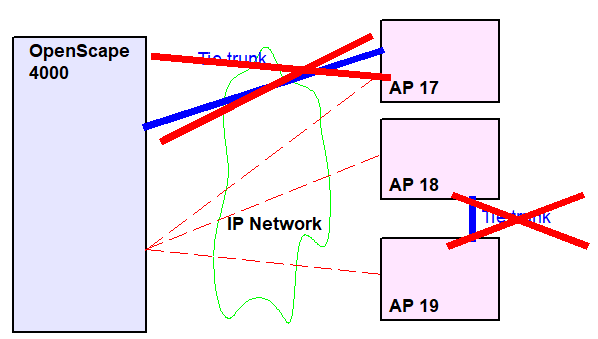
Trunk connections between access points in the
same system or between a central system and its access points are not
permitted.
Figure 184. Tie connections are not permitted within a system
With the configuration in an IP distributed access point, all circuits
are given additional parameters to govern their handling of Voice over
IP. These IPDA classmarks are:
Table 41. IPDA classmarks
|
Classmark
|
Sprache/ Language
|
Beschreibung/ Description
|
|
EC
|
d
|
Echo Cancellation
|
|
EC
|
e
|
Echo Cancellation
|
|
G711
|
d
|
Codec Typ G.711
|
|
G711
|
e
|
Codec Type G.711
|
|
G729
|
d
|
Codec Typ G.729A
|
|
G729
|
e
|
Codec Type G.729A
|
|
G729OPT
|
d
|
Codec Typ G.729A - optional
|
|
G729OPT
|
e
|
Codec Type G.729A - optional
|
|
INIT
|
d
|
stellt Default-Einstellung wieder her
|
|
INIT
|
e
|
restores default setting
|
|
KEINE
|
d
|
schaltet alle Classmarks aus
|
|
NONE
|
e
|
turns all Classmarks off
|
|
ML
|
d
|
Multiple Listener - Ansage wird auf einer Verbindung
übertragen und im Access Point an meherere Sätze geschaltet.
*)
nur für Ansagegeräte/MOH
|
|
ML
|
e
|
Multiple Listener - Announcement is transmitted
on a single connection and switched to multiple ports in the Access Point.
*)
only for Announcement Devices/MOH
|
|
VAD
|
d
|
Voice Activity Detection
|
|
VAD
|
e
|
Voice Activity Detection
|
|
VIAHHS
|
d
|
Payload über Zentralsystem
*) nur für
Ansagegeräte/MOH
|
|
VIAHHS
|
e
|
Payload via central system
*) only for
Announcement Devices/MOH
|
Details of the procedures that are switched with classmarks can be
found in:
- Voice Compression - Section 4.2 on page 4-79 in the document “Gateways HG 3500 and HG 3575”
- Voice Activity Detection (VAD) - Section 4.3 on page 4-81 in the document “Gateways HG 3500 and HG 3575”
- Echo Cancellation- Section 4.5 on page 4-82 in the document “Gateways HG 3500 and HG 3575”
- Codec Standards - Section 1.3 on page 1-34 in the document “Gateways HG 3500 and HG 3575”
Handling the classmarks for a call
If a call is to be established between Subscriber A and Subscriber
B, the classmarks of both subscribers, or of the subscriber and the CO/tie
trunk circuit via which the subscriber is reached, are assessed.
Echo cancellation or voice activity detection is only activated if
both circuits have set the corresponding classmark.
Connections with announcement devices configured with the AMOs SSC,
RCSU or TSCSU are an exception to this rule. Here, the announcement device
setting is always adopted.
Table 42. Classmark handling for EC or VAD
|
EC or VAD
|
Circuit B
|
EC or VAD
|
Announcement Device (RCSU)
|
|||||
|
NO
|
YES
|
NO
|
YES
|
|||||
|
Circuit A
|
NO
|
NO
|
NO
|
Circuit A
|
NO
|
NO
|
YES
|
|
|
YES
|
NO
|
YES
|
YES
|
NO
|
YES
|
|||
In the case of codec types, only one type which supports both is selected.
In contrast to version 1, compression is now available for announcement
devices and conferences. As far as codec classmarks are concerned, conference
trunk circuits are assigned either G711 (default) or G711 & G729OPT
when selecting the codec type.
Table 43. Classmark handling for codec type
|
Circuit A
|
Circuit B
|
Codec type used
|
||||
|
G711
|
G729
|
G729OPT
|
G711
|
G729
|
G729OPT
|
|
|
NO
|
NO
|
NO
|
-
|
-
|
-
|
NONE
|
|
NO
|
NO
|
YES
|
-
|
NO
|
YES
|
G.711
|
|
NO
|
YES
|
-
|
YES
|
NO
|
-
|
G.711
|
|
NO
|
YES
|
-
|
-
|
NO
|
YES
|
G.729
|
|
NO
|
YES
|
-
|
-
|
YES
|
-
|
G.729
|
|
YES
|
NO
|
NO
|
YES
|
-
|
-
|
G.711
|
|
YES
|
NO
|
YES
|
YES
|
NO
|
YES
|
G.711
|
|
YES
|
NO
|
YES
|
YES
|
YES
|
-
|
G.729
|
|
YES
|
NO
|
-
|
NO
|
YES
|
-
|
G.711
|
|
YES
|
YES
|
-
|
YES
|
NO
|
YES
|
G.729
|
|
YES
|
YES
|
-
|
YES
|
YES
|
-
|
G.729
|
|
YES
|
-
|
-
|
YES
|
NO
|
NO
|
G.711
|
|
-
|
NO
|
YES
|
NO
|
NO
|
YES
|
G.711
|
|
-
|
NO
|
YES
|
NO
|
YES
|
-
|
G.729
|
|
-
|
YES
|
-
|
NO
|
YES
|
-
|
G.729
|
|
-
|
-
|
-
|
NO
|
NO
|
NO
|
NONE
|
|
- Applies regardless of whether
YES or NO is set
|
||||||
Generating the classmarks
The default setting is always EC&G711&G729OPT.
IMPORTANT:
The classmark setting in the
CHANGE
branches of the AMOs overwrites the setting that existed prior to the
AMO call. Therefore, if an additional classmark is to be set, the existing
setting must be displayed beforehand and specified again with CHANGE.If a setting is to be reset to its default value, the value INIT must
be specified.
If all classmarks are to be deactivated, the value NONE must be used.
If only some classmarks are to be deactivated, the classmark to be
retained must be specified again with
CHANGE. All others
are automatically deleted. Examples:
Subscriber:
 |
Configuration Management > Station > Station
Click SEARCH and select the subscriber.
Set or delete the required classmarks on the Basic 2 tab under IPDA, IP
Connection Features and Save.
|
 |
CHANGE-SDAT:STNO=54321,TYPE=DATA1,CLASSMRK=NONE;
Deactivates all classmarks as required for digital data terminal devices.
|
|
|
CHA-SDAT:STNO=54321,TYPE=DATA1,CLASSMRK=EC&G711&G729;
Sets the EC, G711 and G729 classmarks. Use of the G.729 codec is forced if the partner
has set G729 or G729OPT.
|
|
|
CHANGE-SDAT:STNO=54321,TYPE=DATA1,CLASSMRK=EC&G711&G729&G729OPT&VAD;Sets the classmarks for EC, G711, G729, G729OPT and VAD (in other words, all).
|
Attendant console:
|
|
Administration of the attendant console can
only be executed in expert mode.
Expert Mode > Expert Access
> Open ...<IP> with AMO (see AMO command)
|
|
|
CHANGE-ACSU:ATNDNO=65432,CLASSMRK=EC&G711;
Sets the EC and G711 classmarks. Calls are always switched without
compression and the echo is suppressed.
|
Announcement devices:
The default setting for AMO SSC and AMO RCSU is always G711&G729OPT&VIAHHS&ML.
The default setting for AMO TSCSU is EC&G711&G729OPT&VIAHHS&ML.
IMPORTANT:
The option of setting G729OPT or even G729
for announcement devices should only be used after careful consideration.
G.729 specifies a codec for voice compression. The codec is totally
unsuitable for music compression. Music playback is extremely distorted
with G.729. In some cases it may be necessary to disable G729OPT
particularly if you want to avoid distortions and if circuits have been
configured with codec G729.
|
|
Configuration Management > Station > Special Stations
Click Search and select the special station (Station Type: EXTANS).
Set or delete the required classmarks on the Features tab and Save.
|
|
|
ADD-SSC:PEN=1-2-37-10,TYPE=EXTANS,CPCALL=HOLD,CLASSMRK=G711&VIAHHS&ML;or
CHANGE-RCSU:PEN=1-2-37-5,CLASSMRK=G711&VIAHHS&ML;Disables G729OPT and sets the G711 classmark. Echo cancellation is not required at
announcement devices because the path from the subscriber to the announcement device
is
not switched.
|
IMPORTANT:
The classmarks VIAHHS and ML are
enabled by default. They may only be disabled in exceptional cases.
In the case of
CHANGE, do not forget to specify both
classmarks if they were previously set.If VIAHHS is not set, announcements and/or music on hold are
no longer distributed via the OpenScape 4000 host system. Instead they
are transferred directly from the HG 3575 which hosts the source to all
other HG 3575 systems that require the announcement.
If ML is not set, an individual connection is established from
the source HG 3575 for each circuit in an access point that requires
an announcement or music on hold.
For further information on announcements or music on hold, refer to
Section 2.12,
“External Music on Hold”.
Conference:
A central configuration switch is used system-wide to set whether
or not compressed connections can be connected to conference units.
By default, only uncompressed RTO connections are supported with conference
units. In other words, the codec classmarks associated with the conference
units are set to G711.
You can use the AMO ZAND to change the setting to G711 & G729OPT.
|
|
Administration of central system data can only
be executed in expert mode.
Expert Mode > Expert Access
> Open ...<IP> with AMO (see AMO command)
|
|
|
CHANGE-ZAND:TYPE=ALLDATA3,IPDAVCCF=YES;
This AMO permits compressed connections with the conference unit.
|
The change becomes effective immediately, that is, the next time an
IP connection is connected to a conference unit.
CO/tie trunks:
|
|
Configuration Management > System Data
> Trunk > Trunk
Click Search and select the circuit.
Set or delete the classmarks for IP connections on the
Basic Data tab and Save.
|
|
|
CHANGE-TACSU:PEN=1-1-91-1,CLASSMRK=EC&G711;
Sets the EC and G711 classmarks. (G729OPT has effectively been
deactivated in contrast to the default setting.)
|
|
|
CHANGE-TDCSU:PEN=1-1-91-1,CLASSMRK=G711;Sets
the G711 classmark.
|
IMPORTANT:
If the classmark setting “NONE“ is
temporarily required for an outbound call (e.g. for privacy module),
this can be done using an access code: AMO WABE: NOEC. This
code can only be used as the prefix.
Example
Figure 185. Classmarks
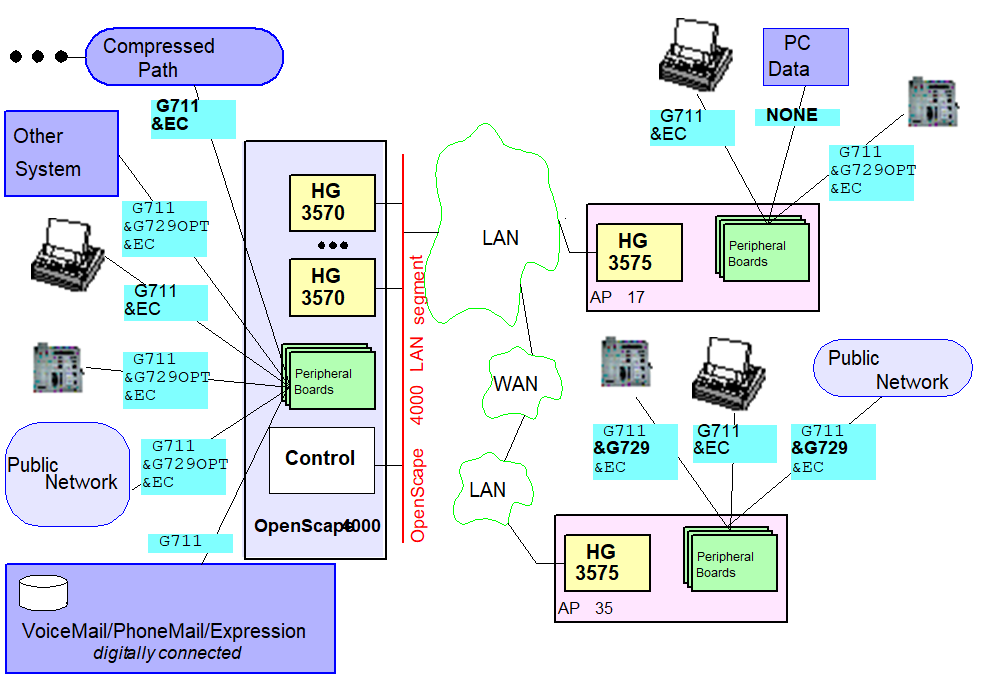
The example in Figure 20 “Classmarks”
shows how classmarks are set for different circuits.
The default is G711&G729OPT&EC.
In the central system, there are three exceptions: the fax which does
not tolerate signal compression, the compressed tie trunk path and the
digital VoiceMail/PhoneMail/Expression server connected. Fax devices
can also be configured with the default classmarks if STMI2/4/STMIX/STMIY and
NCUI2/4 boards are used exclusively. A sequence of compressions and expansions
should be avoided. The selected G711&EC setting in the example ensures
that calls from the compressed tie trunk path cannot be compressed a
second time. Digital announcement/voice recording devices connected generate
absolutely no echo - and save voice in compressed form. Consequently,
compression is disabled and EC is deactivated.
The data terminal device on the AP 17 is set to NONE, as it tolerates
neither compression nor echo cancellation or attenuation/amplification.
When the ISDN service is signaled correctly in the bearer capabilities,
transmission is always performed with the NONE classmark, irrespective
of the classmark setting.
The AP 35 is connected to the central system via WAN. Bandwidth is
therefore a precious commodity and voice compression should always be
used if possible. The setting G711&G729&EC for telephones and
the CO line ensures that calls with telephone subscribers in the central
system and AP 17 are compressed, as are calls from telephones in the
central system or AP 17 via the local CO line in AP 35.