2.21.4.2. Signaling 


The term signaling refers to the entire data exchange between CC and
access point. This includes loading and controlling peripheral boards,
security messages, routine tests and naturally, all call processing messages
including telephone display texts.
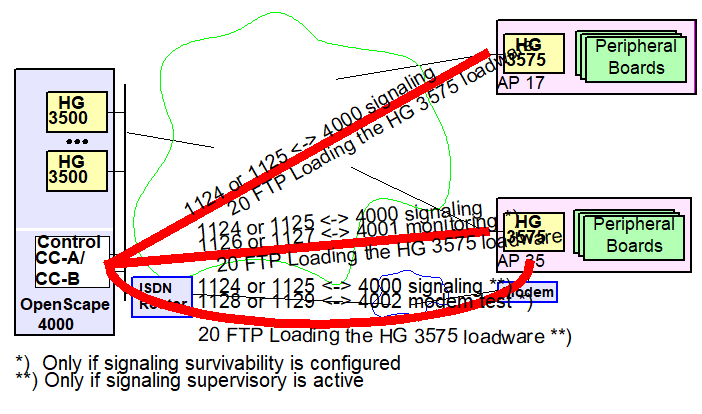
Every access point, that is, every HG 3575, has a signaling connection
to the active CC. The connection for this is always set up by the CM.
The source port alternates between 1124 and 1125. The destination port
(ASC HG 3575) is 4000.
The HG 3575 loadware is loaded over FTP. The HG 3575 logs on to the
CM’s FTP server for this. The FTP server grants read-only access to
the HG 3575 configured and allows only one download at a time.
If signaling survivability is configured additional connections are
used.
The supervisory connection monitors the principal availability of
the path from the CM to the HG 3575 in the IP network - in parallel to
the signaling connection. The connection for this is always set up by
the CC. The source port alternates between 1126 and 1127. The destination
port (ASC HG 3575) is 4001.
If the supervisory connection is interrupted, the signaling connection
is re-routed over a PSTN router and modem. The signaling connection’s
IP address and ports are retained.
The modem-based availability of a HG 3575 with signaling survivability
is cyclically tested in normal mode. The connection for this is always
set up by the CM. The source port alternates between 1128 and 1129. The
destination port (ASC HG 3575) is 4002.
IMPORTANT:
For SURVPATH test: There will be an ARP
request from active CC (physical linux address from V6) for the MAC of
the WAML. Afterwards packets will be routed on port 4002 to the WAML
using the IP Address of the NCUI on the WAML MAC. For normal Signaling
Survivability: Normal Signaling happens on port 4000. Once the keep
alive fails for the supervisory port 4001, there will be an ARP request
from active CC (physical linux address from V6) for the MAC of the WAML. Afterwards
packets will be instantly routed on port 4000 to the WAML using the IP
address of the NCUI but the WAML MAC on same TCP session, i.e. TCP session
is not re-established, only the destination MAC address is replaced by
the WAML MAC.
Figure 40. Example: Port usage for signaling