125.1 Definitions
Normally the Originating Node Number ONNO is taken from incoming messages of networking protocol (e.g. Cornet-NQ). If protocol is not containing ONNO (e.g. Central Office protocols), ONNO is taken from circuit configuration of incoming circuit (AMO TDCSU, parameter NNO) if this is activated by the appropriate COT parameters (see cross reference to AMO COT). For transit ONNO is passed from incoming connection (protocol or TDCSU) to outgoing connection. If the own node is originator of the connection, ONNO is the virtual node number of the calling station. All virtual node numbers of the own physical node are defined in a so called KNDEF-Table (administered by AMO KNDEF,TYPE=OWN). The assignment to the subscriber is done by the configuration AMOs (SCSU/SSCSU/SBCSU set only the default node number) or by AMO SDAT. The virtual node number of the calling station is then inserted into the appropriate protocol elements, if networking protocol allows transfer of originating node numbers (e.g. Cornet-NQ).
The destination node number DNNO is defined by the AMOs RICHT resp. LDAT for number modification purpose; it depicts always the end node of a connection.
|
Figure 12
|
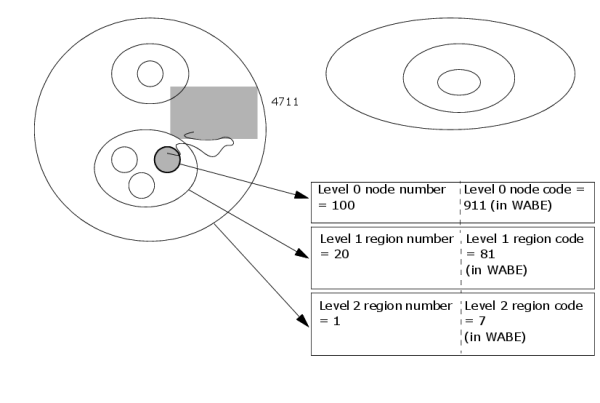
Node numbers are not visible at station display. Dialed and displayed are the station numbers, structured level oriented corresponding to the node numbers (see Figure 12).
In Figure 12 for example the shaded node has the number 1-20-100. Region/node codes are part of the station number in open numbered networks. The station in Figure 12 connected to node 1‑20‑100 has the phone number 7-81-911-4711.
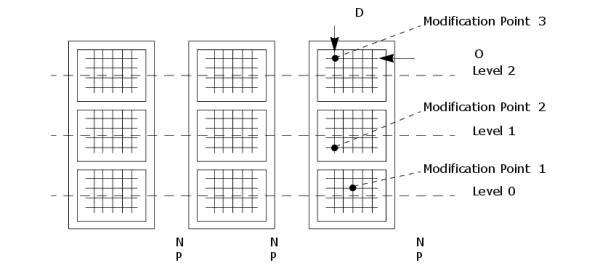
Each NPI has a separate node connection matrix for each level, which means there are 9 individual node connection matrices in all (see Figure 13). The network levels are assigned individual node connection matrices, based on which reductions are applied sequentially from the highest to the lowest level and extensions from the lowest to the highest level:
|
–
|
The logical node OWN is always converted into the virtual node numbers as defined by the AMO KNDEF, TYPE=OWN. This is only possible for the numbering plan UNKNOWN and LEVEL=0.
Any entry for ROW will not be converted into several entries for the existing physical nodes. The logical node ROW is only modified if the direct entry for the physical node (ONNO/DNNO) does not contain a modification. In this way, multiple modifications within one and the same level can be avoided.