215 WABE - Digit Analysis
There are two types of digit analysis result: DARs with a specific dialing outcome (e.g. ’STN’; dialing result is station number), and DARs whose dialing outcome must be defined in other AMOs (e.g. ’CO’; the trunk routes which can be accessed via this DAR are defined with the AMO RICHT).
The DARs NETW, NETWFAX and NETWDTE have a special status; for these DARs
the AMO WABE enters supplementary information (parameter DESTNO) as well as the digit analysis result. In addition, information entered with the AMO RICHT for the NETRTE DAR is relevant for call processing purposes.
The DAR STN in HICOM networks has a special status very similar to the DAR NETW. If an STN is in another node, it is added in the local node with the parameter DESTNO. Then it is used just like NETW. Every DAR STN is only permissible independently of DPLN, i.e. without specifying the parameter DPLN.
The DARs NETW, NETWFAX and NETWDTE have a special status; for these DARs
the AMO WABE enters supplementary information (parameter DESTNO) as well as the digit analysis result. In addition, information entered with the AMO RICHT for the NETRTE DAR is relevant for call processing purposes.
The DAR STN in HICOM networks has a special status very similar to the DAR NETW. If an STN is in another node, it is added in the local node with the parameter DESTNO. Then it is used just like NETW. Every DAR STN is only permissible independently of DPLN, i.e. without specifying the parameter DPLN.
Associated pairs for simultaneous processing are listed in Table 49 and pairs for sequential processing in Table 50. Digit analysis results AFWDVCE, ADND and ACOSX can also be used as ’feature toggling’ digit analysis results. Thus, in the case of these digit analysis results, it is no longer necessary to handle them in pairs with the corresponding deactivation digit analysis results.
Simultaneous updating of the TWABE tables is not carried out automatically. In order to speed up call processing, it is recommended that the desired data be imported with the AMO TWABE (e.g. all CDs to DAR=STN).
Simultaneous updating of the TWABE tables is not carried out automatically. In order to speed up call processing, it is recommended that the desired data be imported with the AMO TWABE (e.g. all CDs to DAR=STN).
|
Table 49
|
|
Table 50
|
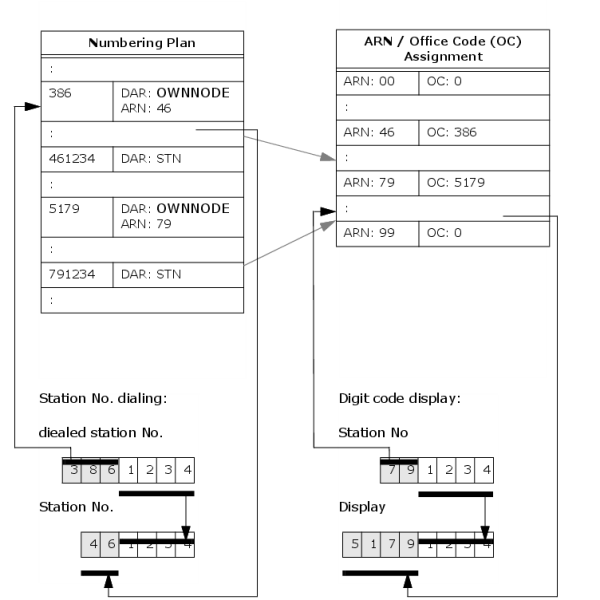
The station number (CD) of DAR OWNNODE is used for feature networking route optimization of the AMO ZAND TYPE=ALLDATA, parameter NODECD. Before changing or deleting this digit code, the relating information has to be changed or deleted with the AMO ZAND.
If a Hicom system is connected to or in a network that operates using the ISDN dial plan, the network access code to the ISDN network must be created with DAR=TIE (tie-trunk) instead of DAR=CO (attention must also be paid here to the CPS-dependent creation of the DAR TIE). There is no longer a CO DAR there as only the LCR decides whether the call is routed to a real public exchange or to a carrier.
Call progress states (CPS) cannot be specified as ranges. However, it is possible not to specify the parameter CPS, in which case all CPSs permitted for the associated digit analysis results are intended. The permitted values are defined in a table that cannot be changed by administration and maintenance.
The DISP-WABE:TYPE=CPS command allows the user to output either the complete table or a specific row (DAR=<param>).
The DISP-WABE:TYPE=CPS command allows the user to output either the complete table or a specific row (DAR=<param>).