198.3
Parameter Description
ABLK
Specifies whether the CC or CCM send STNO of calling party
Type of Input
:
Single value, optional
Possible Values
:
Y(ES), N(O)
Default Value
:
N
ACKT
Time for arrival of seizure acknowledgement
(only relevant for lines with seizure acknowledgement)
Type of Input
:
Single value, optional
Possible Values
:
SZACK1, SZACK2 (see AMO
DTIM1
)
Default Value
:
SZACK1
ALARMNO
Alarm number of directional, logical alarm
Type of Input
:
Single value, optional
Possible Values
:
0
no ALARMNO associated
8-519
existing directional, logical alarm (AMO
VADSU
)
Default Value
:
0
The alarm number must be assigned by AMO
VADSU
ANNTYPE
Announcement type
Type of Input
:
Single value, mandatory
Possible Values
:
1-64
existing announcement type (AMO
SYNCA
)
CCT
Circuit/trunk number
Type of Input
:
Single value, optional
Possible Values
:
String, 1-12 characters
Default Value
:
None
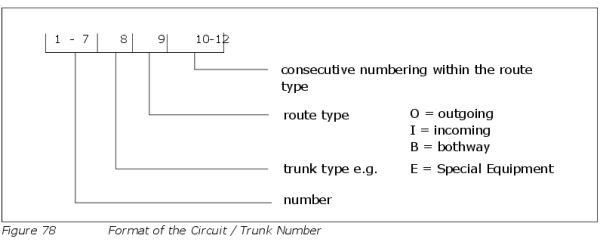
The circuit number can be displayed at the attendant terminal (line number interrogation).
The following configuration of parameter CCT is recommended for customer service information:
If several trunks are added simultaneously (NO > 1), all trunks get the same trunk number.
Using the CHANGE action of the AMO, the trunks can then be allocated their own trunk numbers.
CDGT
Code digits for code caller (CCM)
Type of Input
:
2 combined single values, optional
Possible Values
:
0-9
If no code number or ’0’ is entered, the CCM is created for a search without a code number.
The first value that can be entered is the code number for "normal call", the second value is for "urgent call".
COFIDX
Index of SICOFI data file to be loaded
Type of Input
:
Single value, optional
Possible Values
:
0-7
Default Value
:
0
CONV
Dialled number to pager (CC) number conversion
Type of Input
:
Single value, optional
Possible Values
:
Y(ES)
conversion is wanted
N(O)
conversion is not wanted
Default Value
:
N
If conversion is requested, the corresponding values must be entered in a table with the aid of AMO
PERSI
.
COPNO
Class of Parameter
Type of Input
:
Single value, mandatory
Possible Values
:
0-255
existing COPNO (AMO
COP
)
COTNO
Class of Trunk
Type of Input
:
Single value, mandatory
Possible Values
:
0-255
existing COTNO (AMO
COT
)
DEV
Device type
Type of Input
:
Single value, mandatory
Possible Values
:
RA
recorded announcement facility
ANS
answering device
RAS
recorded announcement facility, synchronized
DICT
dictation equipment
SPKR
loudspeaker
CC
code calling, single
CCM
multiple code calling equipment
DOOR
entrance telephone system
CP_DEVTYP, DH_DEV_TYP, service indicator and trunk operating mode are derived from this parameter (see also table 1).
DPLN
Feature access group / dial plan
Type of Input
:
Single value, optional
Possible Values
:
0-15
Default Value
:
0
A dial plan group is only required for trunks with outgoing or bothway transmission.
DTYPE
Type of dictation equipment
Type of Input
:
Single value, optional
Possible Values
:
1
dictation equipment in general
2
specific dictation equipment, e.g., Grundig, Tele Diktat 2200
3
one-way tie-trunk via TMOM; 2-wired with switching trough after seizure
Default Value
:
1
EOD
End-of-dial timer
End-of-dial signal timer for CCMs with end-of-dial signaling, only relevant for lines with end-of-dial parameter (AMO
COP
, PAR=EOD)
Type of Input
:
Single value, optional
Possible Values
:
CCMEOD1, CCMEOD2
(see AMO
DTIM1
, parameter MPSEOD1, MPSEOD2)
Default Value
:
CCMEOD1
INS
In service for trunks
Type of Input
:
Single value, optional
Possible Values
:
Y(ES)
trunk released for call processing.
Dependability activates the trunk, if possible.
N(O)
do not activate the trunk
Default Value
:
Y
ITR
Internal traffic restriction group / closed user group
Type of Input
:
Single value, optional
Possible Values
:
0-15
Default Value
:
0
MABLK
Length of stno (calling party) send in meet-me mode
Type of Input
:
Single value, optional
Possible Values
:
0
do not send stno
1-16
Default Value
:
0
NO
Number of trunks to be assigned
Type of Input
:
Single value, optional
Possible Values
:
1-30
Default Value
:
1
If parameter NO is specified, parameter PEN can also be specified; it defines the starting port.
OFFTYPE
Type of deactivation during CHANGE or DELETE (see AMO
DSSU
)
Type of Input
:
Single value, optional
Possible Values
:
DC
deactivate conditionally
DI
deactivate immediatly
NL
no lock
Default Value
:
DI
(DELETE)
NL
(CHANGE)
OPTYPE
Operating mode for CCM
Type of Input
:
Maximum of 4 linked single values, optional
Possible Values
:
MEETME
the paged party is connected with the paging party on answering the code call if not specified: display mode
DIS
display mode
DELANS
cancel the job only after answer
DELSEND
cancel the job after sending
BLKEND
Der Suchblock wird durch "|" abgeschlossen, nur bei MFV
NOBEND
No end-of-block identifier
BLKSEP
A-block, B-block and code number, if applicable, are separated by "*", only for DTMF signaling
NOBSEP
no block separators
Default Value
:
DIS & DELSEND & NOBEND & NOBSEP
The 10 parameter values listed here form 4 pairs of opposites (see table). If nothing is declared, then the AMO sets the above default value. By entering one or more of the alternative values (opposites) during the actions ADD or CHANGE, the ’opposite’ (default) value can be changed.
Table 39
Opposite Values
Default
Opposite
DIS
MEETME
DELSEND
DELANS
NOBEND
BLKEND
NOBSEP
BLKSEP
PEN
Port equipment number: LTG-LTU-SLOT-CCT
Type of Input
:
4 combined single values,
mandatory (CHANGE, DELETE),
optional (ADD)
Possible Values
:
g-uu-sss-ccc ( LTG-LTU-SLOT-CIRCUIT)
g = 1 (no
other value)
existing LTG (AMO
UCSU
)
uu =
1-15
17-99
16
existing LTU (AMO
UCSU
)
in HHS (Host Shelf)
in AP (Access Point Shelf)
not defined
sss = 1-121
valid slot with suitable board (AMO
BCSU
)
ccc = 0-254
valid circuit on the board
Default Value
:
First suitable PEN (ADD only)
The possible LTU and Slot values for PEN depend on the systems architecture and can be found in the BCSU AMO description.
The possible Line values depend on the module type and its functionality.
They can be listed using DISP-
BCSU
: TYPE=PEN [,LTG=, LTU=, SLOT=, CCT=]; which will also output the actual PEN status (e.g. NOT CONNECTED).
PEN1
Port equipment number (start PEN): LTG-LTU-SLOT-CCT
PEN2
Port equipment number (stop PEN): LTG-LTU-SLOT-CCT
Type of Input
:
4 combined single values, optional
(partially qualified)
Possible Values
:
see parameter PEN
Default Value
:
PEN1=1-1-1-0, PEN2=PEN1
The parameters PEN1 and PEN2 delimit the search area for the actions DISPLAY and REGENERATE (PEN1 <= PEN2).
If neither PEN1 nor PEN2 is specified, all trunks are output. If only PEN2 is specified, all trunks up to PEN2 are output. Even with partially qualified input, the first value always describes the LTG, the second the LTU and the third value the slot.
See the description of the function DISPLAY for details on how to to use the parameters PEN1 and PEN2.
SRCHATT
Maximum of search attempts
(for CCMs in ’meet-me’ mode)
Type of Input
:
Single value, optional
Possible Values
:
1-99
Default Value
:
5
SRCGRP
Source group
Type of Input
:
Single value, optional
Possible Values
:
1-255
Default Value
:
1
SRCHCANT
Time after which search task should be cancelled
If OPTYPE=DELANS was specified, the search task should be cancelled at the latest after this time limit has expired (for CCM)
Type of Input
:
Single value, optional
Possible Values
:
DELANS1, DELANS2, DELANS3, DLEANS4
(see AMO
CTIME
)
Default Value
:
DELANS3
SRCHORD
Maximum simultaneous search orders
Type of Input
:
Single value, optional
Possible Values
:
1-15
Default Value
:
5
STADIAL
Start dial timer
Type of Input
:
Single value, optional
Possible Values
:
STADIAL1, STADIAL2 (see AMO
DTIM2
)
CCSTAD (see AMO
DTIM1
)
Default Value
:
STADIAL2
For mixed-mode operation (switchable, CC/CCM) the long time CCSTAD should be used in order to delay end-of-dialing (supervision of CC/CCM). If the delay exceeds this time, a message is sent to the dependability system.
STNOLEN
Len. of paged party no. (when code caller numbering differs)
Type of Input
:
Single value, optional
Possible Values
:
0-20
Default Value
:
0
If STNOLEN is equal to 0, the search numbers are evaluated in the dialing plan (code-calling number = station call number).
If STNOLEN is not equal to 0, the code calling numbers are transmitted directly to the CC/CCM. The parameter determines the length of the number to be transmitted by the CC/CCM.
SUPV
Line alarm supervision time
Type of Input
:
Single value, optional
Possible Values
:
SUPV1, SUPV2,... SUPV5 (see AMO
DTIM1
)
Default Value
:
SUPV3
For CCs/CCMs with signaling for remote blocking (manual operation), the time inverval selected must be longer than the pulse intervals on the line.
For the answering device (ANS), the recorded announcement facility (RA/RAS) and dictation equipment (DICT), the time interval should be longer than the time required for a tape change, in order to avoid messages to the dependability system.
For the entrance telephone (DOOR), the time selected can be very short because the line is not monitored.
TBT
Time between two tasks to CCM
Type of Input
:
Single value, optional
Possible Values
:
CCMED1, CCMED2 (see AMO
DTIM1
)
The two time values can be used to cover the requirements of two different CCMs; required time values can be entered according to the device characteristics by using AMO
DTIM1
.
TGRP
Trunk group
Type of Input
:
Single value, optional
Possible Values
:
0
no TGRP associated
1-2000
existing TGRP (AMO
BUEND
)
Default Value
:
0
Trunks intended for incoming traffic only should not be assigned to any trunk group.
Trunks assigned to a trunk group can be used for outgoing and bothway traffic.
If no trunk group number or 0 is entered, the trunk is not assigned to any trunk group.
The number of trunks that can be assigned to one trunk group depends of the device (see table) and the capacity of the trunk group (AMO
BUEND
, parameter NO; maximum 2000).
Table 40
Maximum number of trunks per trunk group / per PABX
DEV
max. no. of trunks per trunk group
max. no. of trunks per PABX
RA
∞
¥
ANS
∞
¥
RAS
∞
64
DICT
∞
¥
SPKR
1
∞
CC
1
∞
CCM
1
2
DOOR
1
∞
TYPE
Options for trunk data interrogation
Type of Input
:
Single value, optional
Possible Values
:
A
Activated trunks
D
Deactivated trunks
CFIG
Trunks not yet assigned (action DISPLAY)
(trunks for which a module has been configured with AMO
BCSU
)
This parameter is used to select trunks in the above-mentioned operating states for the actions DISPLAY and REGENERATE.
WAIT
Time while search task can be inputted
Time during which the DH can still enter code calls while waiting for "READY" (for CCM)
Type of Input
:
Single value, optional
Possible Values
:
NOTRDY1,NOTRDY2 (see AMO
CTIME
)
Default Value
:
NOTRDY1
WAITT
Time for dummy task for code calling equipment
Type of Input
:
Single value, optional
Possible Values
:
WAIT1, WAIT2 (see AMO
CTIME
)
Default Value
:
WAIT1
WIRES
Number of physical wires for code calling devices
Type of Input
:
Single value, optional
Possible Values
:
2, 3, 4, 6
Default Value
:
2
OpenScape 4000 V10, Volume 1: AMO Descriptions, Service Documentation, Issue 5
, ID:
P31003H31A0S107057620
©
09/2025
Mitel Networks Corporation. - All rights reserved.
Mitel and the Mitel logo are trademarks of Mitel Networks Corporation. Unify and associated marks are trademarks of Unify Software and Solutions GmbH&Co. KG. All other trademarks herein are the property of their respective owners.